


Francisella opportunistica sp. nov., isolated from human blood and cerebrospinal fluid
Supporting Files

-
2 2020
-
File Language:
English
Details
-
Journal Article:Int J Syst Evol Microbiol
-
Personal Author:
-
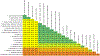
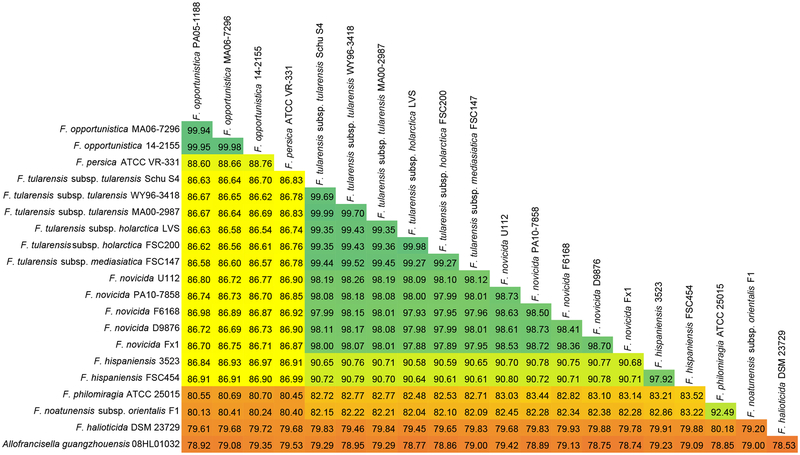
Description:Two isolates of a Gram-negative, non-spore-forming coccobacillus cultured from the blood and cerebrospinal fluid of immunocompromised patients in the United States were described previously. Biochemical and phylogenetic analyses revealed that they belong to a novel species within the | genus. Here we describe a third isolate of this species, recovered from blood of a febrile patient with renal failure, and formally name the | species. Whole genome comparisons indicated the three isolates display greater than 99.9 % average nucleotide identity (ANI) to each other and are most closely related to the tick endosymbiont |, with only 88.6-88.8 % ANI to the type strain of |. Based on biochemical, metabolic and genomic comparisons, we propose that these three isolates should be recognized as | sp. nov, with the type strain of the species, PA05-1188|, available through the Deutsche Sammlung von Mikroorganismen und Zellkulturen (DSM 107100) and the American Type Culture Collection (ATCC BAA-2974).
-
Subjects:
-
Source:Int J Syst Evol Microbiol. 70(2):1145-1151
-
DOI:
-
Pubmed ID:31860434
-
Pubmed Central ID:PMC7056488
-
Document Type:
-
Funding:
-
Genre:
-
Volume:70
-
Issue:2
-
Collection(s):
-
Main Document Checksum:urn:sha-512:402fe9d7dad1fa9b3126de54c348ee951abc6f6a6fdb89f2a7a5b5ebb08db95edec80aa7a5486fd27332249dd538cc4537b7ad28454708f5d7768b91e3bd51b2
-
Download URL:
-
File Type:
 [PDF
- 1.15 MB
]
[PDF
- 1.15 MB
]
Supporting Files


File Language:
English
ON THIS PAGE


CDC STACKS serves as an archival repository of CDC-published products including
scientific findings,
journal articles, guidelines, recommendations, or other public health information authored or
co-authored by CDC or funded partners.
As a repository, CDC STACKS retains documents in their original published format to ensure public access to scientific information.
As a repository, CDC STACKS retains documents in their original published format to ensure public access to scientific information.
You May Also Like
COLLECTION
CDC Public Access