



Prevalence of Alcohol Impairment and Odds of a Driver Injury or Fatality in On-Road Farm Equipment Crashes
Supporting Files

-
4 03 2018
-
Available in CDC Stacks on February 21, 2020, 12:00 AM
File Language:
English
Details
-
Journal Article:Traffic Inj Prev
-
Personal Author:
-
Description:Objective.
To estimate the prevalence of alcohol impairment in crashes involving farm equipment on public roadways and the effect of alcohol impairment on the odds of crash injury or fatality.
Methods.
On-road farm equipment crashes were collected from four Great Plains state Departments of Transportation during 2005–2010. Alcohol impairment was defined as an involved driver having blood alcohol content of ≥0.08g/100ml or a finding of alcohol-impaired as a driver contributing circumstance recorded on the police crash report. Injury or fatality was categorized as: a) no injury (no and possible injury combined), b) injury (non-incapacitating or incapacitating injury,) and c) fatality. Hierarchical multivariable logistic regression modeling, clustered on crash, was used to estimate the odds of an injury/fatality in crashes involving an alcohol-impaired driver.
Results.
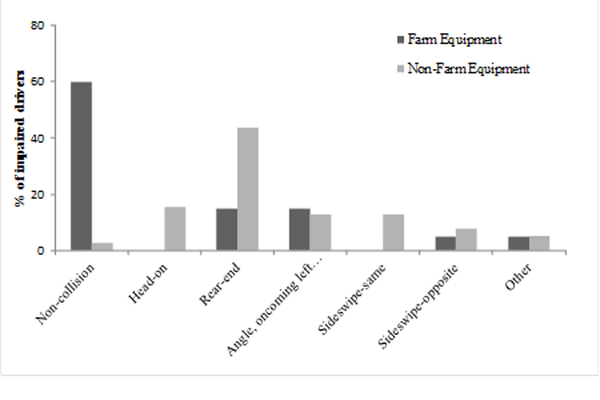
During the five years under study, 3.1% (61 of 1971) of on-road farm equipment crashes involved an alcohol-impaired driver. One in twenty (5.6%) injury crashes and one in six (17.8%) fatality crashes involved an alcohol-impaired driver. The non-farm equipment driver was significantly more likely to be alcohol-impaired than the farm equipment driver (2.4% versus 1.1% respectively, p=0.0012). After controlling for covariates, crashes involving an alcohol-impaired driver had 3.94 (95% CI: 2.14–7.25) times the odds of an injury or fatality. In addition, the non-farm vehicle driver was at 2.49 (95% CI: 2.06–3.01) times higher odds of an injury or fatality than the farm vehicle driver. No differences in rurality of the crash site were found in the multivariable model.
Conclusion.
On-road farm equipment crashes involving alcohol result in greater odds of an injury or fatality. The risk of injury or fatality is higher among the non-farm equipment vehicle drivers who are also more likely to be alcohol-impaired. Further studies are needed to measure the impact of alcohol impairment in on-road farm equipment crashes. -
Subjects:
-
Keywords:
-
Source:Traffic Inj Prev. 19(3):230-234
-
DOI:
-
Pubmed ID:29211499
-
Pubmed Central ID:PMC7034777
-
Document Type:
-
Funding:
-
Genre:
-
Volume:19
-
Issue:3
-
Download URL:
-
File Type:
 [PDF - 129.17 KB]
 -
Collection(s):
-
Main Document Checksum:urn:sha-512:0cd328f395955771171883ba578df3cf702a88843e06dfb5ae4cd2e94399d29fa8655d7b4f1090d1666de2997c858936bfb470d735f41476ff1dfa275d33bd9b
Supporting Files


File Language:
English
 Was this page helpful?
 Found an issue?

CDC STACKS serves as an archival repository of CDC-published products including
scientific findings, journal articles, guidelines, recommendations, or other public health information authored or
co-authored by CDC or funded partners.
As a repository, CDC STACKS retains documents in their original published format to ensure public access to scientific information.
As a repository, CDC STACKS retains documents in their original published format to ensure public access to scientific information.
You May Also Like
COLLECTION
CDC Public Access