



Risk of Stillbirth for Fetuses With Specific Birth Defects
Supporting Files

-
Jan 2020
-
Available in CDC Stacks on 2020-02-21T00:00:00Z
File Language:
English
Details
-
Journal Article:Obstet Gynecol
-
Personal Author:Heinke, Dominique ; Nestoridi, Eirini ; Hernandez-Diaz, Sonia ; Williams, Paige L. ; Rich-Edwards, Janet W. ; Lin, Angela E. ; Van Bennekom, Carla M. ; Mitchell, Allen A. ; Nembhard, Wendy N. ; Fretts, Ruth C. ; Roberts, Drucilla J. ; Duke, C. Wes ; Carmichael, Suzan L. ; Yazdy, Mahsa M.
-
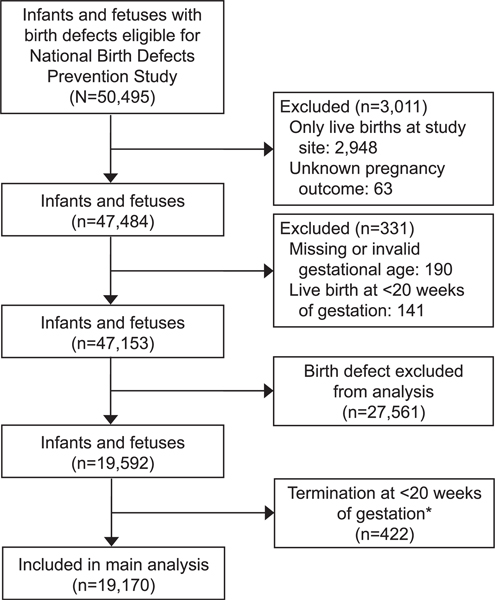
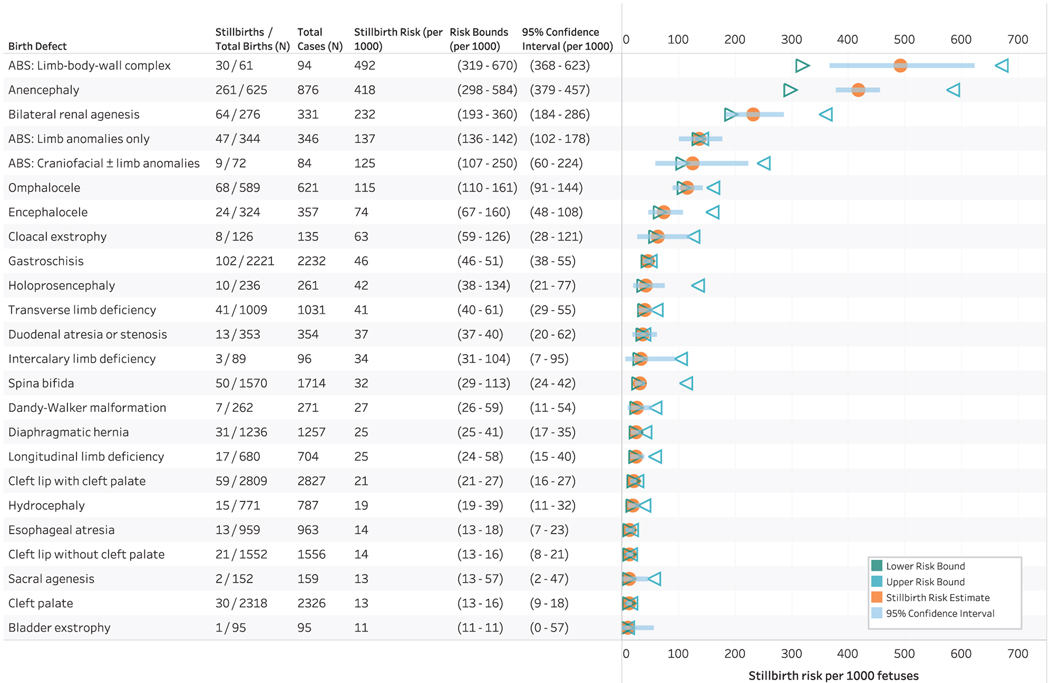
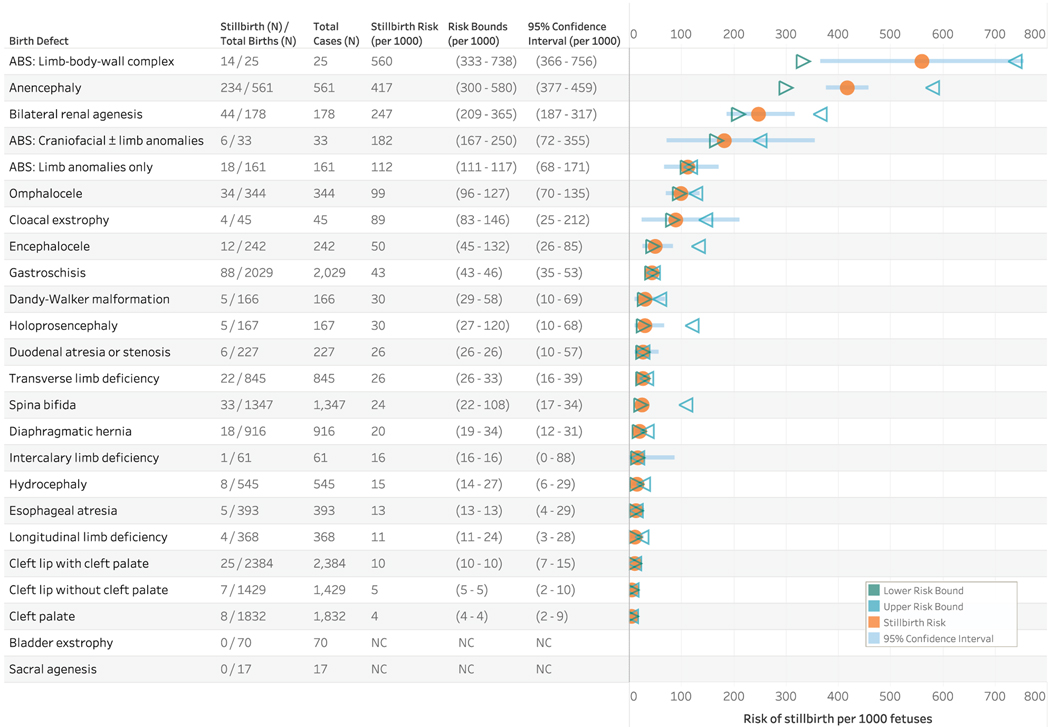
Description:OBJECTIVE: ; To estimate the risk of stillbirth (fetal death at 20 weeks of gestation or more) associated with specific birth defects. ; METHODS: ; We identified a population-based retrospective cohort of neonates and fetuses with selected major birth defects and without known or strongly suspected chromosomal or single-gene disorders from active birth defects surveillance programs in nine states. Abstracted medical records were reviewed by clinical geneticists to confirm and classify all birth defects and birth defect patterns. We estimated risks of stillbirth specific to birth defects among pregnancies overall and among those with isolated birth defects; potential bias owing to elective termination was quantified. ; RESULTS: ; Of 19,170 eligible neonates and fetuses with birth defects, 17,224 were liveborn, 852 stillborn, and 672 electively terminated. Overall, stillbirth risks ranged from 11 per 1,000 fetuses with bladder exstrophy (95% CI 0–57) to 490 per 1,000 fetuses with limb-body-wall complex (95% CI 368–623). Among those with isolated birth defects not affecting major vital organs, elevated risks (per 1,000 fetuses) were observed for cleft lip with cleft palate (10; 95% CI 7–15), transverse limb deficiencies (26; 95% CI 16–39), longitudinal limb deficiencies (11; 95% CI 3–28), and limb defects due to amniotic bands (110; 95% CI 68–171). Quantified bias analysis suggests that failure to account for terminations may lead to up to fourfold underestimation of the observed risks of stillbirth for sacral agenesis (13/1,000; 95% CI 2–47), isolated spina bifida (24/1,000; 95% CI 17–34), and holoprosencephaly (30/1,000; 95% CI 10–68). ; CONCLUSION: ; Birth defect-specific stillbirth risk was high compared with the U.S. stillbirth risk (6/1,000 fetuses), even for isolated cases of oral clefts and limb defects; elective termination may appreciably bias some estimates. These data can inform clinical care and counseling after prenatal diagnosis.
-
Subjects:
-
Source:Obstet Gynecol. 135(1):133-140
-
DOI:
-
Pubmed ID:31809437
-
Pubmed Central ID:PMC7033649
-
Document Type:
-
Funding:
-
Genre:
-
Volume:135
-
Issue:1
-
Download URL:
-
File Type:
 [PDF - 710.85 KB]
 -
Collection(s):
-
Main Document Checksum:urn:sha-512:26f0bfffdae1da5487f39dabe1a670f733c926a3692c2481e04657b2311427a2b1705e95418340128a2c4939455c83fb39fa6e9109a9919c31c3ff42374458c1
Supporting Files


File Language:
English
 Was this page helpful?
 Found an issue?


CDC STACKS serves as an archival repository of CDC-published products including
scientific findings, journal articles, guidelines, recommendations, or other public health information authored or
co-authored by CDC or funded partners.
As a repository, CDC STACKS retains documents in their original published format to ensure public access to scientific information.
As a repository, CDC STACKS retains documents in their original published format to ensure public access to scientific information.
You May Also Like
COLLECTION
CDC Public Access