



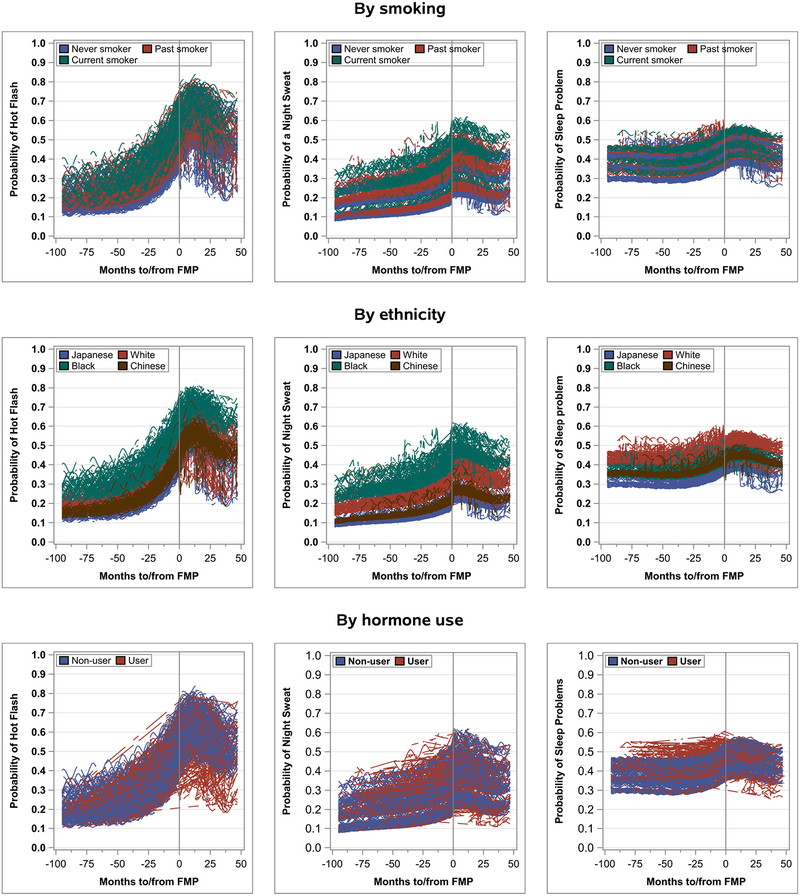
Monthly variation of hot flashes, night sweats and trouble sleeping: Effect of season and proximity to the Final Menstrual Period (FMP) in the SWAN Menstrual Calendar substudy.
Supporting Files

-
2020/01/01
-
Available in CDC Stacks on January 01, 2021, 12:00 AM
File Language:
English
Details
-
Journal Article:Menopause
-
Personal Author:
-
Description:Objective:
Although reproductive function is influenced by season, few studies have evaluated seasonal effects on menopausal symptoms. We assessed the impact of season and proximity to the final menstrual period (FMP) on frequency of symptom reporting.
Methods:
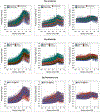
955 participants in the Study of Women's Health Across the Nation recorded whether or not they had experienced menopausal symptoms on a monthly menstrual calendar over a 10-year period. We modeled the log-odds of presence of a given symptom each month using a logistic mixed effects model, assuming a 3rd-order polynomial before the FMP and a different 3rd-order polynomial after the FMP. We assumed sine and cosine functions for month of the year.
Results:
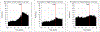
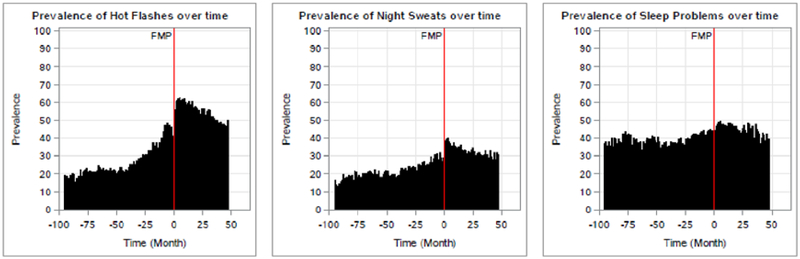
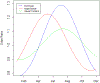
5-10 years prior to the FMP, ~20% of women reported hot flashes and night sweats while ~40% reported trouble sleeping. Prevalence rose ~4 years before the FMP with a sharp jump in hot flash (~60%) and night sweats (~40%) prevalence coincident with the FMP. Peaks in hot flashes and trouble sleeping were observed in July with troughs in January. The peak and trough in night sweats occurred about one month earlier. Odds of hot flashes, night sweats and trouble sleeping were 66%, 50% and 24% greater, respectively, at the seasonal peak versus the seasonal minimum.
Conclusion:
Menopausal symptoms exhibit seasonal variation associated with the summer and winter equinoxes. Seasonal increases in night sweats precede increases in hot flashes. Prospectively recorded monthly symptom data demonstrate that hot flashes and night sweats increase notably coincident with the FMP. -
Subjects:
-
Keywords:
-
Source:Menopause. 27(1):5-13
-
DOI:
-
Pubmed ID:31567864
-
Pubmed Central ID:PMC6934911
-
Document Type:
-
Funding:T42 OH008455/OH/NIOSH CDC HHSUnited States/ ; U01 AG012554/AG/NIA NIH HHSUnited States/ ; R24 HD041028/HD/NICHD NIH HHSUnited States/ ; P2C HD041028/HD/NICHD NIH HHSUnited States/ ; U01 AG012495/AG/NIA NIH HHSUnited States/ ; U01 AG012505/AG/NIA NIH HHSUnited States/ ; U01 AG012531/AG/NIA NIH HHSUnited States/ ; U01 AG012535/AG/NIA NIH HHSUnited States/ ; U01 AG012553/AG/NIA NIH HHSUnited States/ ; U01 NR004061/NR/NINR NIH HHSUnited States/ ; U01 AG012539/AG/NIA NIH HHSUnited States/ ; U01 AG012546/AG/NIA NIH HHSUnited States/
-
Genre:
-
Volume:27
-
Issue:1
-
Download URL:
-
File Type:
 [PDF - 1.21 MB]
 -
Collection(s):
-
Main Document Checksum:urn:sha-512:e1d068f713438737f520c3e434ad36b823fe2334f1c601e33feb0704ccdd398cc55692c6c7737c455ad4a5157310e4efdbb75e19e0bbaebb141ce0d0dbff9bc0
Supporting Files


File Language:
English
 Was this page helpful?
 Found an issue?


CDC STACKS serves as an archival repository of CDC-published products including
scientific findings, journal articles, guidelines, recommendations, or other public health information authored or
co-authored by CDC or funded partners.
As a repository, CDC STACKS retains documents in their original published format to ensure public access to scientific information.
As a repository, CDC STACKS retains documents in their original published format to ensure public access to scientific information.
You May Also Like
COLLECTION
CDC Public Access