


Use of Gabapentinoid Medications Among US adults with Cancer, 2005-2015
Supporting Files

-
1 2020
-
File Language:
English
Details
-
Alternative Title:Support Care Cancer
-
Personal Author:
-
Description:Background
Gabapentinoid use for cancer-pain control may be problematic, given unclear mechanisms of action and increased concerns for physical dependence. The purpose of this report is to examine trends of gabapentinoid use among US adults with cancer from 2005–2015.
Methods
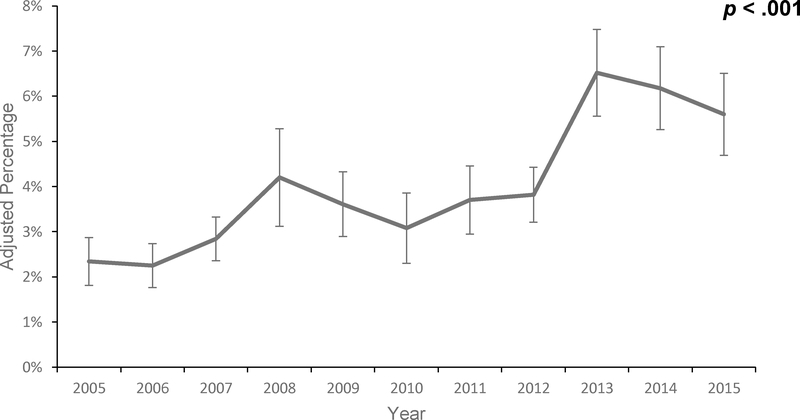
We conducted a serial, cross-sectional study using data from the Medical Expenditure Panel Survey (MEPS). We performed multiple logistic regression to examine the annual percentages of gabapentinoid users, which were adjusted for age, sex, and US region of residence.
Results
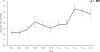
The amount of gabapentinoid prescriptions filled in 2015 was also estimated. The adjusted percentage of gabapentinoid users in 2015 was 5.60% (3.79%, 7.41%), 2.39 times greater than the percentage in 2005 (p < .001). By 2015, the number of gabapentinoid prescriptions had grown to approximately 3.52 million (2.40 million, 4.65 million).
Conclusion
We observed greater than a two-fold increase in the trend of gabapentinoid medication use among US adults with cancer. Investigations on the long-term efficacy of gabapentinoids for complex pain syndromes, and mitigation of risks, is essential to guide informed clinical management and keep patients safe.
-
Subjects:
-
Keywords:
-
Source:Support Care Cancer. 28(1):5-8
-
Pubmed ID:31650294
-
Pubmed Central ID:PMC6884691
-
Document Type:
-
Funding:
-
Volume:28
-
Issue:1
-
Collection(s):
-
Main Document Checksum:urn:sha-512:432ec413ecaacdcd71cff024aaf97e7064fdc848cdafaab28d6d6324bd07f81363a959c4e9d0024437d5d446bffd16f864c1a0435067e15648b2e762204dd622
-
Download URL:
-
File Type:
 [PDF
- 74.44 KB
]
[PDF
- 74.44 KB
]
Supporting Files


File Language:
English
ON THIS PAGE

CDC STACKS serves as an archival repository of CDC-published products including
scientific findings,
journal articles, guidelines, recommendations, or other public health information authored or
co-authored by CDC or funded partners.
As a repository, CDC STACKS retains documents in their original published format to ensure public access to scientific information.
As a repository, CDC STACKS retains documents in their original published format to ensure public access to scientific information.
You May Also Like
COLLECTION
CDC Public Access