



Public Health Program for Decreasing Risk for Ebola Virus Disease Resurgence from Survivors of the 2013–2016 Outbreak, Guinea
Supporting Files
Public Domain

-
Feb 2020
File Language:
English
Details
-
Alternative Title:Emerg Infect Dis
-
Personal Author:Keita, Mory ; Keita, Sakoba ; Diallo, Boubacar ; Camara, Momo ; Mesfin, Samuel ; Nebie, Koumpingnin Yacouba ; Magassouba, N’Faly ; Coulibaly, Seydou ; Barry, Boubacar ; Baldé, Mamadou Oury ; Pallawo, Raymond ; Sow, Sadou ; Diallo, Amadou Bailo ; Formenty, Pierre ; Djingarey, Mamoudou Harouna ; Fall, Ibrahima Socé ; Subissi, Lorenzo
-
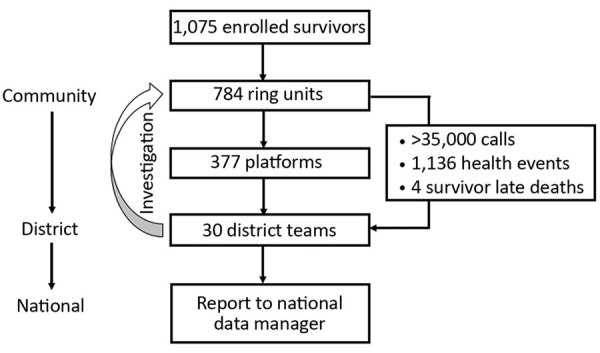
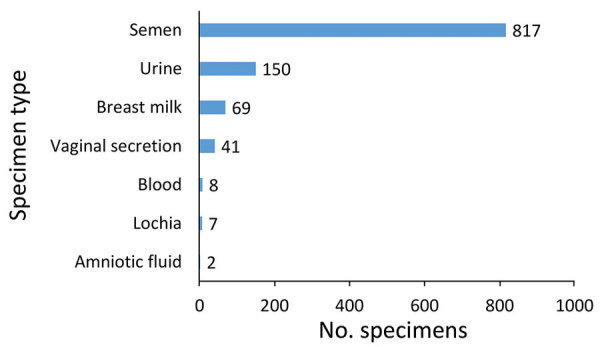
Description:At the end of the 2013-2016 Ebola virus disease outbreak in Guinea, we implemented an alert system for early detection of Ebola resurgence among survivors. Survivors were asked to report health alerts in their household and provide body fluid specimens for laboratory testing. During April-September 2016, a total of 1,075 (88%) of 1,215 survivors participated in the system; follow up occurred at a median of 16 months after discharge (interquartile range 14-18 months). Of these, 784 acted as focal points and reported 1,136 alerts (including 4 deaths among survivors). A total of 372 (91%) of 408 eligible survivors had >1 semen specimen tested; of 817 semen specimens, 5 samples from 4 survivors were positive up to 512 days after discharge. No lochia (0/7) or breast milk (0/69) specimens tested positive. Our findings underscore the importance of long-term monitoring of survivors' semen samples in an Ebola-affected country.
-
Subjects:
-
Source:Emerg Infect Dis. 26(2):206-211
-
Pubmed ID:31961292
-
Pubmed Central ID:PMC6986820
-
Document Type:
-
Place as Subject:
-
Location:
-
Volume:26
-
Issue:2
-
Download URL:
-
File Type:
 [PDF - 493.28 KB]
 -
Collection(s):
-
Main Document Checksum:urn:sha256:16a855b6e5829f721a16569208c2a9379c0480121e96d3835ff892703a788596
Supporting Files


File Language:
English
 Was this page helpful?
 Found an issue?


CDC STACKS serves as an archival repository of CDC-published products including
scientific findings, journal articles, guidelines, recommendations, or other public health information authored or
co-authored by CDC or funded partners.
As a repository, CDC STACKS retains documents in their original published format to ensure public access to scientific information.
As a repository, CDC STACKS retains documents in their original published format to ensure public access to scientific information.
You May Also Like
COLLECTION
Emerging Infectious Diseases