



Update: Product, Substance-Use, and Demographic Characteristics of Hospitalized Patients in a Nationwide Outbreak of E-cigarette, or Vaping, Product Use–Associated Lung Injury — United States, August 2019–January 2020
Supporting Files
Public Domain

-
January 17 2020
File Language:
English
Details
-
Journal Article:Morbidity and Mortality Weekly Report (MMWR)
-
Personal Author:Ellington, Sascha ; Salvatore, Phillip P. ; Ko, Jean ; Danielson, Melissa ; Kim, Lindsay ; Cyrus, Alissa ; Wallace, Megan ; Board, Amy ; Krishnasamy, Vikram ; King, Brian A. ; Rose, Dale ; Jones, Christopher M. ; Pollack, Lori A. ; Abbas, Amena ; Adebayo, Adebola ; Atti, Sukhshant ; Carter, Elizabeth ; Chandra, Gyan ; Eckhaus, Lindsay ; Fajardo, Geroncio ; Goyal, Sonal ; Hallowell, Benjamin ; Hamilton, Janet ; Israel, Mia ; Li, Zheng ; Loretan, Caitlin ; Lynfield, Ruth ; Melstrom, Paul ; Pomeroy, Mary ; Schrodt, Caroline ; Soroka, Stephen ; Thomas, Kimberly ; Wallace, Bailey M.
-
Corporate Authors:
-
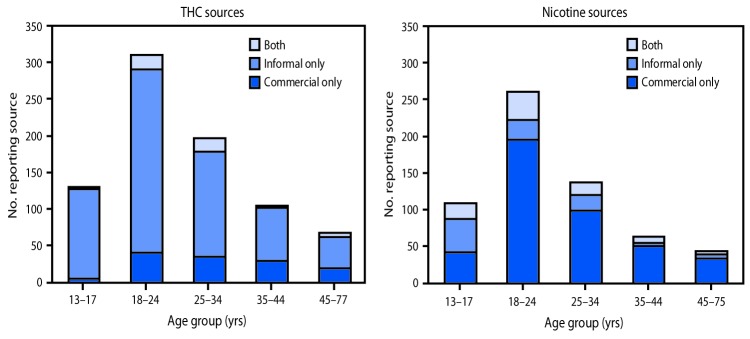
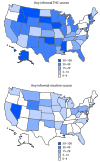
Description:CDC, the Food and Drug Administration (FDA), state and local health departments, and public health and clinical stakeholders continue to investigate a nationwide outbreak of e-cigarette, or vaping, product use-associated lung injury (EVALI) (1). EVALI patients in Illinois, Utah, and Wisconsin acquired tetrahydrocannabinol (THC)-containing products primarily from informal sources (2,3). This report updates demographic characteristics and self-reported sources of THC- and nicotine-containing e-cigarette, or vaping, products derived from EVALI patient data reported to CDC by state health departments. As of January 7, 2020, among 1,979 (76%) patients with available data on substance use, a total of 1,620 (82%) reported using any THC-containing products, including 665 (34%) who reported exclusive THC-containing product use. Use of any nicotine-containing products was reported by 1,128 (57%) patients, including 264 (13%) who reported exclusive nicotine-containing product use. Among 809 (50%) patients reporting data on the source of THC-containing products, 131 (16%) reported acquiring their products from only commercial sources (i.e., recreational dispensaries, medical dispensaries, or both; vape or smoke shops; stores; and pop-up shops), 627 (78%) from only informal sources (i.e., friends, family, in-person or online dealers, or other sources), and 51 (6%) from both types of sources. Among 613 (54%) EVALI patients reporting nicotine-containing product use with available data on product source, 421 (69%) reported acquiring their products from only commercial sources, 103 (17%) from only informal sources, and 89 (15%) from both types of sources. Adolescents aged 13-17 years were more likely to acquire both THC- and nicotine-containing products from informal sources than were persons in older age groups. The high prevalence of acquisition of THC-containing products from informal sources by EVALI patients reinforces CDC's recommendation to not use e-cigarette, or vaping, products that contain THC, especially those acquired from informal sources. Although acquisition of nicotine-containing products through informal sources was not common overall, it was common among persons aged <18 years. While the investigation continues, CDC recommends that the best way for persons to ensure that they are not at risk is to consider refraining from the use of all e-cigarette, or vaping, products.
-
Subjects:
-
Source:MMWR Morbidity Mortal Weekly Rep. 69(2):44-49
-
Series:
-
ISSN:0149-2195 (print) ; 1545-861X (digital)
-
Pubmed ID:31945038
-
Pubmed Central ID:PMC6973348
-
Document Type:
-
Place as Subject:
-
Pages in Document:6 pdf pages
-
Volume:69
-
Issue:2
-
Download URL:
-
File Type:
 [PDF - 182.74 KB]
 -
Collection(s):
-
Main Document Checksum:urn:sha-512:909d762b8839452315dfdfcb5aa1094146bd48c57a17c45c50eaaa692c27c879e2b556f9ee73b36a1920084232239f50d936a6b77cac22eabfd1eabd3fb4a8c1
Supporting Files


File Language:
English
 Was this page helpful?
 Found an issue?



CDC STACKS serves as an archival repository of CDC-published products including
scientific findings, journal articles, guidelines, recommendations, or other public health information authored or
co-authored by CDC or funded partners.
As a repository, CDC STACKS retains documents in their original published format to ensure public access to scientific information.
As a repository, CDC STACKS retains documents in their original published format to ensure public access to scientific information.
You May Also Like
COLLECTION
Morbidity and Mortality Weekly Report (MMWR)