



Population Movement Patterns Among the Democratic Republic of the Congo, Rwanda, and Uganda During an Outbreak of Ebola Virus Disease: Results from Community Engagement in Two Districts — Uganda, March 2019
Supporting Files
Public Domain

-
January 10 2020
File Language:
English
Details
-
Journal Article:Morbidity and Mortality Weekly Report (MMWR)
-
Personal Author:Nakiire, Lydia ; Mwanja, Herman ; Pillai, Satish K. ; Gasanani, Jonan ; Ntungire, Dickson ; Nsabiyumva, Stephen ; Mafigiri, Richardson ; Muneza, Nick ; Ward, Sarah E. ; Daffe, Zeinabou ; Ahabwe, Peter Babigumira ; Kyazze, Simon ; Ojwang, Joseph ; Homsy, Jaco ; Mclntyre, Elvira ; Lamorde, Mohammed ; Walwema, Richard ; Makumbi, Issa ; Muruta, Allan ; Merrill, Rebecca D.
-
Corporate Authors:
-
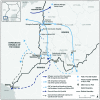
Description:Tailoring communicable disease preparedness and response strategies to unique population movement patterns between an outbreak area and neighboring countries can help limit the international spread of disease. Global recognition of the value of addressing community connectivity in preparedness and response, through field work and visualizing the identified movement patterns, is reflected in the World Health Organization's declaration on July 17, 2019, that the 10th Ebola Virus disease (Ebola) outbreak in the Democratic Republic of the Congo (DRC) was a Public Health Emergency of International Concern (1). In March 2019, the Infectious Diseases Institute (IDI), Uganda, in collaboration with the Ministry of Health (MOH) Uganda and CDC, had previously identified areas at increased risk for Ebola importation by facilitating community engagement with participatory mapping to characterize cross-border population connectivity patterns. Multisectoral participants identified 31 locations and associated movement pathways with high levels of connectivity to the Ebola outbreak areas. They described a major shift in the movement pattern between Goma (DRC) and Kisoro (Uganda), mainly through Rwanda, when Rwanda closed the Cyanika ground crossing with Uganda. This closure led some travelers to use a potentially less secure route within DRC. District and national leadership used these results to bolster preparedness at identified points of entry and health care facilities and prioritized locations at high risk further into Uganda, especially markets and transportation hubs, for enhanced preparedness. Strategies to forecast, identify, and rapidly respond to the international spread of disease require adapting to complex, dynamic, multisectoral cross-border population movement, which can be influenced by border control and public health measures of neighboring countries.
-
Subjects:
-
Source:MMWR Morbidity Mortal Weekly Rep. 69(1):10-13
-
Series:
-
ISSN:0149-2195 (print) ; 1545-861X (digital)
-
Pubmed ID:31917781
-
Pubmed Central ID:PMC6973344
-
Document Type:
-
Place as Subject:
-
Pages in Document:4 pdf pages
-
Volume:69
-
Issue:1
-
Download URL:
-
File Type:
 [PDF - 256.72 KB]
 -
Collection(s):
-
Main Document Checksum:urn:sha-512:3a0ce225550e555be635c72b1b3d43967056c56b0ea8b26c75e6d4b00ce92d980d9c67d72a1073d74266c99c7543f3c4eaf1bb9d84c7edcca9fc0fac68a29dee
Supporting Files


File Language:
English
 Was this page helpful?
 Found an issue?


CDC STACKS serves as an archival repository of CDC-published products including
scientific findings, journal articles, guidelines, recommendations, or other public health information authored or
co-authored by CDC or funded partners.
As a repository, CDC STACKS retains documents in their original published format to ensure public access to scientific information.
As a repository, CDC STACKS retains documents in their original published format to ensure public access to scientific information.
You May Also Like
COLLECTION
Morbidity and Mortality Weekly Report (MMWR)