



Characteristics of E-cigarette, or Vaping, Products Used by Patients with Associated Lung Injury and Products Seized by Law Enforcement — Minnesota, 2018 and 2019
Supporting Files
Public Domain

-
November 29 2019
File Language:
English
Details
-
Journal Article:Morbidity and Mortality Weekly Report (MMWR)
-
Personal Author:Taylor, Joanne ; Wiens, Terra ; Peterson, Jason ; Saravia, Stefan ; Lunda, Mark ; Hanson, Kaila ; Wogen, Matt ; D’Heilly, Paige ; Margetta, Jamie ; Bye, Maria ; Cole, Cory ; Mumm, Erica ; Schwerzler, Lauren ; Makhtal, Roon ; Danila, Richard ; Lynfield, Ruth ; Holzbauer, Stacy ; Blount, Benjamin C. ; Karwowski, Mateusz P. ; Morel-Espinosa, Maria ; Valentin-Blasini, Liza
-
Corporate Authors:
-
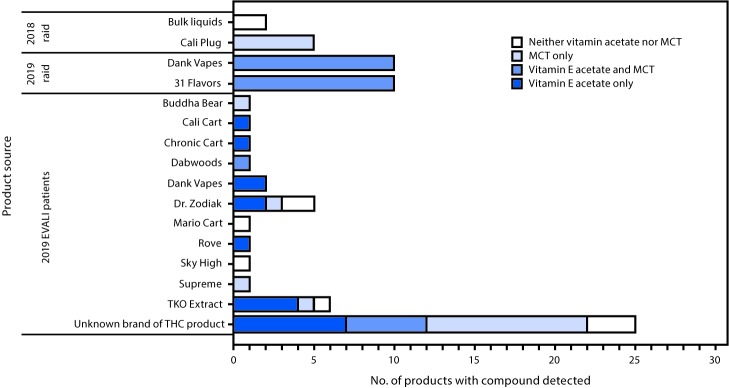
Description:During August 9-October 31, 2019, 96 patients were classified as having e-cigarette, or vaping, product use-associated lung injury (EVALI) by the Minnesota Department of Health (MDH); other patients are being investigated for case classification and exposures. Among 58 patients interviewed, 53 (91%) reported obtaining tetrahydrocannabinol (THC)-containing products from informal sources such as friends, family members, or in-person or online dealers. Using gas chromatography-mass spectrometry (GCMS), the MDH Public Health Laboratory (PHL) analyzed 46 THC-containing e-cigarette, or vaping, products obtained from 12 EVALI patients for various potential toxicants, including vitamin E acetate, which has recently been detected in some THC-containing products and in samples of lung fluid from EVALI patients (1-4). To explore whether vitamin E acetate is a recently added component in THC-containing products, MDH tested ten products seized by law enforcement in 2018, before the EVALI outbreak, and 20 products seized in 2019, during the outbreak. Twenty-four products obtained from 11 EVALI patients from 2019 contained vitamin E acetate. Among the seized products tested by MDH, none seized in 2018 contained vitamin E acetate, although all tested THC-containing products seized in 2019 tested positive for vitamin E acetate. These chemical analyses of products obtained from EVALI patients and of products intended for the illicit market both before and during the outbreak support a potential role for vitamin E acetate in the EVALI outbreak; however, the number of products tested was small, and further research is needed to establish a causal link between exposure to inhaled vitamin E acetate and EVALI. Collaboration between public health jurisdictions and law enforcement to characterize THC-containing products circulating before the recognition of the EVALI outbreak and during the outbreak might provide valuable information about a dynamic market. These Minnesota findings highlight concerns about e-cigarette, or vaping, products that contain THC acquired from informal sources. Because local supply chains and policy environments vary, CDC continues to recommend not using e-cigarette, or vaping, products that contain THC or any e-cigarette, or vaping, products obtained from informal sources. E-cigarette, or vaping, products should never be used by youths, young adults, or pregnant women.* Until the relationship between inhaled vitamin E acetate and lung health is better characterized, vitamin E acetate should not be added to e-cigarette, or vaping, products.
-
Subjects:
-
Source:MMWR Morbidity Mortal Weekly Rep. 68(47):1096-1100
-
Series:
-
ISSN:0149-2195 (print) ; 1545-861X (digital)
-
Pubmed ID:31774740
-
Pubmed Central ID:PMC6881051
-
Document Type:
-
Place as Subject:
-
Pages in Document:5 pdf pages
-
Volume:68
-
Issue:47
-
Download URL:
-
File Type:
 [PDF - 116.55 KB]
 -
Collection(s):
-
Main Document Checksum:urn:sha-512:a1d15e72218bee8d90917f3d7e124056d7d14a477047d78960793a5b52347a854bc9f8d03cd1d40b8d83010e191ab8ef600e12b379fbbae73e27da1786cc9be8
Supporting Files


File Language:
English
 Was this page helpful?
 Found an issue?

CDC STACKS serves as an archival repository of CDC-published products including
scientific findings, journal articles, guidelines, recommendations, or other public health information authored or
co-authored by CDC or funded partners.
As a repository, CDC STACKS retains documents in their original published format to ensure public access to scientific information.
As a repository, CDC STACKS retains documents in their original published format to ensure public access to scientific information.
You May Also Like
COLLECTION
Morbidity and Mortality Weekly Report (MMWR)