



Examining the Effectiveness of Year-Round School Calendars on Improving Educational Attainment Outcomes Within the Context of Advancement of Health Equity: A Community Guide Systematic Review
Supporting Files

-
2019/11/01
-
Available in CDC Stacks on November 01, 2020, 12:00 AM
File Language:
English
Details
-
Alternative Title:J Public Health Manag Pract
-
Personal Author:
-
Corporate Authors:
-
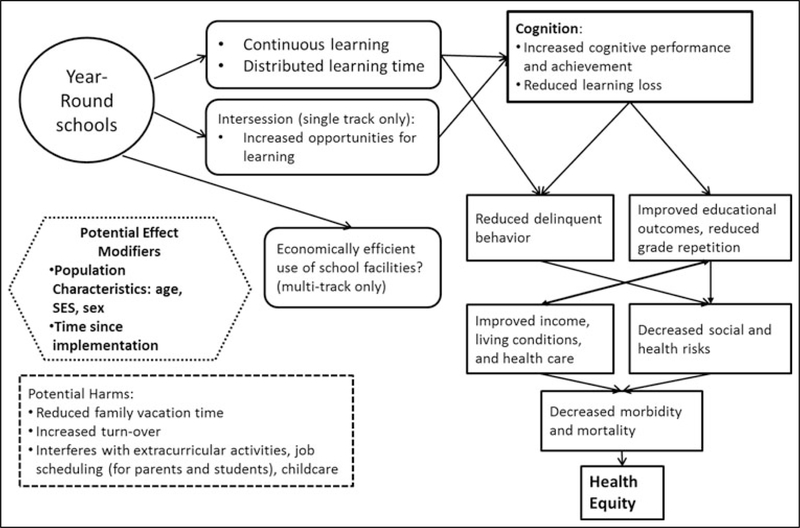
Description:Students may lose knowledge and skills achieved in the school year during the summer break, with losses greatest for students from low-income families. Community Guide systematic review methods were used to summarize evaluations (published 1965-2015) of the effectiveness of year-round school calendars (YRSCs) on academic achievement, a determinant of long-term health. In single-track YRSCs, all students participate in the same school calendar; summer breaks are replaced by short "intersessions" distributed evenly throughout the year. In multi-track YRSCs, cohorts of students follow separate calendar tracks, with breaks at different times throughout the year. An earlier systematic review reported modest gains with single-track calendars and no gains with multi-track calendars. Three studies reported positive and negative effects for single-track programs and potential harm with multi-track programs when low-income students were assigned poorly resourced tracks. Lack of clarity about the role of intersessions as simple school breaks or as additional schooling opportunities in YRSCs leaves the evidence on single-track programs insufficient. Evidence on multi-track YRSCs is also insufficient.
-
Subjects:
-
Source:J Public Health Manag Pract. 25(6):590-594
-
Pubmed ID:30325796
-
Pubmed Central ID:PMC6922050
-
Document Type:
-
Funding:
-
Genre:
-
Volume:25
-
Issue:6
-
Download URL:
-
File Type:
 [PDF - 1.03 MB]
 -
Collection(s):
-
Main Document Checksum:urn:sha-512:1c6a00c66bb6377e8be7a9f3870d751e99f9027c5f5e2a361f60b4af915099d63dd7a9de283a33e1d8a0caff747f7989c97e5039a043e1911ead9bc9daaa3d18
Supporting Files


File Language:
English
 Was this page helpful?
 Found an issue?


CDC STACKS serves as an archival repository of CDC-published products including
scientific findings, journal articles, guidelines, recommendations, or other public health information authored or
co-authored by CDC or funded partners.
As a repository, CDC STACKS retains documents in their original published format to ensure public access to scientific information.
As a repository, CDC STACKS retains documents in their original published format to ensure public access to scientific information.
You May Also Like
COLLECTION
CDC Public Access