


Impact of sociodemographic characteristics on underemployment in a longitudinal, nationally representative study of cancer survivors: Evidence for the importance of gender and marital status
Supporting Files

-
2018 May-Jun
-
File Language:
English
Details
-
Alternative Title:J Psychosoc Oncol
-
Personal Author:
-
Description:Background:
We examined the longitudinal association between sociodemographic factors and an expanded definition of underemployment among those with and without cancer history in the United States.
Methods:
Medical Expenditure Panel Survey data (2007–2013) were used in multivariable regression analyses to compare employment status between baseline and two-year follow-up among adults aged 25–62 years at baseline (n = 1,614 with and n = 39,324 without cancer). Underemployment was defined as becoming/staying unemployed, changing from full to part-time, or reducing part-time work significantly. Interaction effects between cancer history/time since diagnosis and predictors known to be associated with employment patterns, including age, gender/marital status, education, and health insurance status at baseline were modeled.
Results:
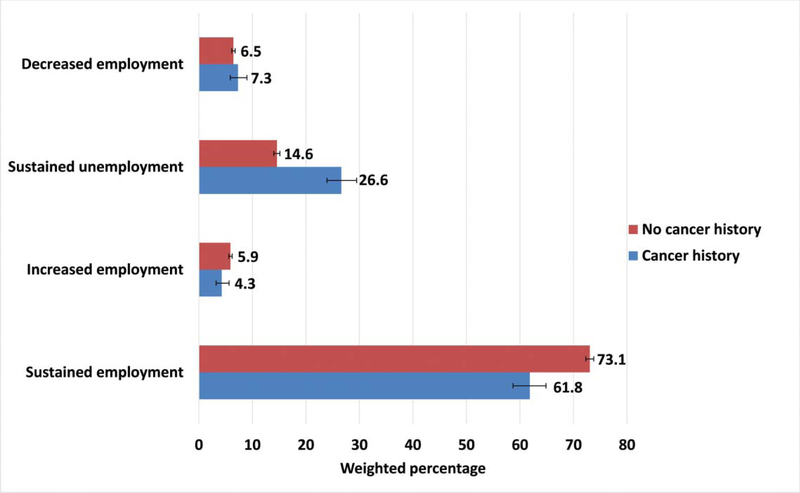
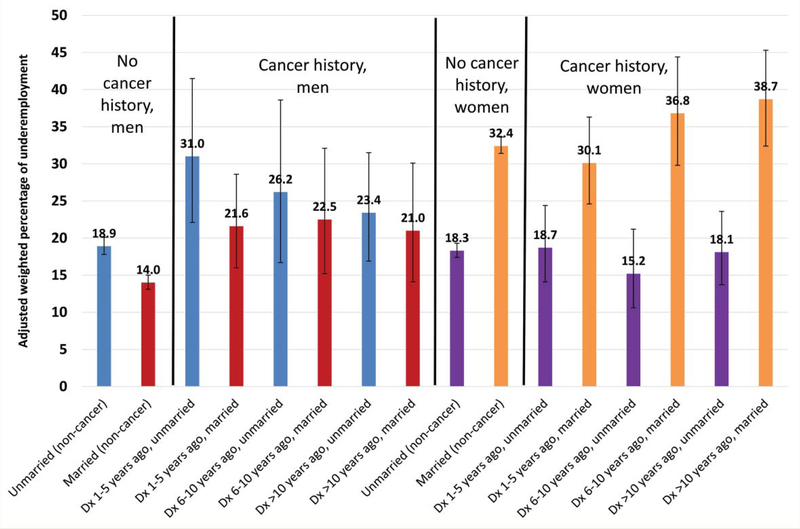
Approximately 25% of cancer survivors and 21% of individuals without cancer reported underemployment at follow-up (p = 0.002). Multivariable analyses indicated that those with a cancer history report underemployment more frequently (24.7%) than those without cancer (21.4%, p = 0.002) with underemployment rates increasing with time since cancer diagnosis. A significant interaction between gender/marital status and cancer history and underemployment was found (p = 0.0004). There were no other significant interactions. Married female survivors diagnosed >10 years ago reported underemployment most commonly (38.7%), and married men without cancer reported underemployment most infrequently (14.0%). A wider absolute difference in underemployment reports for married versus unmarried women as compared to married versus unmarried men was evident, with the widest difference apparent for unmarried versus married women diagnosed >10 years ago (18.1% vs. 38.7%).
Conclusion:
Cancer survivors are more likely to experience underemployment than those without cancer. Longer time since cancer diagnosis and gender/marital status are critical factors in predicting those at greatest risk of underemployment. The impact of cancer on work should be systematically studied across sociodemographic groups and recognized as a component of comprehensive survivorship care.
-
Subjects:
-
Source:J Psychosoc Oncol. 36(3):287-303
-
Pubmed ID:29634413
-
Pubmed Central ID:PMC6913911
-
Document Type:
-
Funding:
-
Volume:36
-
Issue:3
-
Collection(s):
-
Main Document Checksum:urn:sha256:bdf33da7c8cd2aaac9acfcfb524d3659d9aa35758b81c5a27938631eb489930e
-
Download URL:
-
File Type:
 [PDF
- 744.35 KB
]
[PDF
- 744.35 KB
]
Supporting Files


File Language:
English
ON THIS PAGE

CDC STACKS serves as an archival repository of CDC-published products including
scientific findings,
journal articles, guidelines, recommendations, or other public health information authored or
co-authored by CDC or funded partners.
As a repository, CDC STACKS retains documents in their original published format to ensure public access to scientific information.
As a repository, CDC STACKS retains documents in their original published format to ensure public access to scientific information.
You May Also Like
COLLECTION
CDC Public Access