


State policies in the United States impacting drug-related convictions and their consequences in 2015
Supporting Files

-
July 30 2019
-
File Language:
English
Details
-
Alternative Title:Drug Sci Policy Law
-
Personal Author:
-
Description:Background:
Criminal justice system involvement has been associated with health issues, including sexually transmitted disease. Both incarceration and sexually transmitted disease share associations with various social conditions, including poverty, stigma, and drug use.
Methods:
United States state laws (including Washington, D.C.) regarding drug possession and consequences of drug-related criminal convictions were collected and coded. Drug possession policies focused on mandatory sentences for possession of marijuana, crack cocaine and methamphetamines. Consequences of drug-related convictions included ineligibility for public programmes, ineligibility for occupational licences and whether employers may ask prospective employees about criminal history. We analysed correlations between state sexually transmitted disease rates and percentage of a state’s population convicted of a felony.
Results:
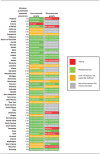
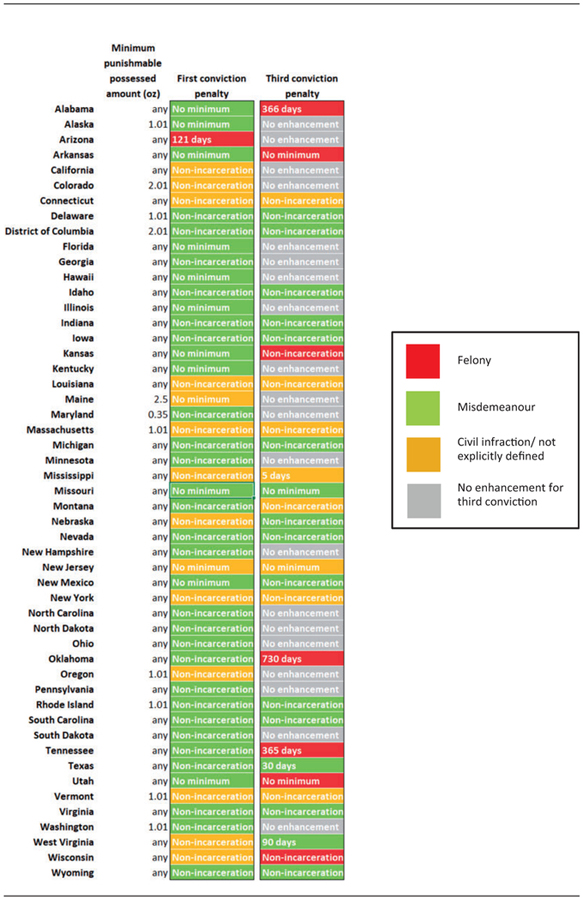
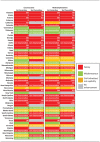
First-time possession of marijuana results in mandatory incarceration in one state; first-time possession of crack cocaine or methamphetamines results in mandatory incarceration in 12 (23.5%) states. Many states provide enhanced punishment upon a third possession conviction. A felony drug conviction results in mandatory ineligibility for the Supplemental Nutrition Assistance Program and/or Temporary Assistance for Needy Families in 17 (33.3%) states. Nine (17.6%) states prohibit criminal history questions on job applications. Criminal convictions limit eligibility for various professional licences in all states. State chlamydia, gonorrhoea and syphilis rates were positively associated with the percentage of the state population convicted of a felony (p < 0.05).
Conclusion:
While associations between crime, poverty, stigma and health have been investigated, our findings could be used to investigate the relationship between the likelihood of criminal justice system interactions, their consequences and public health outcomes including sexually transmitted disease risk.
-
Subjects:
-
Source:Drug Sci Policy Law. 5
-
Pubmed ID:31777660
-
Pubmed Central ID:PMC6880964
-
Document Type:
-
Funding:
-
Volume:5
-
Collection(s):
-
Main Document Checksum:urn:sha256:472101a2b6381e2cf0e297a729b773860479d7123eb14d2e4b51283161c05293
-
Download URL:
-
File Type:
 [PDF
- 399.80 KB
]
[PDF
- 399.80 KB
]
Supporting Files


File Language:
English
ON THIS PAGE


CDC STACKS serves as an archival repository of CDC-published products including
scientific findings,
journal articles, guidelines, recommendations, or other public health information authored or
co-authored by CDC or funded partners.
As a repository, CDC STACKS retains documents in their original published format to ensure public access to scientific information.
As a repository, CDC STACKS retains documents in their original published format to ensure public access to scientific information.
You May Also Like
COLLECTION
CDC Public Access