



Speak Up! Prosocial Intervention Verbalizations Predict Successful Bystander Intervention for a Laboratory Analogue of Sexual Aggression
Supporting Files

-
January 09 2019
-
Available in CDC Stacks on March 01, 2021, 12:00 AM
File Language:
English
Details
-
Journal Article:Sex Abuse
-
Personal Author:
-
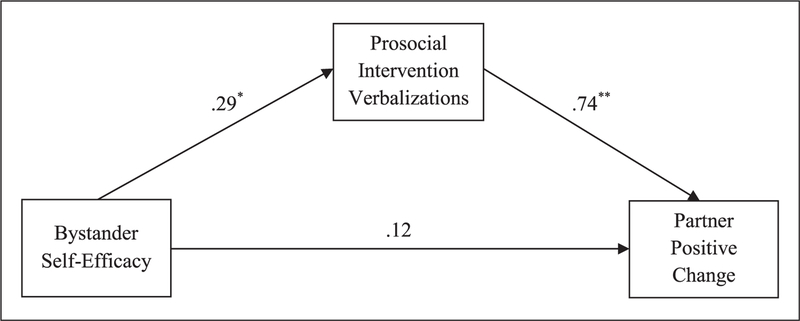
Description:This study evaluated a mechanism by which men's self-efficacy to intervene increases their likelihood of preventing a laboratory analogue of sexual aggression (SA) via specific verbalizations and whether alcohol inhibits this mechanism. A sample of 78 male peer dyads were randomly assigned to consume an alcoholic or nonalcoholic beverage and complete a laboratory paradigm to assess bystander intervention to prevent SA toward a female who had ostensibly consumed an alcoholic or nonalcoholic beverage. Participants' verbalizations during the task were subjected to quantitative analysis. Regardless of alcohol use, bystander self-efficacy increased the likelihood of successful bystander intervention via participants' use of more prosocial verbalizations. Findings highlight prosocial verbalizations within the male peer context that may effectively prevent SA.
-
Subjects:
-
Source:Sex Abuse. 32(2):220-243
-
DOI:
-
Pubmed ID:30623745
-
Pubmed Central ID:PMC6856396
-
Document Type:
-
Funding:
-
Genre:
-
Volume:32
-
Issue:2
-
Download URL:
-
File Type:
 [PDF - 457.22 KB]
 -
Collection(s):
-
Main Document Checksum:urn:sha-512:c6bb969a54b77895a72ec9f3e088753931938f7a5d478ab5aac3627e803d27cb0e77822d3abf5a4c059e497276f9b4fac381fc895df2b31608f71e7daa8f378e
Supporting Files


File Language:
English
 Was this page helpful?
 Found an issue?

CDC STACKS serves as an archival repository of CDC-published products including
scientific findings, journal articles, guidelines, recommendations, or other public health information authored or
co-authored by CDC or funded partners.
As a repository, CDC STACKS retains documents in their original published format to ensure public access to scientific information.
As a repository, CDC STACKS retains documents in their original published format to ensure public access to scientific information.
You May Also Like
COLLECTION
CDC Public Access