



Anxiety in the family: A genetically informed analysis of transactional associations between mother, father and child anxiety symptoms
Supporting Files

-
May 20 2019
-
Available in CDC Stacks on 2020-12-01T00:00:00Z
File Language:
English
Details
-
Alternative Title:J Child Psychol Psychiatry
-
Personal Author:
-
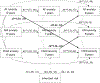
Description:Background: ; Anxiety in parents is associated with anxiety in offspring, although little is known about the mechanisms underpinning these intergenerational associations. We conducted the first genetically sensitive study to simultaneously examine the effects of mother, father and child anxiety symptoms on each other over time. ; Method: ; Adoptive parent and child symptoms were measured at child ages 6, 7 and 8 years from 305 families involved in the Early Growth and Development Study, using a prospective adoption design. Children were adopted at birth to non-relatives and composite data on internalising problems within birth families were used as a proxy measure of offspring inherited risk for anxiety. Structural equation models were fitted to the data to examine prospective associations between adoptive mother, father and child symptoms, whilst accounting for individuals’ symptom stability over time. ; Results: ; Child anxiety symptoms at age 7 predicted adoptive mothers’ anxiety symptoms at age 8. No mother-to-child or child-to-father effects were observed. These results were consistent in sensitivity analyses using only paternal offspring reports and using a second measure of child anxiety symptoms. Fathers’ anxiety symptoms at child age 6 prospectively predicted child symptoms, but only when paternal offspring reports were included in the model. Composite data on birth family internalising problems were not associated with child anxiety symptoms. ; Conclusions: ; Results show environmentally mediated associations between parent and child anxiety symptoms. Results support developmental theories suggesting that child anxiety symptoms can exert influence on caregivers, and mothers and fathers may play unique roles during the development of child symptoms. Further research is needed on the role of genetic transmission associated with anxiety symptoms in biologically related families. In the meantime, researchers and clinicians should strive to include fathers in assessments and consider the effects of child symptoms on caregivers.
-
Subjects:
- Article
- Anxiety
- parent-child relationships
- genetics
- longitudinal
- structural equation modelling
- Adult
- Child
- Child of Impaired Parents
- Child, Adopted
- Fathers
- Female
- Gene-Environment Interaction
- Genetic Predisposition to Disease
- Humans
- Longitudinal Studies
- Male
- Mothers
- Parent-Child Relations
- Social Environment
-
Source:J Child Psychol Psychiatry. 60(12):1269-1277
-
Pubmed ID:31106427
-
Pubmed Central ID:PMC6856374
-
Document Type:
-
Funding:R01 HD042608/HD/NICHD NIH HHS/United States ; 107706/Z/15/Z/Royal Society/International ; UH3 OD023389/OD/NIH HHS/United States ; R56 HD042608/HD/NICHD NIH HHS/United States ; 107706/WT_/Wellcome Trust/United Kingdom ; R01 MH092118/MH/NIMH NIH HHS/United States ; UG3 OD023389/OD/NIH HHS/United States ; MR/M021475/1/MRC_/Medical Research Council/United Kingdom ; G0500079/MRC_/Medical Research Council/United Kingdom ; UH3-OD023389/CD/ODCDC CDC HHS/United States ; WT_/Wellcome Trust/United Kingdom
-
Volume:60
-
Issue:12
-
Download URL:
-
File Type:
 [PDF - 374.34 KB]
 -
Collection(s):
-
Main Document Checksum:urn:sha256:dcd5ef47fc6b90523c2861f413b9aa27331dabcefd6359c2617d478a6657fd8f
Supporting Files


File Language:
English
 Was this page helpful?
 Found an issue?


CDC STACKS serves as an archival repository of CDC-published products including
scientific findings, journal articles, guidelines, recommendations, or other public health information authored or
co-authored by CDC or funded partners.
As a repository, CDC STACKS retains documents in their original published format to ensure public access to scientific information.
As a repository, CDC STACKS retains documents in their original published format to ensure public access to scientific information.
You May Also Like
COLLECTION
CDC Public Access