


Disease Dynamics and Bird Migration—Linking Mallards Anas platyrhynchos and Subtype Diversity of the Influenza A Virus in Time and Space
Supporting Files
Public Domain

-
Apr 20 2012
-
File Language:
English
Details
-
Alternative Title:PLoS One
-
Personal Author:
-
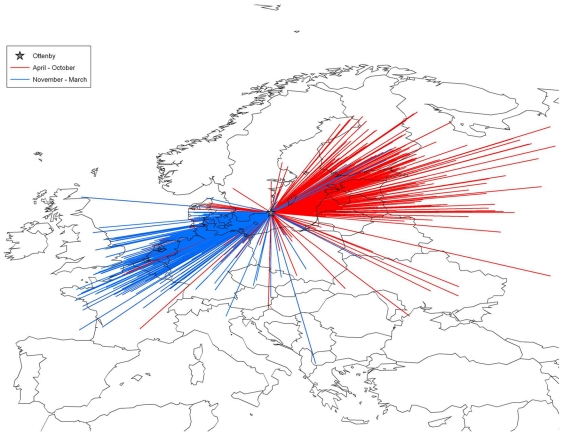
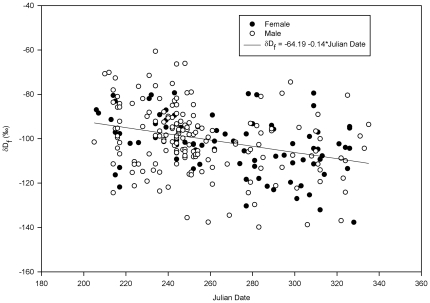
Description:The mallard Anas platyrhynchos is a reservoir species for influenza A virus in the northern hemisphere, with particularly high prevalence rates prior to as well as during its prolonged autumn migration. It has been proposed that the virus is brought from the breeding grounds and transmitted to conspecifics during subsequent staging during migration, and so a better understanding of the natal origin of staging ducks is vital to deciphering the dynamics of viral movement pathways. Ottenby is an important stopover site in southeast Sweden almost halfway downstream in the major Northwest European flyway, and is used by millions of waterfowl each year. Here, mallards were captured and sampled for influenza A virus infection, and positive samples were subtyped in order to study possible links to the natal area, which were determined by a novel approach combining banding recovery data and isotopic measurements (δ(2)H) of feathers grown on breeding grounds. Geographic assignments showed that the core natal areas of studied mallards were in Estonia, southern and central Finland, and northwestern Russia. This study demonstrates a clear temporal succession of latitudes of natal origin during the course of autumn migration. We also demonstrate a corresponding and concomitant shift in virus subtypes. Acknowledging that these two different patterns were based in part upon different data, a likely interpretation worth further testing is that the early arriving birds with more proximate origins have different influenza A subtypes than the more distantly originating late autumn birds. If true, this knowledge would allow novel insight into the origins and transmission of the influenza A virus among migratory hosts previously unavailable through conventional approaches.
-
Subjects:
-
Source:PLoS One. 2012; 7(4).
-
Document Type:
-
Place as Subject:
-
Volume:7
-
Issue:4
-
Collection(s):
-
Main Document Checksum:urn:sha256:ab857649cc2a4f13f6514fb48b6439388bc8250ec26aadbe1fd102c1c29c41b5
-
Download URL:
-
File Type:
 [PDF
- 739.45 KB
]
[PDF
- 739.45 KB
]
Supporting Files


File Language:
English
ON THIS PAGE




CDC STACKS serves as an archival repository of CDC-published products including
scientific findings,
journal articles, guidelines, recommendations, or other public health information authored or
co-authored by CDC or funded partners.
As a repository, CDC STACKS retains documents in their original published format to ensure public access to scientific information.
As a repository, CDC STACKS retains documents in their original published format to ensure public access to scientific information.
You May Also Like
COLLECTION
CDC Public Access