


Assessment of Adolescents’ Victimization, Aggression, and Problem Behaviors: Evaluation of the Problem Behavior Frequency Scale
Supporting Files

-
September 14 2015
-
File Language:
English
Details
-
Alternative Title:Psychol Assess
-
Personal Author:
-
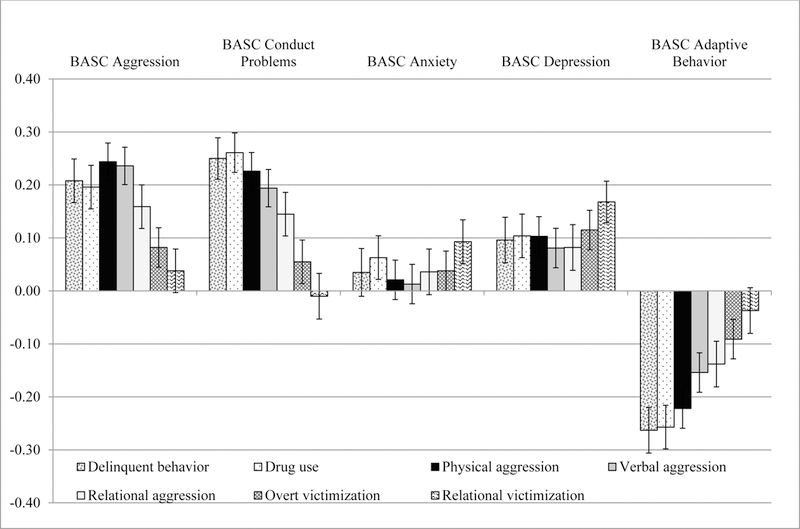
Description:This study evaluated the Problem Behavior Frequency Scale (PBFS), a self-report measure designed to assess adolescents' frequency of victimization, aggression, and other problem behaviors. Analyses were conducted on a sample of 5,532 adolescents from 37 schools at 4 sites. About half (49%) of participants were male; 48% self-identified as Black non-Hispanic; 21% as Hispanic, 18% as White non-Hispanic. Adolescents completed the PBFS and measures of beliefs and values related to aggression, and delinquent peer associations at the start of the 6th grade and over 2 years later. Ratings of participants' behavior were also obtained from teachers on the Behavioral Assessment System for Children. Confirmatory factor analyses supported a 7-factor model that differentiated among 3 forms of aggression (physical, verbal, and relational), 2 forms of victimization (overt and relational), drug use, and other delinquent behavior. Support was found for strong measurement invariance across gender, sites, and time. The PBFS factors generally showed the expected pattern of correlations with teacher ratings of adolescents' behavior and self-report measures of relevant constructs. (PsycINFO Database Record
-
Subjects:
-
Source:Psychol Assess. 28(6):702-714
-
Pubmed ID:26372261
-
Pubmed Central ID:PMC6714549
-
Document Type:
-
Funding:
-
Volume:28
-
Issue:6
-
Collection(s):
-
Main Document Checksum:urn:sha256:b1c9c9c0402ab29c5e02214bd0a3b2660a9331f7cb5604bf3d86bad7be2917c5
-
Download URL:
-
File Type:
 [PDF
- 661.96 KB
]
[PDF
- 661.96 KB
]
Supporting Files


File Language:
English
ON THIS PAGE


CDC STACKS serves as an archival repository of CDC-published products including
scientific findings,
journal articles, guidelines, recommendations, or other public health information authored or
co-authored by CDC or funded partners.
As a repository, CDC STACKS retains documents in their original published format to ensure public access to scientific information.
As a repository, CDC STACKS retains documents in their original published format to ensure public access to scientific information.
You May Also Like
COLLECTION
CDC Public Access