


One hypervirulent clone, sequence type 283, accounts for a large proportion of invasive Streptococcus agalactiae isolated from humans and diseased tilapia in Southeast Asia
Supporting Files
Public Domain

-
June 27 2019
-
File Language:
English
Details
-
Alternative Title:PLoS Negl Trop Dis
-
Personal Author:Barkham, Timothy ; Zadoks, Ruth N. ; Azmai, Mohammad Noor Amal ; Baker, Stephen ; Bich, Vu Thi Ngoc ; Chalker, Victoria ; Chau, Man Ling ; Dance, David ; Deepak, Rama Narayana ; van Doorn, H. Rogier ; Gutierrez, Ramona A. ; Holmes, Mark A. ; Huong, Lan Nguyen Phu ; Koh, Tse Hsien ; Martins, Elisabete ; Mehershahi, Kurosh ; Newton, Paul ; Ng, Lee Ching ; Phuoc, Nguyen Ngoc ; Sangwichian, Ornuma ; Sawatwong, Pongpun ; Surin, Uraiwan ; Tan, Thean Yen ; Tang, Wen Ying ; Thuy, Nguyen Vu ; Turner, Paul ; Vongsouvath, Manivanh ; Zhang, Defeng ; Whistler, Toni ; Chen, Swaine L.
-
Description:Background
In 2015, Singapore had the first and only reported foodborne outbreak of invasive disease caused by the group B Streptococcus (GBS; Streptococcus agalactiae). Disease, predominantly septic arthritis and meningitis, was associated with sequence type (ST)283, acquired from eating raw farmed freshwater fish. Although GBS sepsis is well-described in neonates and older adults with co-morbidities, this outbreak affected non-pregnant and younger adults with fewer co-morbidities, suggesting greater virulence. Before 2015 ST283 had only been reported from twenty humans in Hong Kong and two in France, and from one fish in Thailand. We hypothesised that ST283 was causing region-wide infection in Southeast Asia.
Methodology/Principal findings
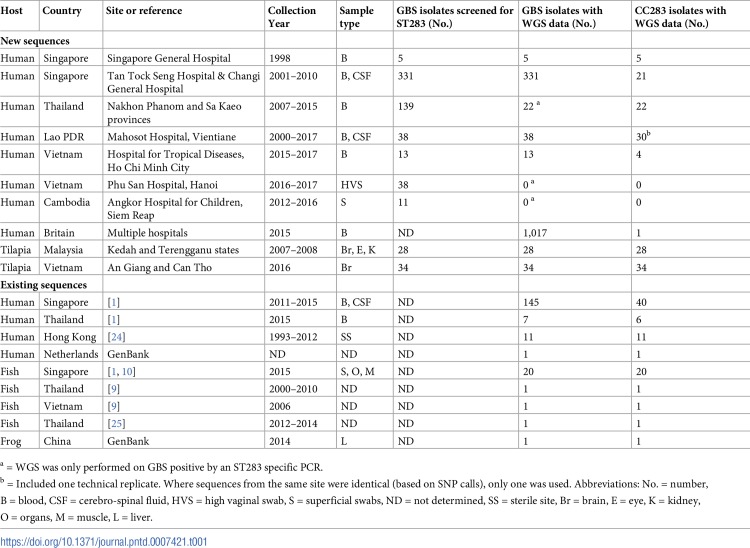
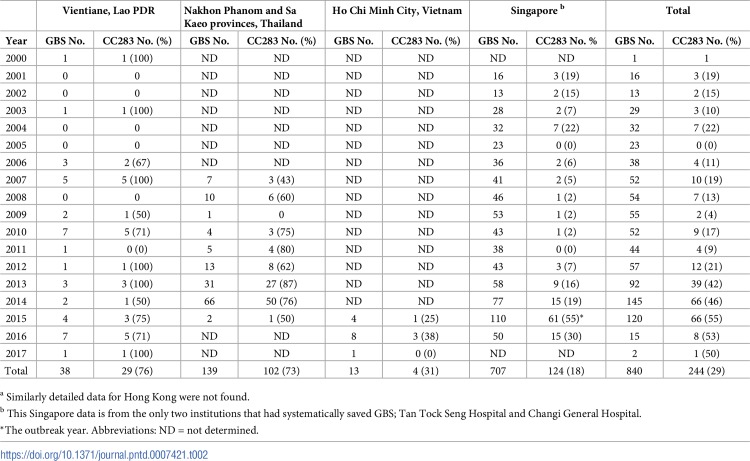
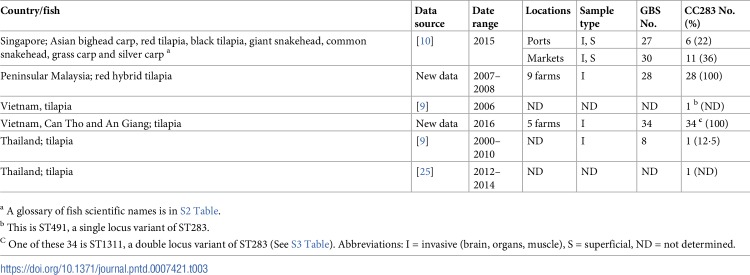
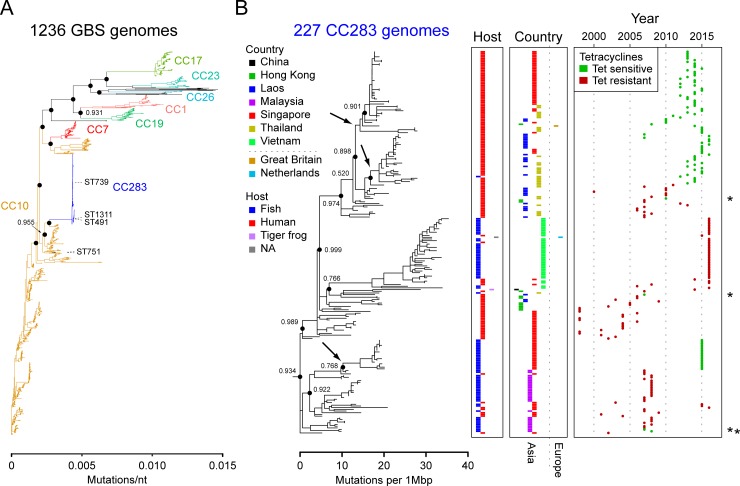
We performed a literature review, whole genome sequencing on 145 GBS isolates collected from six Southeast Asian countries, and phylogenetic analysis on 7,468 GBS sequences including 227 variants of ST283 from humans and animals. Although almost absent outside Asia, ST283 was found in all invasive Asian collections analysed, from 1995 to 2017. It accounted for 29/38 (76%) human isolates in Lao PDR, 102/139 (73%) in Thailand, 4/13 (31%) in Vietnam, and 167/739 (23%) in Singapore. ST283 and its variants were found in 62/62 (100%) tilapia from 14 outbreak sites in Malaysia and Vietnam, in seven fish species in Singapore markets, and a diseased frog in China.
Conclusions
GBS ST283 is widespread in Southeast Asia, where it accounts for a large proportion of bacteraemic GBS, and causes disease and economic loss in aquaculture. If human ST283 is fishborne, as in the Singapore outbreak, then GBS sepsis in Thailand and Lao PDR is predominantly a foodborne disease. However, whether transmission is from aquaculture to humans, or vice versa, or involves an unidentified reservoir remains unknown. Creation of cross-border collaborations in human and animal health are needed to complete the epidemiological picture.
-
Subjects:
-
Source:PLoS Negl Trop Dis. 13(6)
-
Pubmed ID:31246981
-
Pubmed Central ID:PMC6597049
-
Document Type:
-
Place as Subject:
-
Volume:13
-
Issue:6
-
Collection(s):
-
Main Document Checksum:urn:sha256:24eb91b899f974d39142d285f95c7211d61c42ff896d99bdf18e5f91127cf742
-
Download URL:
-
File Type:
 [PDF
- 1.29 MB
]
[PDF
- 1.29 MB
]
Supporting Files


File Language:
English
ON THIS PAGE






CDC STACKS serves as an archival repository of CDC-published products including
scientific findings,
journal articles, guidelines, recommendations, or other public health information authored or
co-authored by CDC or funded partners.
As a repository, CDC STACKS retains documents in their original published format to ensure public access to scientific information.
As a repository, CDC STACKS retains documents in their original published format to ensure public access to scientific information.
You May Also Like
COLLECTION
CDC Public Access