



Evacuations as a Result of Hurricane Sandy: Analysis of the 2014 New Jersey Behavioral Risk Factor Survey
Supporting Files

-
12 2017
-
Available in CDC Stacks on August 23, 2019, 12:00 AM
File Language:
English
Details
-
Journal Article:Disaster Med Public Health Prep
-
Personal Author:
-
Description:Objective:
We characterized evacuations related to Hurricane Sandy, which made landfall in New Jersey on October 29, 2012.
Methods:
We analyzed data from the 2014 New Jersey Behavioral Risk Factor Survey. The proportion of respondents reporting evacuation was used to estimate the number of New Jersey adults who evacuated. We determined evacuation rates in heavily impacted and less-impacted municipalities, as well as evacuation rates for municipalities under and not under mandatory evacuation orders. We tested associations between demographic and health factors, such as certain chronic health conditions, and evacuation.
Results:
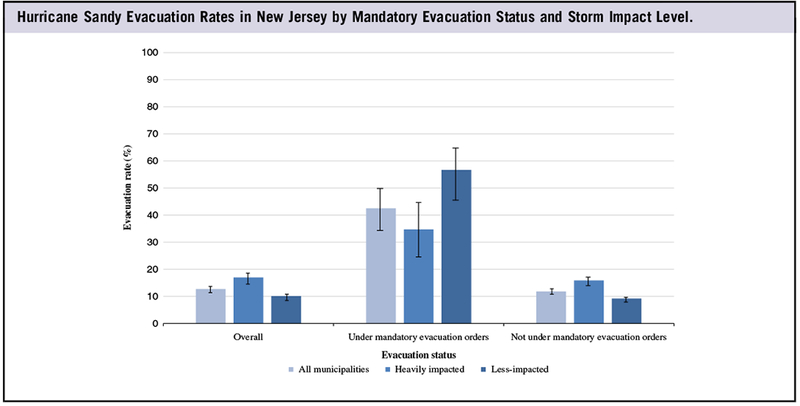
Among respondents, 12.7% (95% CI: 11.8%-13.6%) reported evacuating, corresponding to approximately 880,000 adults. In heavily impacted municipalities, 17.0% (95% CI: 15.2%-18.7%) evacuated, compared with 10.1% (95% CI: 9.0%-11.2%) in less-impacted municipalities. In municipalities under mandatory evacuation orders, 42.5% (95% CI: 35.1%-49.8%) evacuated, compared with 11.8% (95% CI: 10.9%-12.9%) in municipalities not under mandatory orders. Female gender (odds ratio OR: 1.36; 95% CI: 1.14-1.64), unmarried status (OR: 1.22; 95% CI: 1.02-1.46), shorter length of residence (OR: 1.28; 95% CI: 1.03-1.60), and living in a heavily impacted municipality (OR: 1.84; 95% CI: 1.54-2.20) were significantly associated with evacuation. History of stroke (OR: 1.61; 95% CI: 1.02-2.53) was the only chronic condition associated with evacuation.
Conclusions:
Approximately 880,000 New Jersey adults evacuated because of Hurricane Sandy. Those in heavily impacted municipalities and municipalities under mandatory evacuation orders had higher evacuation rates; however, still fewer than half evacuated. These findings can be used for future disaster planning. -
Subjects:
-
Keywords:
-
Source:Disaster Med Public Health Prep. 11(6):720-728
-
DOI:
-
Pubmed ID:28659220
-
Pubmed Central ID:PMC6706855
-
Document Type:
-
Funding:
-
Genre:
-
Place as Subject:
-
Volume:11
-
Issue:6
-
Download URL:
-
File Type:
 [PDF - 160.86 KB]
 -
Collection(s):
-
Main Document Checksum:urn:sha-512:5365749c1095c4174b83148d58098c438ad485c6225e43741c085ab0f82275d0c57b1ceba40589a8fe1ea35f72e7d6143138df6c53e92c59ddfef4f9afc8d13e
Supporting Files


File Language:
English
 Was this page helpful?
 Found an issue?

CDC STACKS serves as an archival repository of CDC-published products including
scientific findings, journal articles, guidelines, recommendations, or other public health information authored or
co-authored by CDC or funded partners.
As a repository, CDC STACKS retains documents in their original published format to ensure public access to scientific information.
As a repository, CDC STACKS retains documents in their original published format to ensure public access to scientific information.
You May Also Like
COLLECTION
CDC Public Access