


Reduction in Cadmium Exposure in the United States Population, 1988–2008: The Contribution of Declining Smoking Rates
Supporting Files
Public Domain

-
Nov 07 2011
-
File Language:
English
Details
-
Alternative Title:Environ Health Perspect
-
Personal Author:
-
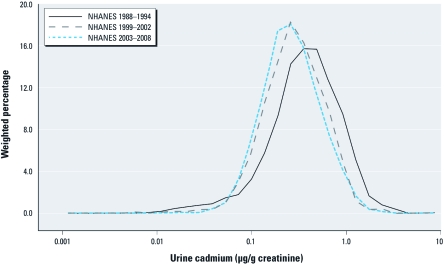
Description:Public health policies such as tobacco control, air pollution reduction, and hazardous waste remediation may have reduced cadmium exposure among U.S. adults. However, trends in urine cadmium, a marker of cumulative cadmium exposure, have not been evaluated.|We estimated the trends in urine cadmium concentrations in U.S. adults using data from the National Health and Nutrition Examination Surveys (NHANES) from 1988 to 2008. We also evaluated the impact of changes in the distribution of available cadmium determinants (age, sex, race, education, body mass index, smoking, and occupation) at the population level to explain cadmium trends.|The study population included 19,759 adults ≥ 20 years of age with measures of urine cadmium and cadmium determinants.|Age-adjusted geometric means of urine cadmium concentrations were 0.36, 0.35, 0.27, 0.27, 0.28, 0.25, and 0.26 µg/g creatinine in 1988-1991, 1991-1994, 1999-2000, 2001-2002, 2003-2004, 2005-2006, and 2007-2008, respectively. The age, sex, and race/ethnicity-adjusted percent reduction in urine cadmium geometric means comparing 1999-2002 and 2003-2008 with 1988-1994 were 27.8% (95% confidence interval: 22.3%, 32.9%) and 34.3% (29.9%, 38.4%), respectively (p-trend < 0.001), with reductions in all participant subgroups investigated. In never smokers, reductions in serum cotinine accounted for 15.6% of the observed reduction. In ever smokers, changes in smoking cessation, and cumulative and recent dose accounted for 17.1% of the observed reduction.|Urine cadmium concentrations decreased markedly between 1988 and 2008. Declining smoking rates and changes in exposure to tobacco smoke may have played an important role in the decline of urine cadmium concentrations, benefiting both smokers and nonsmokers. Cadmium has been associated to several health outcomes in NHANES 1999-2008. Consequently, despite the observed decline, further reduction in cadmium exposure is needed.
-
Subjects:
-
Source:Environ Health Perspect. 2011; 120(2):204-209.
-
Document Type:
-
Name as Subject:
-
Place as Subject:
-
Volume:120
-
Issue:2
-
Collection(s):
-
Main Document Checksum:urn:sha256:4bd451dacaff116a8ef12abe611fbfccfe7476b326468f4db5594524fdc3f944
-
Download URL:
-
File Type:
 [PDF
- 297.91 KB
]
[PDF
- 297.91 KB
]
Supporting Files


File Language:
English
ON THIS PAGE

CDC STACKS serves as an archival repository of CDC-published products including
scientific findings,
journal articles, guidelines, recommendations, or other public health information authored or
co-authored by CDC or funded partners.
As a repository, CDC STACKS retains documents in their original published format to ensure public access to scientific information.
As a repository, CDC STACKS retains documents in their original published format to ensure public access to scientific information.
You May Also Like
COLLECTION
CDC Public Access