


Association of Maternity Care Practices and Policies with In-Hospital Exclusive Breastfeeding in the United States
Supporting Files

-
March 14 2019
-
File Language:
English
Details
-
Journal Article:Breastfeed Med
-
Personal Author:
-
Description:Background:
Experiences during the birth hospitalization affect breastfeeding outcomes. In the United States, hospital policies and practices supportive of breastfeeding are routinely assessed through the Maternity Practices in Infant Nutrition and Care (mPINC) survey; however, mPINC does not capture data on breastfeeding outcomes.
Materials and Methods:
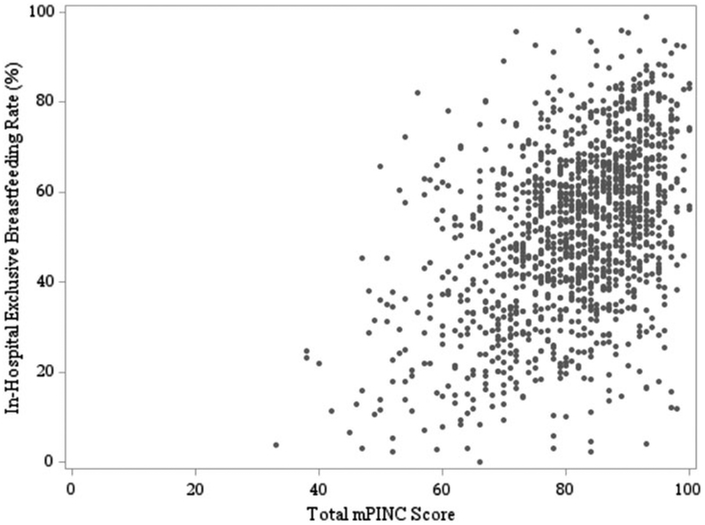
Data from the 2015 mPINC survey were linked to 2015 data from the Joint Commission (TJC), a major accreditor of health care systems in the United States (n = 1,305 hospitals). Each hospital participating in mPINC is given a total score, which is the average of seven subscores; all ranging from 0 to 100. TJC has hospital-specific data on the percentage of infants exclusively breastfeeding at hospital discharge. We used linear regression to estimate differences between quartiles of (1) total mPINC score and (2) each mPINC subscore with rates of exclusive breastfeeding at hospital discharge, adjusting for hospital type, teaching status, and number of annual births. We additionally used linear models to test for trend across quartiles of mPINC score.
Results:
The mean percentage of in-hospital exclusive breastfeeding increased from 39.0% for hospitals in the lowest mPINC total score quartile (<75) to 60.4% for hospitals in the highest mPINC total score quartile (≥89), an adjusted difference of 21.1 percentage points (95% confidence interval 18.6–23.6). The mean percentage of in-hospital exclusive breastfeeding significantly increased (p < 0.0001) as mPINC scores increased for total mPINC score and for each mPINC subscore.
Conclusions:
Higher mPINC scores were associated with higher rates of in-hospital exclusive breastfeeding. Hospitals can make improvements to their maternity care practices and policies to support breastfeeding.
-
Subjects:
-
Source:Breastfeed Med. 14(4):243-248
-
DOI:
-
Pubmed ID:30807205
-
Pubmed Central ID:PMC6681453
-
Document Type:
-
Funding:
-
Genre:
-
Volume:14
-
Issue:4
-
Collection(s):
-
Main Document Checksum:urn:sha-512:06820901da0bc9c45f9330dc8bec228ff92157f0e85011700bba73fd8dd62b432a43f54230bb097669e9de5e75fcc54bd485d0cb09123db8213d0502cb70caae
-
Download URL:
-
File Type:
 [PDF
- 444.69 KB
]
[PDF
- 444.69 KB
]
Supporting Files


File Language:
English
ON THIS PAGE

CDC STACKS serves as an archival repository of CDC-published products including
scientific findings,
journal articles, guidelines, recommendations, or other public health information authored or
co-authored by CDC or funded partners.
As a repository, CDC STACKS retains documents in their original published format to ensure public access to scientific information.
As a repository, CDC STACKS retains documents in their original published format to ensure public access to scientific information.
You May Also Like
COLLECTION
CDC Public Access