


A Combination of Two Human Monoclonal Antibodies Prevents Zika Virus Escape Mutations in Non-human Primates
Supporting Files

-
Nov 06 2018
-
File Language:
English
Details
-
Alternative Title:Cell Rep
-
Personal Author:Keeffe, Jennifer R. ; Van Rompay, Koen K.A. ; Olsen, Priscilla C. ; Wang, Qiao ; Gazumyan, Anna ; Azzopardi, Stephanie A. ; Schaefer-Babajew, Dennis ; Lee, Yu E. ; Stuart, Jackson B. ; Singapuri, Anil ; Watanabe, Jennifer ; Usachenko, Jodie ; Ardeshir, Amir ; Saeed, Mohsan ; Agudelo, Marianna ; Eisenreich, Thomas ; Bournazos, Stylianos ; Oliveira, Thiago Y. ; Rice, Charles M. ; Coffey, Lark L. ; MacDonald, Margaret R. ; Bjorkman, Pamela J. ; Nussenzweig, Michel C. ; Robbiani, Davide F.
-
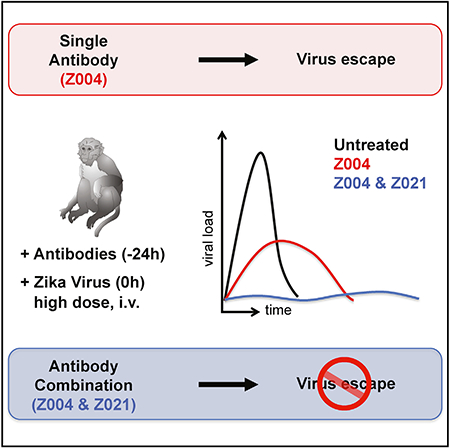
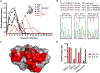
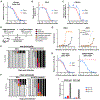
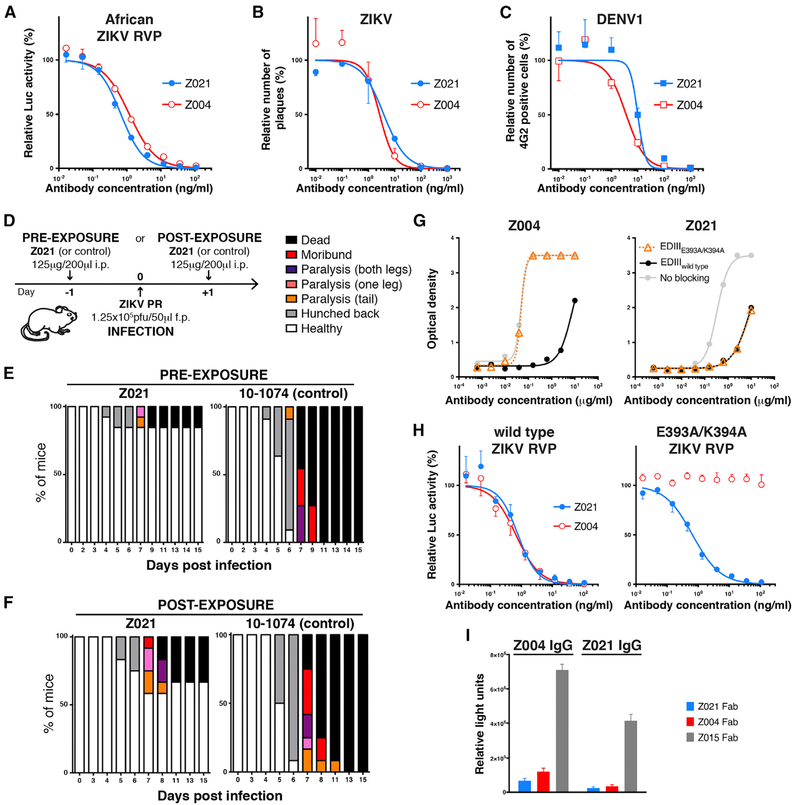
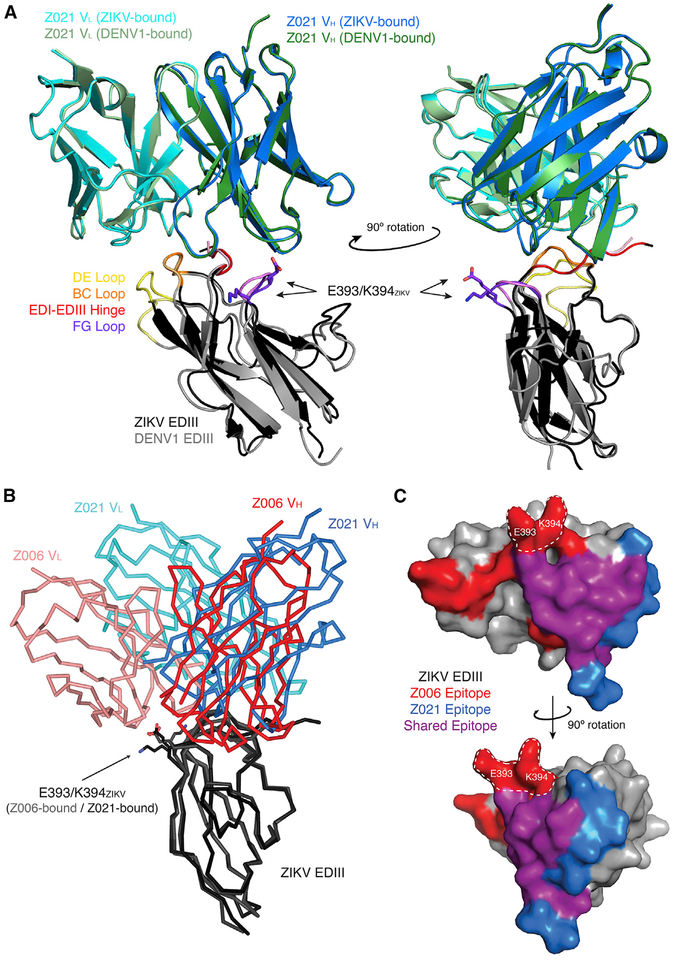
Description:Zika virus (ZIKV) causes severe neurologic complications and fetal aberrations. Vaccine development is hindered by potential safety concerns due to antibody cross-reactivity with dengue virus and the possibility of disease enhancement. In contrast, passive administration of anti-ZIKV antibodies engineered to prevent enhancement may be safe and effective. Here, we report on human monoclonal antibody Z021, a potent neutralizer that recognizes an epitope on the lateral ridge of the envelope domain III (EDIII) of ZIKV and is protective against ZIKV in mice. When administered to macaques undergoing a high-dose ZIKV challenge, a single anti-EDIII antibody selected for resistant variants. Co-administration of two antibodies, Z004 and Z021, which target distinct sites on EDIII, was associated with a delay and a 3- to 4-log decrease in peak viremia. Moreover, the combination of these antibodies engineered to avoid enhancement prevented viral escape due to mutation in macaques, a natural host for ZIKV.
-
Subjects:
-
Source:Cell Rep. 25(6):1385-1394.e7
-
Pubmed ID:30403995
-
Pubmed Central ID:PMC6268006
-
Document Type:
-
Funding:R01 AI037526/NIAID NIH HHS/National Institute of Allergy and Infectious Diseases Extramural Activities/United States ; UM1 AI100663/NIAID NIH HHS/National Institute of Allergy and Infectious Diseases Extramural Activities/United States ; T32 AI070084/NIAID NIH HHS/National Institute of Allergy and Infectious Diseases Extramural Activities/United States ; P51 OD011107/ODCDC CDC HHS/Office of the Director/United States ; U19 AI057229/NIAID NIH HHS/National Institute of Allergy and Infectious Diseases Extramural Activities/United States ; UL1 TR001866/NCATS NIH HHS/National Center for Advancing Translational Sciences/United States ; R01 AI124690/NIAID NIH HHS/National Institute of Allergy and Infectious Diseases Extramural Activities/United States ; P01 AI138938/NIAID NIH HHS/National Institute of Allergy and Infectious Diseases Extramural Activities/United States ; R21 AI129479/NIAID NIH HHS/National Institute of Allergy and Infectious Diseases Extramural Activities/United States ; R37 AI037526/NIAID NIH HHS/National Institute of Allergy and Infectious Diseases Extramural Activities/United States ; U19 AI111825/NIAID NIH HHS/National Institute of Allergy and Infectious Diseases Extramural Activities/United States
-
Volume:25
-
Issue:6
-
Collection(s):
-
Main Document Checksum:urn:sha256:5c7bb7bfd38c84798acd02782ba9a0b6b35bd333404b1eb48346cffffffcf4d2
-
Download URL:
-
File Type:
 [PDF
- 1.99 MB
]
[PDF
- 1.99 MB
]
Supporting Files


File Language:
English
ON THIS PAGE




CDC STACKS serves as an archival repository of CDC-published products including
scientific findings,
journal articles, guidelines, recommendations, or other public health information authored or
co-authored by CDC or funded partners.
As a repository, CDC STACKS retains documents in their original published format to ensure public access to scientific information.
As a repository, CDC STACKS retains documents in their original published format to ensure public access to scientific information.
You May Also Like
COLLECTION
CDC Public Access