



Rehabilitation Utilization for Falls Among Community-Dwelling Older Adults in the United States in the National Health and Aging Trends Study
Supporting Files

-
8 2018
-
Available in CDC Stacks on August 01, 2019, 12:00 AM
File Language:
English
Details
-
Alternative Title:Arch Phys Med Rehabil
-
Personal Author:
-
Description:Objective:
To determine the characteristics of community-dwelling older adults receiving fall-related rehabilitation.
Design:
Cross-sectional analysis of the fifth round (2015) of the National Health and Aging Trends Study (NHATS). Fall-related rehabilitation utilization was analyzed using weighted multinomial logistic regression with SEs adjusted for the sample design.
Setting:
In-person interviews of a nationally representative sample of community-dwelling older adults.
Participants:
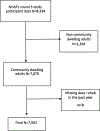
Medicare beneficiaries from NHATS (N = 7062).
Interventions:
Not applicable.
Main Outcomes Measures:
Rehabilitation utilization categorized into fall-related rehabilitation, other rehabilitation, or no rehabilitation.
Results:
Fall status (single fall: odds ratio OR = 2.96; 95% confidence interval CI, 1.52–5.77; recurrent falls: OR= 14.21; 95% CI, 7.45–27.10), fear of falling (OR = 3.11; 95% CI, 1.90–5.08), poor Short Physical Performance Battery scores (score 0: OR = 6.62; 95% CI, 3.31–13.24; score 1–4: OR = 4.65; 95% CI, 2.23–9.68), and hip fracture (OR = 3.24; 95% CI, 1.46–7.20) were all associated with receiving fall-related rehabilitation. Lower education level (less than high school diploma compared with 4-y college degree: OR =.21; 95% CI, .11–.40) and Hispanic ethnicity (OR = .37; 95% CI, .15–.87) were associated with not receiving fall-related rehabilitation.
Conclusions:
Hispanic older adults and older adults who are less educated are less likely to receive fall-related rehabilitation. Recurrent fallers followed by those who fell once in the past year were more likely to receive fall-related rehabilitation than are older adults who have not had a fall in the past year. -
Subjects:
-
Keywords:
-
Source:Arch Phys Med Rehabil. 99(8):1568-1575
-
Pubmed ID:29545001
-
Pubmed Central ID:PMC6668351
-
Document Type:
-
Funding:
-
Place as Subject:
-
Volume:99
-
Issue:8
-
Download URL:
-
File Type:
 [PDF - 456.95 KB]
 -
Collection(s):
-
Main Document Checksum:urn:sha256:45de2a4b4ab0362a60c327c9e89cdd91f29e39b4413283b8734a4fcae06d108d
Supporting Files


File Language:
English
 Was this page helpful?
 Found an issue?


CDC STACKS serves as an archival repository of CDC-published products including
scientific findings, journal articles, guidelines, recommendations, or other public health information authored or
co-authored by CDC or funded partners.
As a repository, CDC STACKS retains documents in their original published format to ensure public access to scientific information.
As a repository, CDC STACKS retains documents in their original published format to ensure public access to scientific information.
You May Also Like
COLLECTION
CDC Public Access