


i
A CLC-type F−/H+ antiporter in ion-swapped conformations
-
June 25 2018
Source: Nat Struct Mol Biol. 25(7):601-606
 [PDF-1.09 MB]
Details:
-
Alternative Title:Nat Struct Mol Biol
-
Personal Author:
-
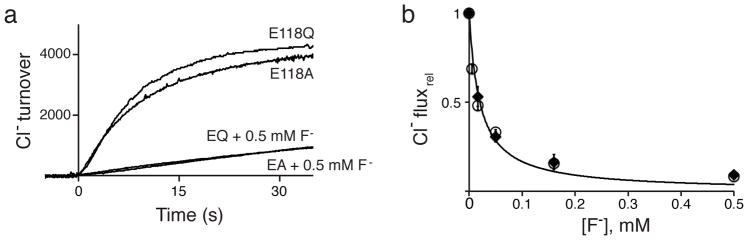
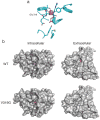
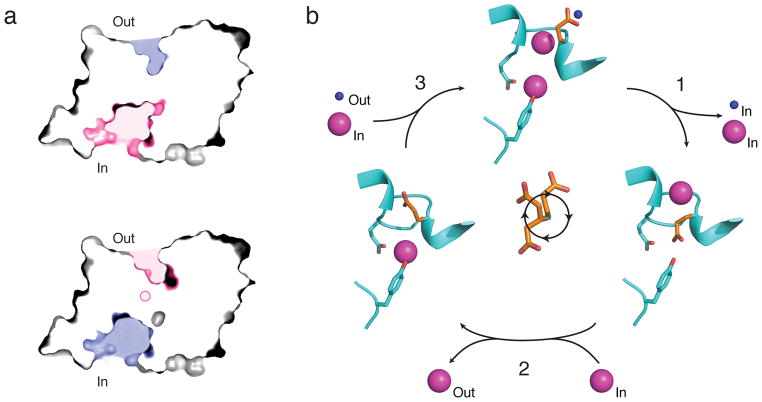
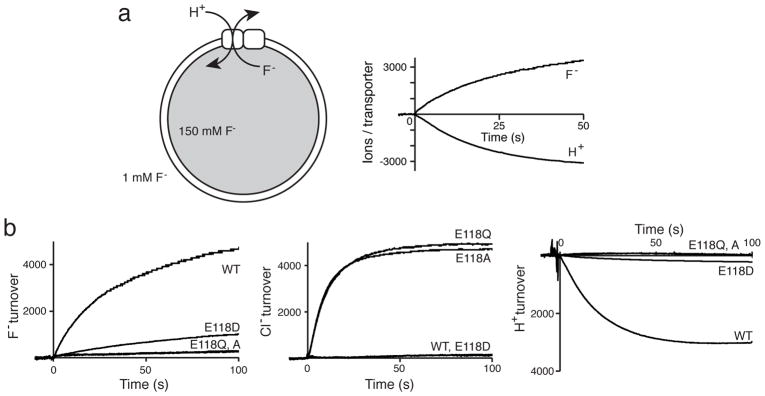
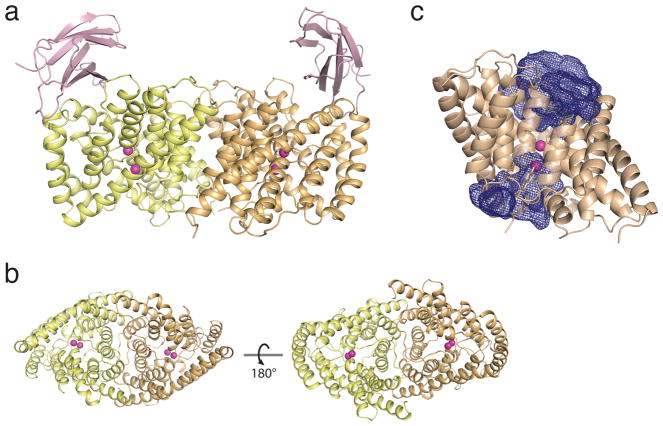
Description:Fluoride/proton antiporters of the CLC| family combat F| toxicity in bacteria by exporting this halide from the cytoplasm. These transporters belong to the widespread CLC superfamily but display transport properties different from those of the well-studied Cl|/H| antiporters. Here, we report a structural and functional investigation of these F|-transport proteins. Crystal structures of a CLC| homolog from Enterococcus casseliflavus are captured in two conformations with simultaneous accessibility of F| and H| ions via separate pathways on opposite sides of the membrane. Manipulation of a key glutamate residue critical for H| and F| transport reverses the anion selectivity of transport; replacement of the glutamate with glutamine or alanine completely inhibits F| and H| transport while allowing for rapid uncoupled flux of Cl|. The structural and functional results lead to a 'windmill' model of CLC antiport wherein F| and H| simultaneously move through separate ion-specific pathways that switch sidedness during the transport cycle.
-
Subjects:
-
Pubmed ID:29941917
-
Pubmed Central ID:PMC6044475
-
Document Type:
-
Funding:
-
Collection(s):
-
Main Document Checksum:
-
Download URL:
-
File Type:
Supporting Files
-

gif 
jpeg 
gif 
jpeg 
gif 
jpeg 
doc 
xml 
gif 
jpeg 
gif 
jpeg 
gif 
jpeg





More +


 Email
CDC-INFO
Email
CDC-INFO