



Effects of Inflammation on Biomarkers of Vitamin A Status among a Cohort of Bolivian Infants
Supporting Files

-
September 05 2018
File Language:
English
Details
-
Alternative Title:Nutrients
-
Personal Author:
-
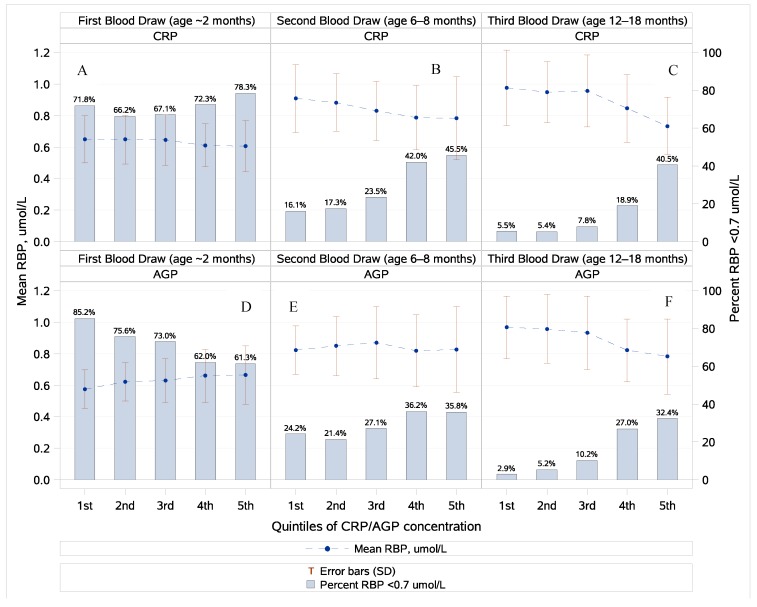
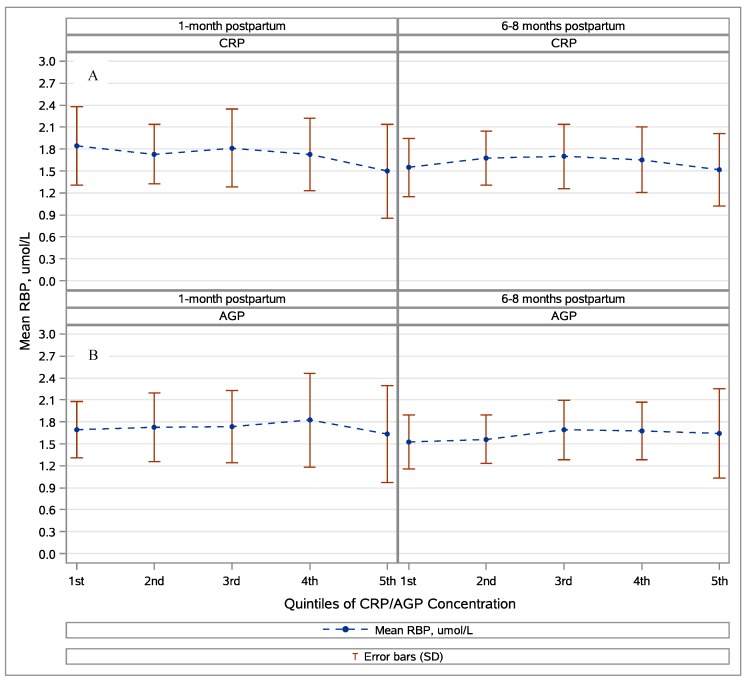
Description:Globally, vitamin A deficiency (VAD) affects nearly 200 million children with negative health consequences. VAD can be measured by a retinol-binding protein (RBP) and serum retinol concentrations. Their concentrations are not always present in a 1:1 molar ratio and are affected by inflammation. This study sought to quantify VAD and its impact on infant mortality and infectious morbidity during the first 18 months of life in a cohort of mother-infant dyads in El Alto, Bolivia, while accounting for the previously mentioned measurement issues. Healthy mother-infant dyads (| = 461) were enrolled from two hospitals and followed for 12 to 18 months. Three serum samples were collected (at one to two, six to eight, and 12 to 18 months of infant age) and analyzed for RBP, and a random 10% subsample was analyzed for retinol. Linear regression of RBP on retinol was used to generate RBP cut-offs equivalent to retinol <0.7 µmol/L. All measures of RBP and retinol were adjusted for inflammation, which was measured by a C-reactive protein and alpha (1)-acid glycoprotein serum concentrations using linear regression. Infant mortality and morbidity rates were calculated and compared by early VAD status at two months of age. Retinol and RBP were weakly affected by inflammation. This association varied with infant age. Estimated VAD (RBP < 0.7 µmol/L) decreased from 71.0% to 14.8% to 7.7% at two, six to eight, and 12 to 18 months of age. VAD was almost nonexistent in mothers. Early VAD was not significantly associated with infant mortality or morbidity rates. This study confirmed a relationship between inflammation and vitamin A biomarkers for some subsets of the population and suggested that the vitamin A status in early infancy improves with age and may not have significantly affected morbidity in this population of healthy infants.
-
Subjects:
-
Source:Nutrients. 2018; 10(9)
-
Pubmed ID:30189693
-
Pubmed Central ID:PMC6164950
-
Document Type:
-
Funding:Pediatric Center Seed Grant Program/Emory University/ ; K01 AI087724/AI/NIAID NIH HHS/United States ; International Collaborative Award for Research/International Pediatric Research Foundation/ ; U19 AI057266/AI/NIAID NIH HHS/United States ; T32AI074492/National Institutes of Health/ ; T32 AI074492/AI/NIAID NIH HHS/United States ; grant/Thrasher Research Fund/ ; HD052460-01/National Institutes of Health/ ; UL1 TR000454/TR/NCATS NIH HHS/United States ; Laney Graduate School Stipend/Emory University/ ; UL1 TR000454/National Institutes of Health/ ; UL1 TR002378/TR/NCATS NIH HHS/United States ; 1K01AI087724-01/National Institutes of Health/ ; PUP/Burroughs Wellcome Fund/ ; U19-AI057266/National Institutes of Health/ ; T32 HD052460/HD/NICHD NIH HHS/United States
-
Place as Subject:
-
Volume:10
-
Issue:9
-
Download URL:
-
File Type:
 [PDF - 1.06 MB]
 -
Collection(s):
-
Main Document Checksum:urn:sha256:95167d8a02bea9acce2930f62d33b46302b1da858bfccfb2e8345f3a7111b556
Supporting Files


File Language:
English
 Was this page helpful?
 Found an issue?

CDC STACKS serves as an archival repository of CDC-published products including
scientific findings, journal articles, guidelines, recommendations, or other public health information authored or
co-authored by CDC or funded partners.
As a repository, CDC STACKS retains documents in their original published format to ensure public access to scientific information.
As a repository, CDC STACKS retains documents in their original published format to ensure public access to scientific information.
You May Also Like
COLLECTION
CDC Public Access