



Factors associated with mosquito net use by individuals in households owning nets in Ethiopia
Supporting Files
Public Domain

-
Dec 13 2011
File Language:
English
Details
-
Alternative Title:Malar J
-
Personal Author:Graves, Patricia M ; Ngondi, Jeremiah M ; Hwang, Jimee ; Getachew, Asefaw ; Gebre, Teshome ; Mosher, Aryc W ; Patterson, Amy E ; Shargie, Estifanos B ; Tadesse, Zerihun ; Wolkon, Adam ; Reithinger, Richard ; Emerson, Paul M ; Richards, Frank O
-
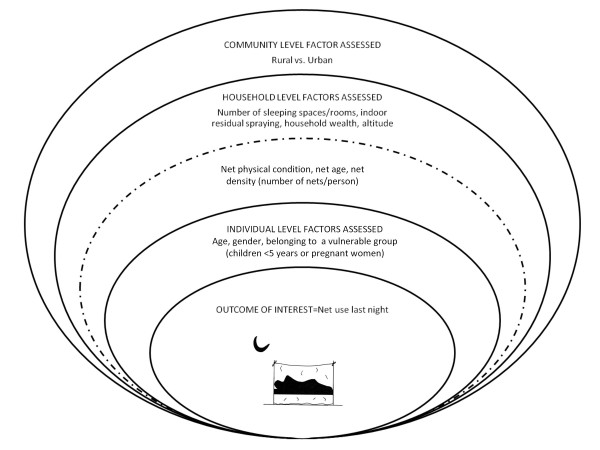
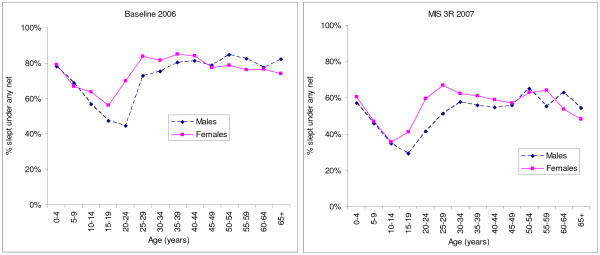
Description:Background ; Ownership of insecticidal mosquito nets has dramatically increased in Ethiopia since 2006, but the proportion of persons with access to such nets who use them has declined. It is important to understand individual level net use factors in the context of the home to modify programmes so as to maximize net use. ; Methods ; Generalized linear latent and mixed models (GLLAMM) were used to investigate net use using individual level data from people living in net-owning households from two surveys in Ethiopia: baseline 2006 included 12,678 individuals from 2,468 households and a sub-sample of the Malaria Indicator Survey (MIS) in 2007 included 14,663 individuals from 3,353 households. Individual factors (age, sex, pregnancy); net factors (condition, age, net density); household factors (number of rooms 2006 or sleeping spaces 2007, IRS, women's knowledge and school attendance 2007 only, wealth, altitude); and cluster level factors (rural or urban) were investigated in univariate and multi-variable models for each survey. ; Results ; In 2006, increased net use was associated with: age 25-49 years (adjusted (a) OR = 1.4, 95% confidence interval (CI) 1.2-1.7) compared to children U5; female gender (aOR = 1.4; 95% CI 1.2-1.5); fewer nets with holes (Ptrend = 0.002); and increasing net density (Ptrend < 0.001). Reduced net use was associated with: age 5-24 years (aOR = 0.2; 95% CI 0.2-0.3). In 2007, increased net use was associated with: female gender (aOR = 1.3; 95% CI 1.1-1.6); fewer nets with holes (aOR all nets in HH good = 1.6; 95% CI 1.2-2.1); increasing net density (Ptrend < 0.001); increased women's malaria knowledge (Ptrend < 0.001); and urban clusters (aOR = 2.5; 95% CI 1.5-4.1). Reduced net use was associated with: age 5-24 years (aOR = 0.3; 95% CI 0.2-0.4); number of sleeping spaces (aOR per additional space = 0.6, 95% CI 0.5-0.7); more old nets (aOR all nets in HH older than 12 months = 0.5; 95% CI 0.3-0.7); and increasing household altitude (Ptrend < 0.001). ; Conclusion ; In both surveys, net use was more likely by women, if nets had fewer holes and were at higher net per person density within households. School-age children and young adults were much less likely to use a net. Increasing availability of nets within households (i.e. increasing net density), and improving net condition while focusing on education and promotion of net use, especially in school-age children and young adults in rural areas, are crucial areas for intervention to ensure maximum net use and consequent reduction of malaria transmission.
-
Subjects:
-
Source:Malar J. 2011; 10:354.
-
Document Type:
-
Place as Subject:
-
Volume:10
-
Download URL:
-
File Type:
 [PDF - 856.08 KB]
 -
Collection(s):
-
Main Document Checksum:urn:sha256:3f3d58edcf4e323efe384a9839a06a7e134d6a05cec284a0a378753d8f5a3bc7
Supporting Files


File Language:
English
 Was this page helpful?
 Found an issue?

CDC STACKS serves as an archival repository of CDC-published products including
scientific findings, journal articles, guidelines, recommendations, or other public health information authored or
co-authored by CDC or funded partners.
As a repository, CDC STACKS retains documents in their original published format to ensure public access to scientific information.
As a repository, CDC STACKS retains documents in their original published format to ensure public access to scientific information.
You May Also Like
COLLECTION
CDC Public Access