


Infectious diseases acquired by international travelers visiting the United States
Supporting Files
Public Domain

-
8 01 2018
-
File Language:
English
Details
-
Alternative Title:J Travel Med
-
Personal Author:
-
Corporate Authors:
-
Description:Background:
Estimates of travel-related illness have focused predominantly on populations from highly developed countries visiting low- or middle-income countries, yet travel to and within high-income countries is very frequent. Despite being a top international tourist destination, few sources describe the spectrum of infectious diseases acquired among travelers to the United States.
Methods:
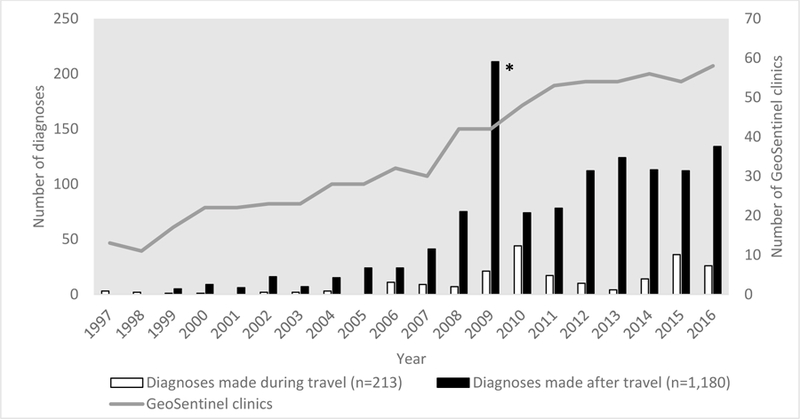
We performed a descriptive analysis summarizing demographic and travel characteristics, and clinical diagnoses among non-US-resident international travelers seen during or after travel to the United States at a GeoSentinel clinic from 1 January 1997 through 31 December 2016.
Results:
There were 1,222 ill non-US-resident travelers with 1,393 diagnoses recorded during the 20-year analysis period. Median age was 40 years (range 0–86 years); 52% were female. Patients visited from 63 countries and territories, most commonly Canada (31%), Germany (14%), France (9%), and Japan (7%). Travelers presented with a range of illnesses; skin and soft tissue infections of unspecified etiology were the most frequently reported during travel (29 diagnoses, 14% of during-travel diagnoses); arthropod bite/sting was the most frequently reported after travel (173 diagnoses, 15% after-travel diagnoses). Lyme disease was the most frequently reported arthropod-borne disease after travel (42, 4%). Nonspecific respiratory, gastrointestinal and systemic infections were also among the most frequently reported diagnoses overall. Low-frequency illnesses (<2% of cases) made up over half of diagnoses during travel and 41% of diagnoses after travel, including 13 cases of coccidioidomycosis and mosquito-borne infections like West Nile, dengue, and Zika virus diseases.
Conclusions:
International travelers to the United States acquired a diverse array of mostly cosmopolitan infectious diseases, including nonspecific respiratory, gastrointestinal, dermatologic, and systemic infections comparable to what has been reported among travelers to low- and middle-income countries. Clinicians should consider the specific health risks when preparing visitors to the United States and when evaluating and treating those who become ill.
-
Subjects:
-
Source:J Travel Med. 25(1)
-
Document Type:
-
Place as Subject:
-
Volume:25
-
Issue:1
-
Collection(s):
-
Main Document Checksum:urn:sha-512:ae7216f5243005029f3f7e61228d16bc2088362445b5fb88123bd6abb196af45b9e5e622b7602514cd35d9f3e14092532f35e53090cddb9b29c95ecd887064bb
-
Download URL:
-
File Type:
 [PDF
- 130.25 KB
]
[PDF
- 130.25 KB
]
Supporting Files


File Language:
English
ON THIS PAGE

CDC STACKS serves as an archival repository of CDC-published products including
scientific findings,
journal articles, guidelines, recommendations, or other public health information authored or
co-authored by CDC or funded partners.
As a repository, CDC STACKS retains documents in their original published format to ensure public access to scientific information.
As a repository, CDC STACKS retains documents in their original published format to ensure public access to scientific information.
You May Also Like
COLLECTION
CDC Public Access