



Walking as an Opportunity for Cardiovascular Disease Prevention
Supporting Files
Public Domain

-
May 30 2019
File Language:
English
Details
-
Journal Article:Preventing Chronic Disease (PCD)
-
Personal Author:
-
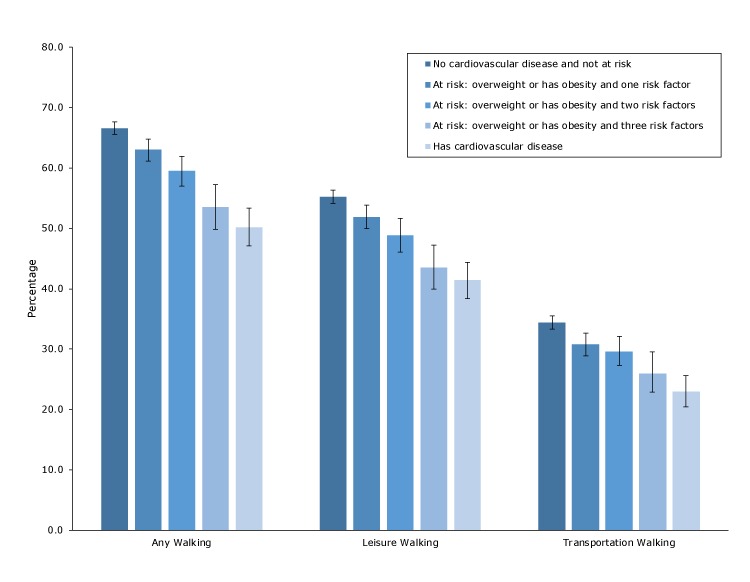
Description:Introduction ; Cardiovascular disease (CVD) is the leading cause of death in the United States, and increasing physical activity can help prevent and manage disease. Walking is an easy way for most adults to be more active and may help people at risk for CVD avoid inactivity, increase their physical activity levels, and improve their cardiovascular health. To guide efforts that promote walking for CVD prevention and management, we estimated the prevalence of walking among US adults by CVD risk status. ; Methods ; Nationally representative data on walking from participants (N = 29,742) in the 2015 National Health Interview Survey Cancer Control Supplement were analyzed. We estimated prevalence of walking (ie, any, transportation, and leisure) overall and by CVD status. We defined CVD status as either not having CVD and not at risk for CVD; being at risk for CVD (overweight or having obesity plus 1 or more additional risk factors); or having CVD. We defined additional risk factors as diabetes, high cholesterol, or hypertension. Odds ratios were estimated by using logistic regression models adjusted for respondent characteristics. ; Results ; Prevalence of any walking decreased with increasing CVD risk (no CVD/not at risk, 66.6%; at risk: overweight or has obesity with 1 risk factor, 63.0%; with 2 risk factors, 59.5%; with 3 risk factors, 53.6%; has CVD, 50.2%). After adjusting for respondent characteristics, the odds of any walking and leisure walking decreased with increasing CVD risk. However, CVD risk was not associated with walking for transportation. ; Conclusions ; Promoting walking may be a way to help adults avoid inactivity and encourage an active lifestyle for CVD prevention and management.
-
Subjects:
-
Source:Prev Chronic Dis. 16
-
DOI:
-
ISSN:1545-1151
-
Pubmed ID:31146804
-
Pubmed Central ID:PMC6549420
-
Document Type:
-
Volume:16
-
Download URL:
-
File Type:
 [PDF - 311.70 KB]
 -
Collection(s):
-
Main Document Checksum:urn:sha-512:295be8e0e426f1c66ca29f28f97cdb8d96e352af825012a38c26a8fe6b38536558ad58f3ee6dc8107c049e8ac9b6c94fd2a22f550b55be32ca5cbe68e99c38ad
Supporting Files


File Language:
English
 Was this page helpful?
 Found an issue?

CDC STACKS serves as an archival repository of CDC-published products including
scientific findings, journal articles, guidelines, recommendations, or other public health information authored or
co-authored by CDC or funded partners.
As a repository, CDC STACKS retains documents in their original published format to ensure public access to scientific information.
As a repository, CDC STACKS retains documents in their original published format to ensure public access to scientific information.
You May Also Like
COLLECTION
Preventing Chronic Disease