



Exposure to Secondhand Smoke and Secondhand E-Cigarette Aerosol Among Middle and High School Students
Supporting Files
Public Domain

-
April 04 2019
File Language:
English
Details
-
Journal Article:Preventing Chronic Disease (PCD)
-
Personal Author:
-
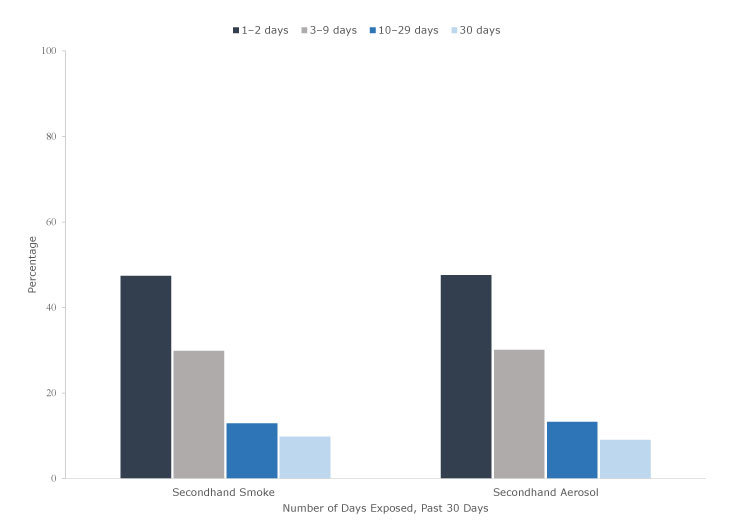
Description:Introduction ; Youth exposure to secondhand smoke (SHS) and secondhand aerosol from e-cigarettes (SHA) may contribute to the renormalization of tobacco product use behaviors. Our study assessed self-reported SHS or SHA exposures in indoor or outdoor public places among US students. ; Methods ; Data came from the 2015 and 2017 National Youth Tobacco Survey, a school-based survey of US students in grades 6 through 12. Past 30-day exposure to SHS and SHA in indoor and outdoor public places was assessed. The prevalence of exposure was assessed overall and by covariates for each year. We used adjusted prevalence ratios (aPRs) to assess determinants of exposure. ; Results ; We observed no significant change from 2015 through 2017 in exposure to SHS (52.6% to 50.5%), SHA (25.2% to 25.6%), or either SHS or SHA (56.7% to 55.1%). Following multivariable adjustment, in 2017, exposure to either SHS or SHA in public was higher among female students versus male students (aPR = 1.29), high school students versus middle school students (aPR = 1.15), current e-cigarette users versus nonusers (aPR = 2.89), and current users of other tobacco product versus nonusers (aPR = 1.21). Exposure was higher for students who reported that a household member used tobacco products. ; Conclusion ; In 2017, more than half (55.1%, 14.3 million) of US middle and high school students reported exposure to secondhand tobacco product emissions in indoor or outdoor public places. E-cigarette use may complicate the enforcement of existing smoke-free policies and contribute to the renormalization of tobacco use behaviors. Continued efforts are warranted to reduce the social acceptability of tobacco product use and protect bystanders from all tobacco product emissions.
-
Subjects:
-
Source:Prev Chronic Dis. 16
-
DOI:
-
ISSN:1545-1151
-
Pubmed ID:30950787
-
Pubmed Central ID:PMC6464049
-
Document Type:
-
Volume:16
-
Download URL:
-
File Type:
 [PDF - 434.57 KB]
 -
Collection(s):
-
Main Document Checksum:urn:sha-512:6a8296433662022c392621c4233514a542c7b9d1ac6b4369a006ba9b2bc57b1b62a32a57aa0f08871accb7dc8647113b189c15b90a1e85edb36257480be6bfe4
Supporting Files


File Language:
English
 Was this page helpful?
 Found an issue?

CDC STACKS serves as an archival repository of CDC-published products including
scientific findings, journal articles, guidelines, recommendations, or other public health information authored or
co-authored by CDC or funded partners.
As a repository, CDC STACKS retains documents in their original published format to ensure public access to scientific information.
As a repository, CDC STACKS retains documents in their original published format to ensure public access to scientific information.
You May Also Like
COLLECTION
Preventing Chronic Disease