


i
Mucosal Barrier Injury Laboratory-Confirmed Bloodstream Infections (MBI-LCBI): Descriptive Analysis of Data Reported to National Healthcare Safety Network (NHSN), 2013
-
October 12 2015
Source: Infect Control Hosp Epidemiol. 37(1):2-7 -
Alternative Title:Infect Control Hosp Epidemiol
-
Personal Author:
-
Description:OBJECTIVES.
To determine the impact of mucosal barrier injury laboratory-confirmed bloodstream infections (MBI-LCBIs) on central-line–associated bloodstream infection (CLABSI) rates during the first year of MBI-LCBI reporting to the National Healthcare Safety Network (NHSN)
DESIGN.
Descriptive analysis of 2013 NHSN data
SETTING.
Selected inpatient locations in acute care hospitals
METHODS.
A descriptive analysis of MBI-LCBI cases was performed. CLABSI rates per 1,000 central-line days were calculated with and without the inclusion of MBI-LCBIs in the subset of locations reporting ≥1 MBI-LCBI, and in all locations (regardless of MBI-LCBI reporting) to determine rate differences overall and by location type.
RESULTS.
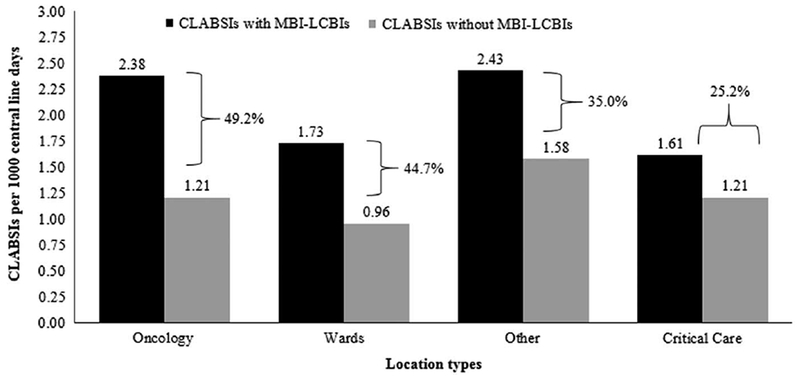
From 418 locations in 252 acute care hospitals reporting ≥1 MBI-LCBIs, 3,162 CLABSIs were reported; 1,415 (44.7%) met the MBI-LCBI definition. Among these locations, removing MBI-LCBI from the CLABSI rate determination produced the greatest CLABSI rate decreases in oncology (49%) and ward locations (45%). Among all locations reporting CLABSI data, including those reporting no MBI-LCBIs, removing MBI-LCBI reduced rates by 8%. Here, the greatest decrease was in oncology locations (38% decrease); decreases in other locations ranged from 1.2% to 4.2%.
CONCLUSIONS.
An understanding of the potential impact of removing MBI-LCBIs from CLABSI data is needed to accurately interpret CLABSI trends over time and to inform changes to state and federal reporting programs. Whereas the MBI-LCBI definition may have a large impact on CLABSI rates in locations where patients with certain clinical conditions are cared for, the impact of MBI-LCBIs on overall CLABSI rates across inpatient locations appears to be more modest.
-
Subjects:
-
Pubmed ID:26456954
-
Pubmed Central ID:PMC6557152
-
Document Type:
-
Place as Subject:
-
Collection(s):
-
Main Document Checksum:
-
Download URL:
-
File Type:
 [PDF-133.54 KB]
Details:
Supporting Files



More +


 Email
CDC-INFO
Email
CDC-INFO