



Polybrominated Diphenyl Ethers and Biphenyl in Serum: Time Trend Study from the National Health and Nutrition Examination Survey for Years 2005/06 through 2013/14
Supporting Files

-
April 30 2019
-
File Language:
English
Details
-
Journal Article:Environ Sci Technol
-
Personal Author:
-
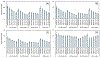
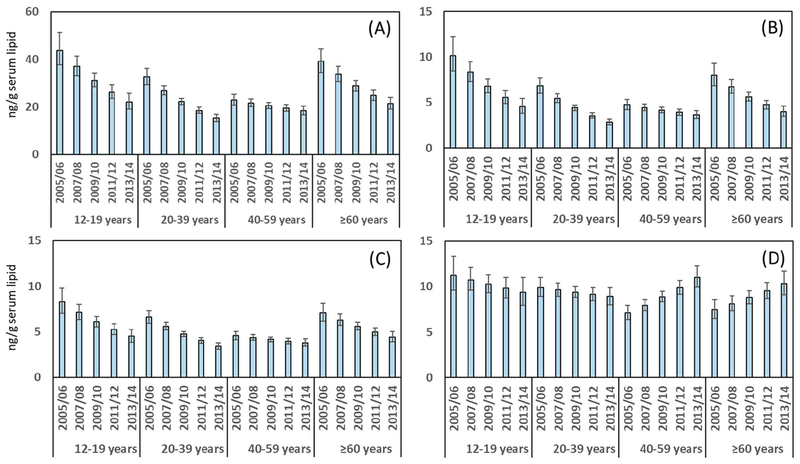
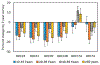
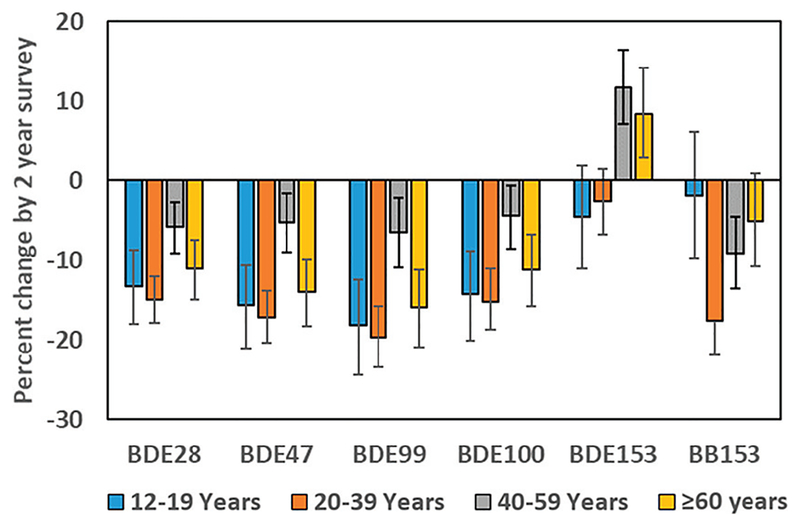
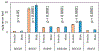
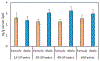
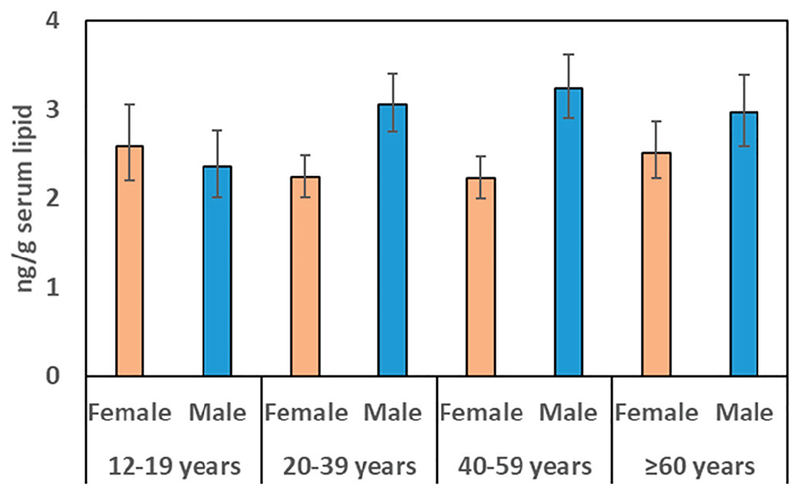
Description:Eleven polybrominated diphenyl ether (tri- to deca-BDE) congeners and 2,2',4,4',5,5'-hexabromobiphenyl (BB153) have been measured in pooled serum samples from the National Health and Nutrition Examination Survey (NHANES) for one decade (from survey years 2005/06 through 2013/14). The pools, which are representative of the general noninstitutionalized population of the United States, encompassed thirty-two demographic groups defined by sex, race/ethnicity (Mexican American, non-Hispanic black, non-Hispanic white, and all other race/ethnicities), and age (12-19, >20-39, >40-59, and ≥60 years). The adjusted geometric means were determined in a multiple linear regression model for the six congeners (BDE28, BDE47, BDE99, BDE100, BDE153, and BB153) with detectable concentrations in at least 60% of pools in each of the thirty-two demographic groups; the level of significance for all statistical comparisons thereof were determined. BDE154 and BDE209 were detected in 60% of the NHANES 2011/12 and 2013/14 pools; only these two survey periods were evaluated for these congeners. The percent change in concentration by a 2-year survey period was calculated. All examined PBDEs reported in five survey periods decreased in concentration, except BDE153, for which concentrations increased by 12.0% (95% CI 7.1-16.4) and 8.4% (95% CI 2.9-14.1) for the age groups 40-59 and ≥60 years, respectively; no significant change was observed in younger age groups. Excluding BDE153, we observed larger percentage decreases by a 2-year survey period for the age groups 12-19, 20-39, and ≥60 years compared with the age group 40-59 years. The percentage decrease by a two-year survey period ranged between -19.6% (BDE99, 20-39 years old) and -4.5% (BDE100, 40-59 years old). Although five polybrominated diphenyl ether (PDBE) congeners and BB153 are still frequently detected in the U.S. general population, PBDE concentrations have decreased since 2005-2006, likely, because of changes in manufacturing practices that started in the mid-2000s.
-
Subjects:
-
Source:Environ Sci Technol. 53(10):6018-6024
-
DOI:
-
Pubmed ID:31002243
-
Pubmed Central ID:PMC6556778
-
Document Type:
-
Funding:
-
Genre:
-
Volume:53
-
Issue:10
-
Collection(s):
-
Main Document Checksum:urn:sha-512:18d4bf61cd30216f0770a02272d97c716b3a77f8c096e0ccff2075355d8752b3813fb0fda9612e9cf1cc12fbaeb797eb17f6ef735652f24e1d5987ce046641e9
-
Download URL:
-
File Type:
 [PDF
- 1.06 MB
]
[PDF
- 1.06 MB
]
Supporting Files


File Language:
English
 Was this page helpful?
 Found an issue?


CDC STACKS serves as an archival repository of CDC-published products including
scientific findings,
journal articles, guidelines, recommendations, or other public health information authored or
co-authored by CDC or funded partners.
As a repository, CDC STACKS retains documents in their original published format to ensure public access to scientific information.
As a repository, CDC STACKS retains documents in their original published format to ensure public access to scientific information.
You May Also Like
COLLECTION
CDC Public Access