



Multiple introductions and subsequent transmission of multidrug-resistant Candida auris in the USA: a molecular epidemiological survey
Supporting Files

-
December 2018
-
File Language:
English
Details
-
Alternative Title:Lancet Infect Dis
-
Personal Author:
-
Description:Background
Transmission of multidrug-resistant Candida auris infection has been reported in the USA. To better understand its emergence and transmission dynamics and to guide clinical and public health responses, we did a molecular epidemiological investigation of C auris cases in the USA.
Methods
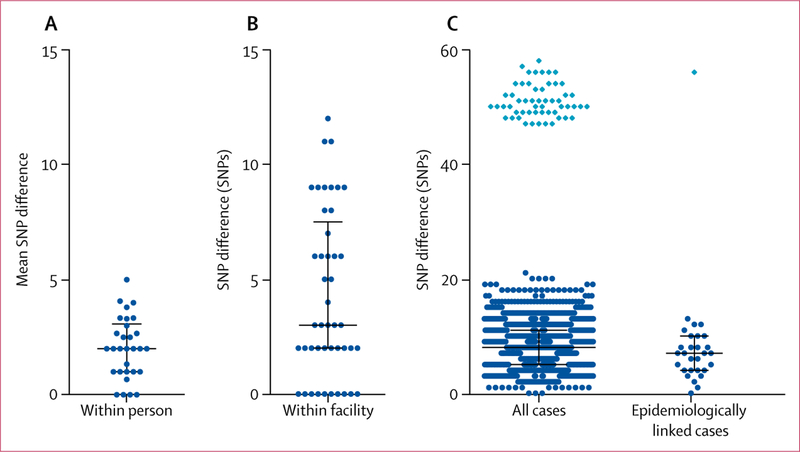
In this molecular epidemiological survey, we used whole-genome sequencing to assess the genetic similarity between isolates collected from patients in ten US states (California, Connecticut, Florida, Illinois, Indiana, Maryland, Massachusetts, New Jersey, New York, and Oklahoma) and those identified in several other countries (Colombia, India, Japan, Pakistan, South Africa, South Korea, and Venezuela). We worked with state health departments, who provided us with isolates for sequencing. These isolates of C auris were collected during the normal course of clinical care (clinical cases) or as part of contact investigations or point prevalence surveys (screening cases). We integrated data from standardised case report forms and contact investigations, including travel history and epidemiological links (ie, patients that had shared a room or ward with a patient with C auris). Genetic diversity of C auris within a patient, a facility, and a state were evaluated by pairwise differences in single-nucleotide polymorphisms (SNPs).
Findings
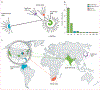
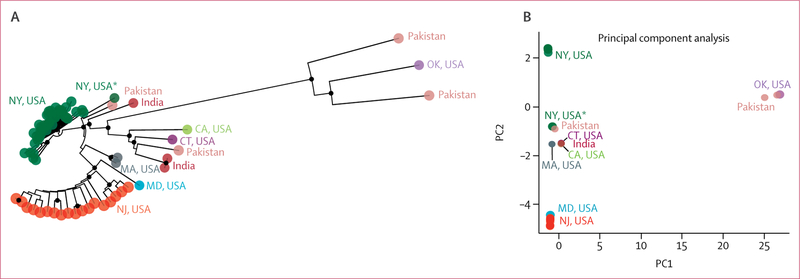
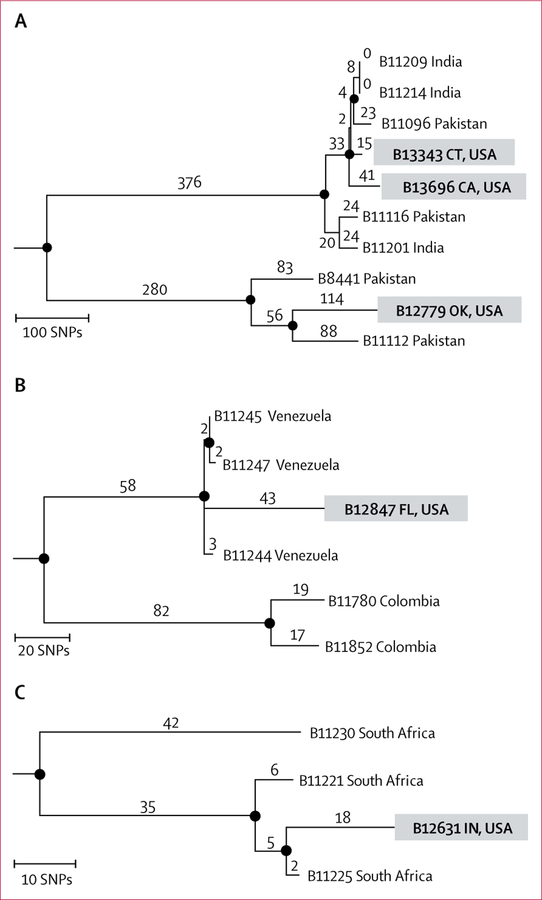
From May 11, 2013, to Aug 31, 2017, isolates that corresponded to 133 cases (73 clinical cases and 60 screening cases) were collected. Of 73 clinical cases, 66 (90%) cases involved isolates related to south Asian isolates, five (7%) cases were related to South American isolates, one (1%) case to African isolates, and one (1%) case to east Asian isolates. Most (60 [82%]) clinical cases were identified in New York and New Jersey; these isolates, although related to south Asian isolates, were genetically distinct. Genomic data corroborated five (7%) clinical cases in which patients probably acquired C auris through health-care exposures abroad. Among clinical and screening cases, the genetic diversity of C auris isolates within a person was similar to that within a facility during an outbreak (median SNP difference three SNPs, range 0–12).
Interpretation
Isolates of C auris in the USA were genetically related to those from four global regions, suggesting that C auris was introduced into the USA several times. The five travel-related cases are examples of how introductions can occur. Genetic diversity among isolates from the same patients, health-care facilities, and states indicates that there is local and ongoing transmission.
-
Subjects:
-
Source:Lancet Infect Dis. 18(12):1377-1384
-
Pubmed ID:30293877
-
Pubmed Central ID:PMC6556114
-
Document Type:
-
Funding:
-
Volume:18
-
Issue:12
-
Collection(s):
-
Main Document Checksum:urn:sha256:7d1543857a23d7f15b1d481cde6de2cb62cc11ad37e34b6f3bd868388aa76e33
-
Download URL:
-
File Type:
 [PDF
- 852.63 KB
]
[PDF
- 852.63 KB
]
Supporting Files


File Language:
English
 Was this page helpful?
 Found an issue?


CDC STACKS serves as an archival repository of CDC-published products including
scientific findings,
journal articles, guidelines, recommendations, or other public health information authored or
co-authored by CDC or funded partners.
As a repository, CDC STACKS retains documents in their original published format to ensure public access to scientific information.
As a repository, CDC STACKS retains documents in their original published format to ensure public access to scientific information.
You May Also Like
COLLECTION
CDC Public Access