



Condom Availability Programs in Schools: a Review of the Literature
Supporting Files

-
3 2019
-
Available in CDC Stacks on March 01, 2020, 12:00 AM
File Language:
English
Details
-
Journal Article:Am J Health Promot
-
Personal Author:
-
Description:Objective:
This review synthesizes findings from the peer-reviewed evaluation literature on condom availability programs (CAPs) in secondary schools.
Data Source:
Peer reviewed evaluation literature indexed in MEDLINE, EMBASE, PsychINFO, ERIC, CINAHL, Sociological Abstracts, SCOPUS, and POPLINE.
Study Inclusion and Exclusion Criteria:
Manuscripts had to be peer-reviewed, written in English, and report evaluation data from a U.S., school-based CAP.
Data Extraction:
Articles were coded independently by two authors. Discrepancies were resolved through open discussion.
Data Synthesis:
We grouped findings into outcome evaluation and process evaluation findings. Outcome evaluation findings included STIs, pregnancy rates, condom use, contraception use, sexual risk, and substance use. Process evaluation findings included awareness of CAPs, attitudes towards CAPs, attitudes towards condoms, and receipt of education and instruction.
Results:
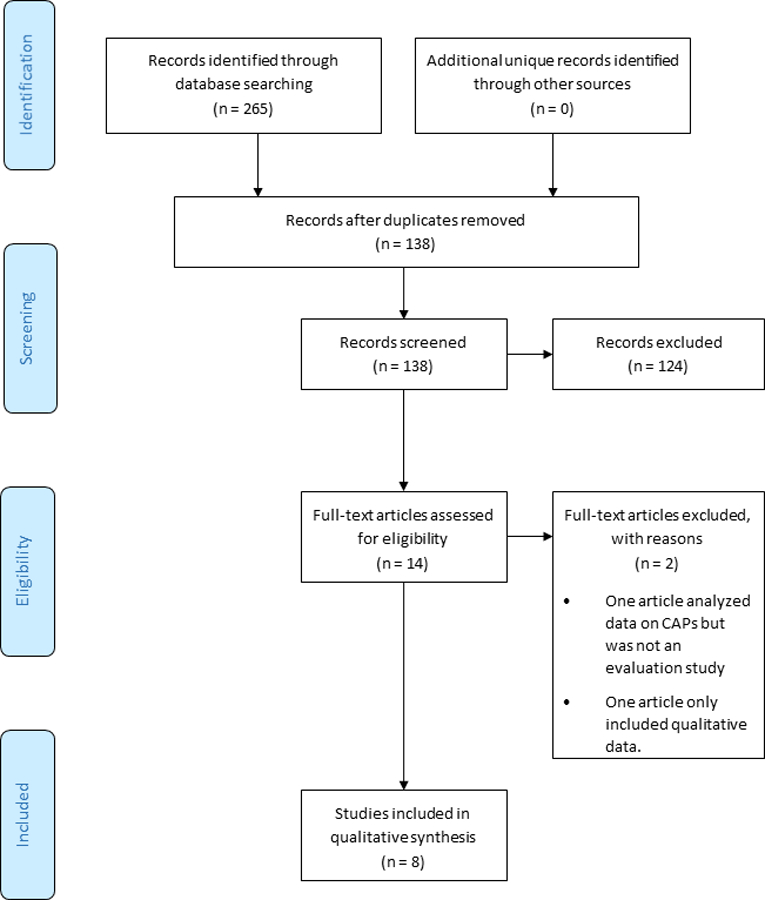
Of the 138 citations reviewed, twelve articles published between 1995 and 2012 met the inclusion criteria, representing 8 programs. Evaluations indicate CAPs yield condom acquisition rates between 23% and 48%, have mixed results related to condom use, and are not associated with increases in sexual and other risk behaviors. One program found CAPs were associated with a decrease in a combined rate of chlamydia and gonorrhea. One program found no association between CAPs and unintended pregnancy. Students’ attitudes toward CAPs were favorable and awareness was high.
Conclusions:
CAPS are accepted by students and can be an appropriate and relevant school-based intervention for teens. CAPs can increase condom use, but more evaluations are needed on CAPs impact on rates of HIV, STIs, and unintended pregnancy. -
Keywords:
-
Source:Am J Health Promot. 33(3):457-467
-
DOI:
-
Pubmed ID:30068218
-
Pubmed Central ID:PMC6540114
-
Document Type:
-
Funding:
-
Genre:
-
Volume:33
-
Issue:3
-
Download URL:
-
File Type:
 [PDF - 413.91 KB]
 -
Collection(s):
-
Main Document Checksum:urn:sha-512:cd2117e4d07c6d157117a4981e3762d3c75755218d3bb92a1c370dad9e73bf828dc6194154db78277a0e1cd3e37b56f64403a5522fcf29314884ba65a10a7e13
Supporting Files


File Language:
English
 Was this page helpful?
 Found an issue?

CDC STACKS serves as an archival repository of CDC-published products including
scientific findings, journal articles, guidelines, recommendations, or other public health information authored or
co-authored by CDC or funded partners.
As a repository, CDC STACKS retains documents in their original published format to ensure public access to scientific information.
As a repository, CDC STACKS retains documents in their original published format to ensure public access to scientific information.
You May Also Like
COLLECTION
CDC Public Access