



Mosquitoes of Western Uganda
Supporting Files
Public Domain

-
Nov 2012
-
Available in CDC Stacks on May 26, 2019, 12:00 AM
File Language:
English
Details
-
Journal Article:J Med Entomol
-
Personal Author:
-
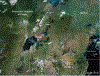
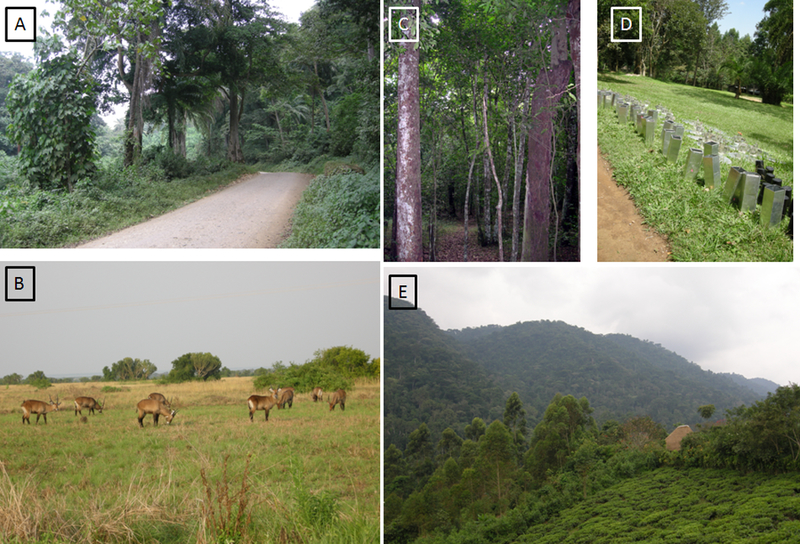
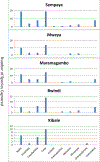
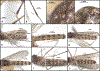
Description:The mosquito fauna in many areas of western Uganda has never been studied and is currently unknown. One area, Bwamba County, has been previously studied and documented but the species lists have not been updated for >40 yr. This paucity of data makes it difficult to determine which arthropod-borne viruses pose a risk to human or animal populations. Using CO2 baited-light traps, from 2008 through 2010, 67,731 mosquitoes were captured at five locations in western Uganda including Mweya, Sempaya, Maramagambo, Bwindi (BINP), and Kibale (KNP). Overall, 88 mosquito species, 7 subspecies, and 7 species groups in 10 genera were collected. The largest number of species was collected at Sempaya (65 species), followed by Maramagambo (45), Mweya (34), BINP (33), and KNP (22). However, species diversity was highest in BINP (Simpson's Diversity Index 1-D = 0.85), followed by KNP (0.80), Maramagambo (0.79), Sempaya (0.67), and Mweya (0.56). Only six species Aedes (Aedimorphus) cumminsii (Theobald), Aedes (Neomelaniconion) circumluteolus (Theobald), Culex (Culex) antennatus (Becker), Culex (Culex) decens group, Culex (Lutzia) tigripes De Grandpre and De Charmoy, and Culex (Oculeomyia) annulioris (Theobald), were collected from all five sites suggesting large differences in species composition among sites. Four species (Aedes (Stegomyia) metallicus (Edwards), Anopheles (Cellia) rivulorum Leeson, Uranotaenia (Uranotaenia) chorleyi (Edwards), and Uranotaenia (Uranotaenia) pallidocephala (Theobald) and one subspecies (Aedes (Stegomyia) aegypti formosus (Walker)) were collected in Bwamba County for the first time. This study represents the first description of the mosquito species composition of Mweya, Maramagambo, BINP, and KNP. A number of morphological variations were noted regarding the postspiracular scales, hind tibia, and sternites that make Culex (Culex) neavei (Theobald) challenging to identify. At least 50 species collected in this study have previously been implicated in the transmission of arboviruses of public health importance suggesting a high potential for maintenance and transmission of a wide variety of arboviruses in western Uganda.
-
Subjects:
-
Source:J Med Entomol. 49(6):1289-1306
-
DOI:
-
Document Type:
-
Genre:
-
Volume:49
-
Issue:6
-
Download URL:
-
File Type:
 [PDF - 1.12 MB]
 -
Collection(s):
-
Main Document Checksum:urn:sha-512:1a693614e82597f0b48d4b8b5e69fd57a483af9b30e01cb6a95813e6338d7839e1883914725b637233480205824671f33d39e9174dfb4b54d8ab43ae08ee1460
Supporting Files


File Language:
English
 Was this page helpful?
 Found an issue?





CDC STACKS serves as an archival repository of CDC-published products including
scientific findings, journal articles, guidelines, recommendations, or other public health information authored or
co-authored by CDC or funded partners.
As a repository, CDC STACKS retains documents in their original published format to ensure public access to scientific information.
As a repository, CDC STACKS retains documents in their original published format to ensure public access to scientific information.
You May Also Like
COLLECTION
CDC Public Access