


Prenatal exposure to the herbicide 2,4-D is associated with deficits in auditory processing during infancy
Supporting Files

-
5 2019
-
File Language:
English
Details
-
Alternative Title:Environ Res
-
Personal Author:
-
Description:Introduction
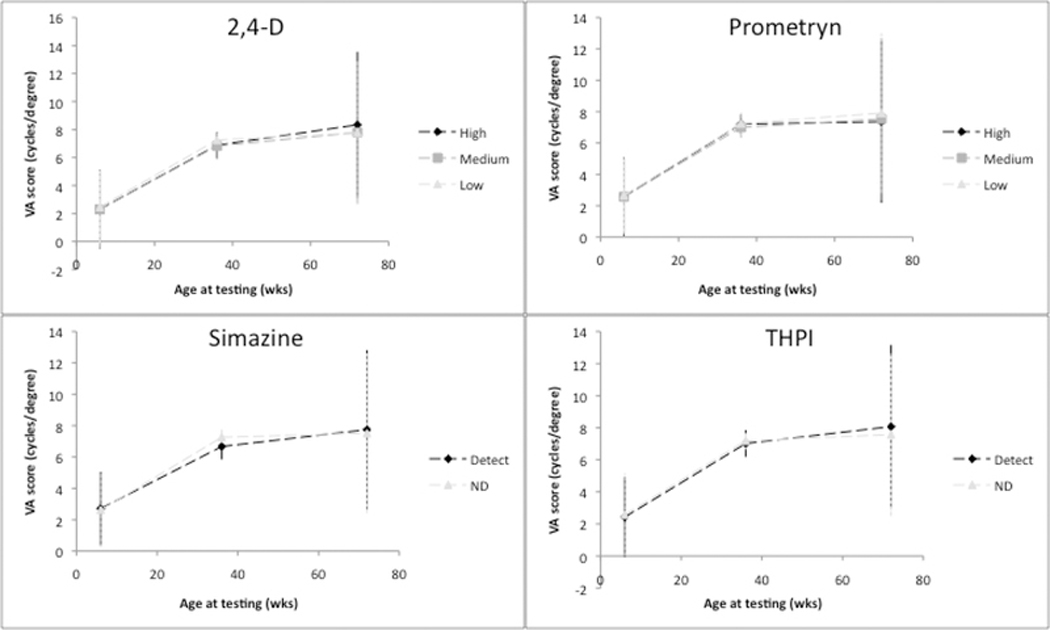
Despite widespread use, many herbicides and fungicides are not well studied for neurological effects. Fetal and infant brains are rapidly developing, yet the effects of early-life exposure to these classes of pesticides on visual and auditory function are unknown. Here we examined the effects of prenatal herbicide and fungicide exposure on infant grating visual acuity (VA) and auditory brainstem response (ABR).
Methods
9 herbicides and 13 fungicides were measured in umbilical cord blood plasma from a cohort of infants in Fuyang County, China (n=232). Grating VA and ABR latencies for waves I, III, V were measured at 3 time points: 6 weeks, 9 months, and 18 months. Outcomes included VA score, ABR wave V latency and ABR central conduction time (CCT [wave V- wave I]). Pesticides were analyzed as 3- level ordinal (non-detect [ND]/medium/high), or dichotomous (ND/detect), depending on detection rates. Linear mixed models were used to evaluate relations between pesticides and VA and ABR outcomes.
Results
2,4-dichloroacetic acid (2,4-D), prometryn, simazine, and tetrahydrophthalamide (THPI, a metabolite of captan) were detected in 27, 81, 17, and 16% of samples, respectively. Infants prenatally exposed to 2,4-D had slower auditory response times at 6 weeks. Infants with cord levels of 2,4-D >1.17 ng/mL had wave V latencies that were 0.12 (95% CI: 0.03, 0.22) ms slower (p=0.01) and overall CCTs that were 0.15 (95% CI: 0.05, 0.25) ms slower (p=0.003) than infants with non-detectable 2,4-D in their cord blood. No other statistically significant findings were observed for the other herbicides and fungicides or for the grating VA outcome.
Conclusions
Prenatal exposure to the herbicide 2,4-D was associated with slower auditory signal transmission in early infancy. ABR latencies reflect auditory pathway maturation and longer latencies may indicate delayed auditory development.
-
Subjects:
-
Keywords:
-
Source:Environ Res. 172:486-494
-
Pubmed ID:30851698
-
Pubmed Central ID:PMC6511332
-
Document Type:
-
Funding:
-
Volume:172
-
Collection(s):
-
Main Document Checksum:urn:sha-512:792179bb69f70c82af713018cdbca158678e4cd2f0ac389d31c8e15e9c035e81c49ad3871a3899b62e87e180c33c85049f966f1267e94524704c6f4018fabec5
-
Download URL:
-
File Type:
 [PDF
- 551.20 KB
]
[PDF
- 551.20 KB
]
Supporting Files


File Language:
English
ON THIS PAGE



CDC STACKS serves as an archival repository of CDC-published products including
scientific findings,
journal articles, guidelines, recommendations, or other public health information authored or
co-authored by CDC or funded partners.
As a repository, CDC STACKS retains documents in their original published format to ensure public access to scientific information.
As a repository, CDC STACKS retains documents in their original published format to ensure public access to scientific information.
You May Also Like
COLLECTION
CDC Public Access