


Think twice: A cognitive perspective of an antibiotic timeout intervention to improve antibiotic use
Supporting Files

-
June 18 2016
-
File Language:
English
Details
-
Journal Article:J Biomed Inform
-
Personal Author:
-
Description:Objectives:
To understand clinicians’ impressions of and decision-making processes regarding an informatics-supported antibiotic timeout program to re-evaluate the appropriateness of continuing vancomycin and piperacillin/tazobactam.
Methods:
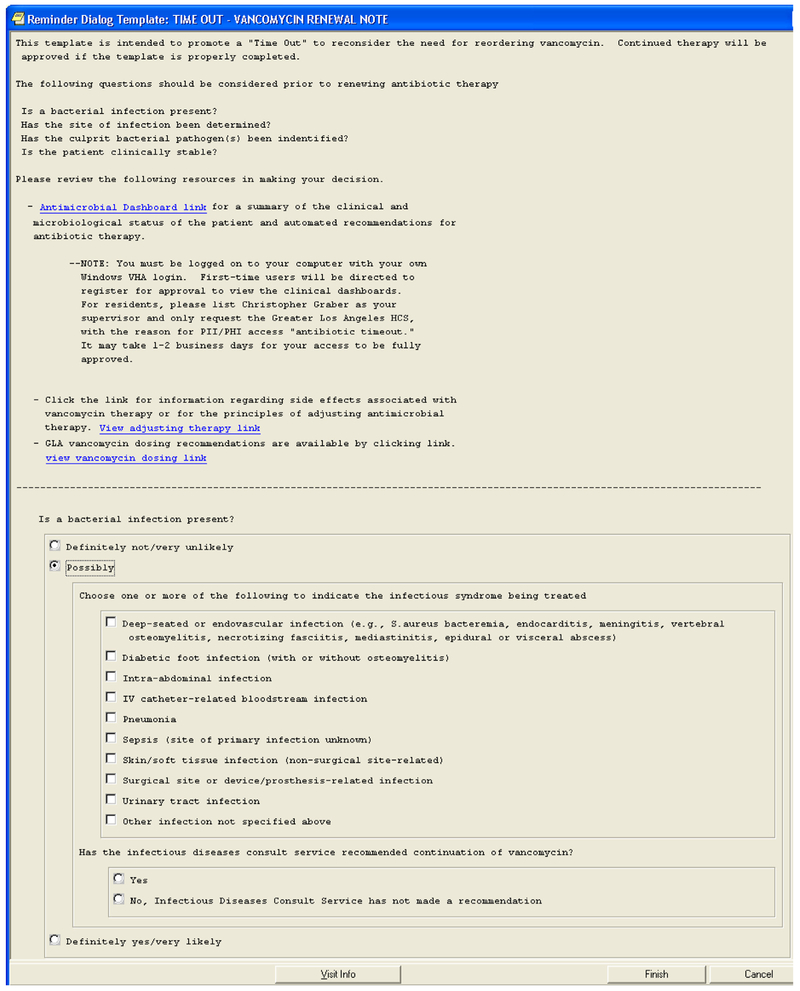
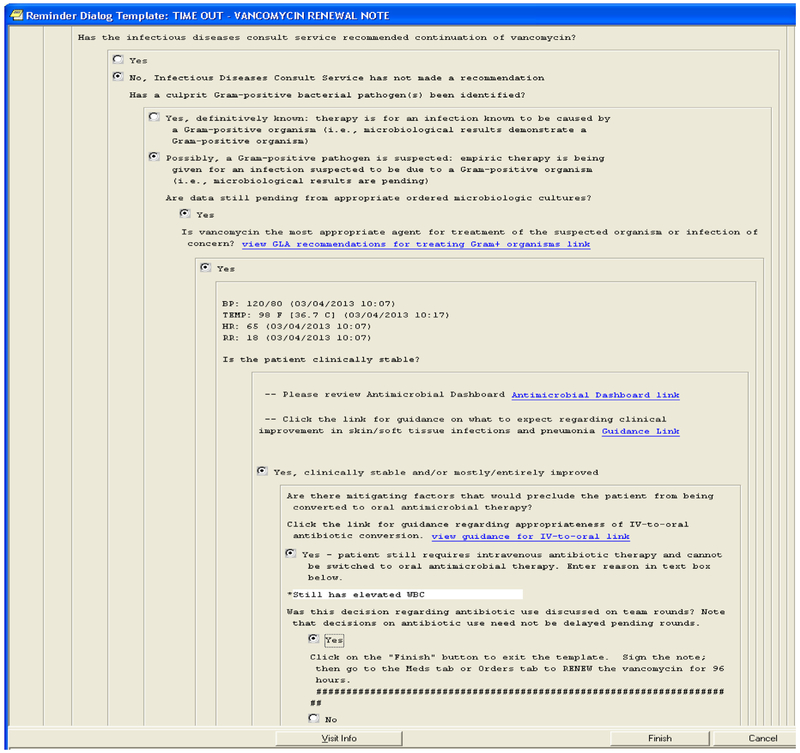
We implemented a multi-pronged informatics intervention, based on Dual Process Theory, to prompt discontinuation of unwarranted vancomycin and piperacillin/tazobactam on or after day three in a large Veterans Affairs Medical Center. Two workflow changes were introduced to facilitate cognitive deliberation about continuing antibiotics at day three: (1) teams completed an electronic template note, and (2) a paper summary of clinical and antibiotic-related information was provided to clinical teams. Shortly after starting the intervention, six focus groups were conducted with users or potential users. Interviews were recorded and transcribed. Iterative thematic analysis identified recurrent themes from feedback.
Results:
Themes that emerged are represented by the following quotations: (1) captures and controls attention (“it reminds us to think about it”), (2) enhances informed and deliberative reasoning (“it makes you think twice”), (3) redirects decision direction (“…because [there was no indication] I just [discontinued] it without even trying”), (4) fosters autonomy and improves team empowerment (“the template…forces the team to really discuss it”), and (5) limits use of emotion-based heuristics (“my clinical concern is high enough I think they need more aggressive therapy…”).
Conclusions:
Requiring template completion to continue antibiotics nudged clinicians to re-assess the appropriateness of specified antibiotics. Antibiotic timeouts can encourage deliberation on overprescribed antibiotics without substantially curtailing autonomy. An effective nudge should take into account clinician’s time, workflow, and thought processes.
-
Subjects:
-
Source:J Biomed Inform. 71 Suppl:S22-S31
-
DOI:
-
Pubmed ID:27327529
-
Pubmed Central ID:PMC6505694
-
Document Type:
-
Funding:
-
Genre:
-
Collection(s):
-
Main Document Checksum:urn:sha-512:f612f9ac149ff64b49e41fec3fe62f2a401485ebcb77ef084108bf37259604f3c49cf79df58d777d3c94c1ee2e3809f3b48bd52bc3b86e5a50dc2b9d68f76645
-
Download URL:
-
File Type:
 [PDF
- 939.65 KB
]
[PDF
- 939.65 KB
]
Supporting Files


File Language:
English
ON THIS PAGE

CDC STACKS serves as an archival repository of CDC-published products including
scientific findings,
journal articles, guidelines, recommendations, or other public health information authored or
co-authored by CDC or funded partners.
As a repository, CDC STACKS retains documents in their original published format to ensure public access to scientific information.
As a repository, CDC STACKS retains documents in their original published format to ensure public access to scientific information.
You May Also Like
COLLECTION
CDC Public Access