


Immunogenicity and safety of a mixed vaccination schedule with one dose of nonavalent and one dose of bivalent HPV vaccine versus two doses of nonavalent vaccine – a randomized clinical trial
Supporting Files

-
October 09 2018
-
File Language:
English
Details
-
Alternative Title:Vaccine
-
Personal Author:
-
Description:Background
Limited data is available on the use of different HPV vaccines in the same subjects. We evaluated the immunogenicity and safety of a mixed vaccination schedule with one dose of nonavalent (9vHPV) and one dose of bivalent vaccine (2vHPV) administered in different order versus two doses of 9vHPV vaccine.
Methods
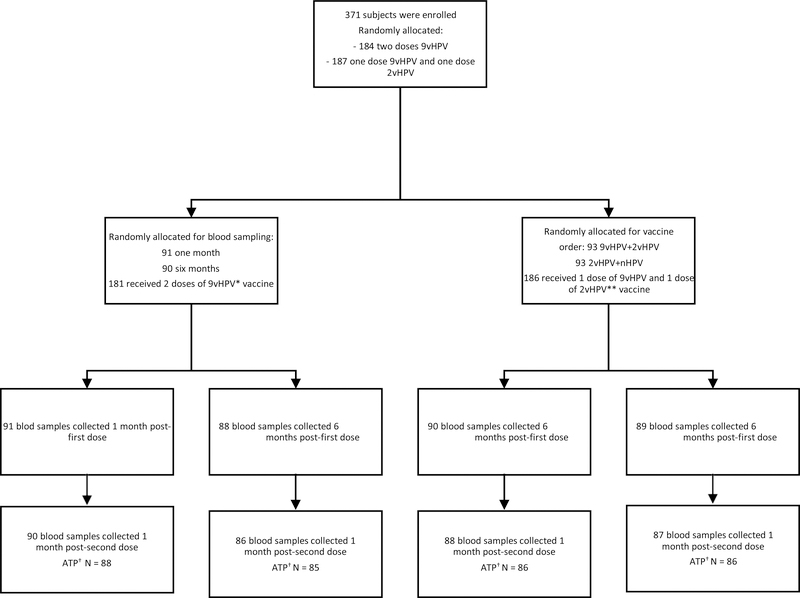
371 girls and boys aged 9–10 years were randomized (1:1) to receive (I) two doses of 9vHPV or (II) a mixed schedule of 2vHPV+9vHPV or 9vHPV+2vHPV with a 6 month interval. Antibodies to HPV were tested by ELISA in blood samples collected one or six months post-first dose and one month post-second dose.
Results
Post-first dose of 9vHPV 99.4–100% of subjects were seropositive to 9 HPV types included in the vaccine. GMTs varied from 5.0 to 73.6 IU(AU)/ml depending on HPV type. Post-first dose of 2vHPV all subjects were seropositive to HPV16 and 18 (GMTs 16.7 and 11.7 IU/ml, respectively) and 50.0–76.7% were seropositive to 7 types not included in 2vHPV (GMTs varied from 0.3 to 17.5 AU/ml depending on type). Post-second dose all subjects, regardless of the study group, were seropositive to 9 HPV types included in 9vHPV. Anti-HPV16 and 18 GMTs were higher in subjects with the mixed schedule and for the other 7 HPV types higher in subjects who received two doses of 9vHPV vaccine. A higher proportion of subjects who received 2vHPV reported local or systemic adverse events than those who received 9vHPV as the first dose. Post-second dose there were no differences in reported adverse events between the two vaccines.
Conclusions
The results show the mixed HPV vaccination schedules used in this study are immunogenic and have an acceptable safety profile. Although the seroprotective threshold of antibodies remains unknown the 100% seropositivity to all 9 HPV types included in 9vHPV and the increase of GMTs observed in all study groups post-second dose administration are reassuring and suggest protection might be achieved regardless of the schedule used.
-
Subjects:
-
Source:Vaccine. 36(46):7017-7024
-
Pubmed ID:30314913
-
Pubmed Central ID:PMC6497054
-
Document Type:
-
Funding:
-
Volume:36
-
Issue:46
-
Collection(s):
-
Main Document Checksum:urn:sha256:4d4d09bb2db5fea17982533582e51da20c0f8e479a6bb6bf8c79241c70fca117
-
Download URL:
-
File Type:
 [PDF
- 550.08 KB
]
[PDF
- 550.08 KB
]
Supporting Files


File Language:
English
ON THIS PAGE

CDC STACKS serves as an archival repository of CDC-published products including
scientific findings,
journal articles, guidelines, recommendations, or other public health information authored or
co-authored by CDC or funded partners.
As a repository, CDC STACKS retains documents in their original published format to ensure public access to scientific information.
As a repository, CDC STACKS retains documents in their original published format to ensure public access to scientific information.
You May Also Like
COLLECTION
CDC Public Access