



Variation in the food environment of small and non-traditional stores across racial segregation and corporate status
Supporting Files

-
March 08 2019
-
Available in CDC Stacks on June 01, 2019, 12:00 AM
File Language:
English
Details
-
Journal Article:Public Health Nutr
-
Personal Author:
-
Description:Objective:
We examined differences in consumer-level characteristics and structural resources and capabilities of small and nontraditional food retailers (i.e., corner stores, gas-marts, pharmacies, dollar stores) by racial segregation of store neighborhood and corporate status (corporate/franchise- versus independently-owned).
Design:
Observational store assessments and manager surveys were used to examine availability-, affordability-, and marketing-related characteristics experienced by consumers as well as store resources (e.g., access to distributors) and perceived capabilities for healthful changes (e.g., reduce pricing on healthy foods). Cross-sectional regression analyses of store and manager data based on neighborhood segregation and store corporate status were conducted.
Setting:
Small and non-traditional food stores in Minneapolis and St. Paul, MN, USA
Participants:
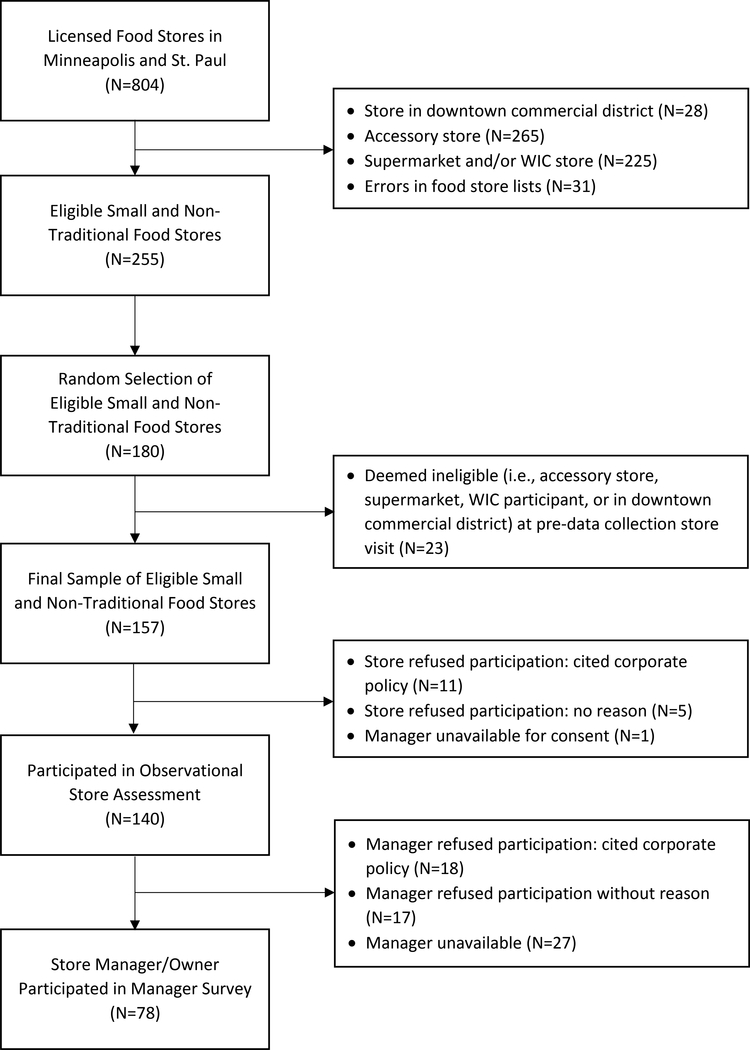
140 stores; 78 managers
Results:
Several consumer- and structural-level differences occurred by corporate status, independent of residential segregation. Compared to independently-owned stores, corporate/franchise-owned stores were more likely to: not offer fresh produce; when offered, receive produce via direct delivery and charge higher prices; promote unhealthier consumer purchases; and have managers that perceived greater difficulty in making healthful changes (P ≤0.05). Only two significant differences were identified by residential racial segregation. Stores in predominantly people of color communities (<30% Non-Hispanic White) had less availability of fresh fruit and less promotion of unhealthy impulse buys relative to stores in predominantly White communities (P ≤0.05).
Conclusions:
Corporate status appears to be a relevant determinant of the consumer-level food environment of small and nontraditional stores. Policies and interventions aimed at making these settings healthier may need to consider multiple social determinants to enable successful implementation. -
Subjects:
-
Source:Public Health Nutr. 22(9):1624-1634
-
DOI:
-
Pubmed ID:30846012
-
Pubmed Central ID:PMC6494699
-
Document Type:
-
Funding:
-
Genre:
-
Volume:22
-
Issue:9
-
Download URL:
-
File Type:
 [PDF - 455.15 KB]
 -
Collection(s):
-
Main Document Checksum:urn:sha-512:5197c924cc1a33d5d54740ac2a71b1817a0f84b268017666374be45e7dda1c4b1be949f8701eb9cfb8a90ab427a48afb024afc3df64ab1c32fa09dd87c77ee93
Supporting Files


File Language:
English
 Was this page helpful?
 Found an issue?


CDC STACKS serves as an archival repository of CDC-published products including
scientific findings, journal articles, guidelines, recommendations, or other public health information authored or
co-authored by CDC or funded partners.
As a repository, CDC STACKS retains documents in their original published format to ensure public access to scientific information.
As a repository, CDC STACKS retains documents in their original published format to ensure public access to scientific information.
You May Also Like
COLLECTION
CDC Public Access