


A NOVEL AUTOCIDAL OVITRAP FOR THE SURVEILLANCE AND CONTROL OF AEDES AEGYPTI
Supporting Files

-
Sep 2013
File Language:
English
Details
-
Alternative Title:J Am Mosq Control Assoc
-
Personal Author:
-
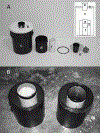
Description:We describe an inexpensive autocidal ovitrap for Aedes aegypti that uses cross-linked polyacrylamide (PAM) gel as the oviposition substrate. Aedes aegypti females readily laid eggs on PAM gel that had been hydrated with either hay infusion or water. Aedes aegypti larvae that hatched from their eggs desiccated on the surface of the PAM gel. We tested the effects of gel hydration, texture, and type of attractant on trap performance, and compared the capture rates of standard ovitraps with those of PAM gel ovitraps in the field. The results showed that the number of eggs did not vary over a range of gel hydration levels (40-100%) and that more eggs were recovered from ovitraps containing coarse gel than from those containing homogenized gel. The PAM gel hydrated with hay infusion was more attractive to gravid female mosquitoes than gel hydrated with water. In the field, the number of eggs recovered from autocidal ovitraps with PAM gel was similar to that recovered from standard ovitraps with hay infusion.
-
Subjects:
-
Source:J Am Mosq Control Assoc. 29(3):293-296
-
Pubmed ID:24199506
-
Pubmed Central ID:PMC6489123
-
Document Type:
-
Funding:
-
Volume:29
-
Issue:3
-
Collection(s):
-
Main Document Checksum:urn:sha256:e0d2e6e155a81f56551cd2ac3e87f4e3b80a96ff830d9f281eb3b5afd14fb777
-
Download URL:
-
File Type:
 [PDF
- 150.73 KB
]
[PDF
- 150.73 KB
]
Supporting Files


File Language:
English
ON THIS PAGE

CDC STACKS serves as an archival repository of CDC-published products including
scientific findings,
journal articles, guidelines, recommendations, or other public health information authored or
co-authored by CDC or funded partners.
As a repository, CDC STACKS retains documents in their original published format to ensure public access to scientific information.
As a repository, CDC STACKS retains documents in their original published format to ensure public access to scientific information.
You May Also Like
COLLECTION
CDC Public Access