



Effectiveness of targeted enhanced terminal room disinfection on hospital-wide acquisition and infection with multidrug-resistant organisms and Clostridium difficile: a secondary analysis of a multicentre cluster randomised controlled trial with crossover design (BETR Disinfection)
Supporting Files

-
8 2018
-
Available in CDC Stacks on August 01, 2019, 12:00 AM
File Language:
English
Details
-
Journal Article:Lancet Infect Dis
-
Personal Author:
-
Corporate Authors:
-
Description:Background
The hospital environment is a source of pathogen transmission. The effect of enhanced disinfection strategies on the hospital-wide incidence of infection has not been investigated in a multicentre, randomised controlled trial. We aimed to assess the effectiveness of four disinfection strategies on hospital-wide incidence of multidrug-resistant organisms and Clostridium difficile in the Benefits of Enhanced Terminal Room (BETR) Disinfection study.
Methods
We did a prespecified secondary analysis of the results from the BETR Disinfection study, a pragmatic, multicentre, crossover cluster-randomised trial that assessed four different strategies for terminal room disinfection in nine hospitals in the southeastern USA. Rooms from which a patient with a specific infection or colonisation (due to the target organisms C difficile, meticillin-resistant Staphylococcus aureus, vancomycin-resistant enterococci (VRE), or multidrug-resistant Acinetobacter spp) was discharged were terminally disinfected with one of four strategies: standard disinfection (quaternary ammonium disinfectant, except for C difficile, for which 10% hypochlorite bleach was used; reference); standard disinfection and disinfecting ultraviolet light (UV-C), except for C difficile, for which bleach and UV-C was used (UV strategy); 10% hypochlorite (bleach strategy); and bleach and UV-C (bleach and UV strategy). We randomly assigned the sequence of strategies for each hospital (1:1:1:1), and each strategy was used for 7 months, including a 1-month wash-in period and 6 months of data collection. The prespecified secondary outcomes were hospital-wide, hospital-acquired incidence of all target organisms (calculated as number of patients with hospital-acquired infection with a target organism per 10 000 patient days), and hospital-wide, hospital-acquired incidence of each target organism separately. BETR Disinfection is registered with ClinicalTrials.gov, number NCT01579370.
Findings
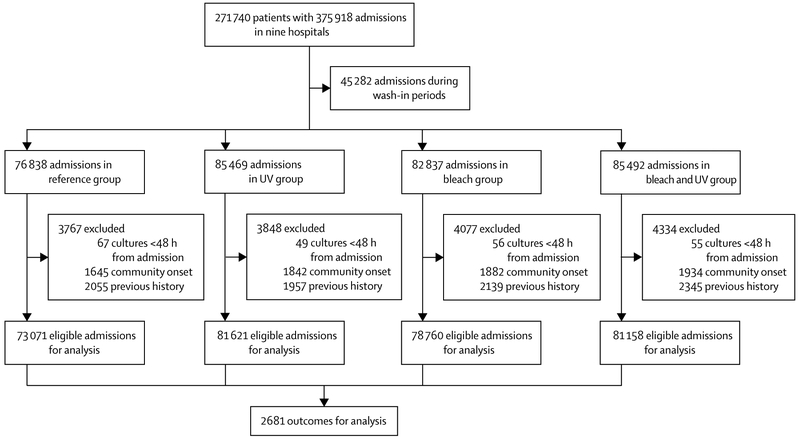
Between April, 2012, and July, 2014, there were 271 740 unique patients with 375 918 admissions. 314 610 admissions met all inclusion criteria (n=73 071 in the reference study period, n=81 621 in the UV study period, n=78 760 in the bleach study period, and n=81 158 in the bleach and UV study period). 2681 incidenct cases of hospital-acquired infection or colonisation occurred during the study. There was no significant difference in the hospital-wide risk of target organism acquisition between standard disinfection and the three enhanced terminal disinfection strategies for all target multidrug-resistant organisms (UV study period relative risk RR 0.89, 95% CI 0.79–1.00; p=0.052; bleach study period 0.92, 0.79–1.08; p=0.32; bleach and UV study period 0.99, 0.89–1.11; p=0.89). The decrease in risk in the UV study period was driven by decreases in risk of acquisition of C difficile (RR 0.89, 95% CI 0.80–0.99; p=0.031) and VRE (0.56, 0.31–0.996; p=0.048).
Interpretation
Enhanced terminal room disinfection with UV in a targeted subset of high-risk rooms led to a decrease in hospital-wide incidence of C difficile and VRE. Enhanced disinfection overcomes limitations of standard disinfection strategies and is a potential strategy to reduce the risk of acquisition of multidrug-resistant organisms and C difficile. -
Subjects:
-
Keywords:
-
Source:Lancet Infect Dis. 18(8):845-853
-
DOI:
-
Pubmed ID:29880301
-
Pubmed Central ID:PMC6487496
-
Document Type:
-
Funding:
-
Genre:
-
Volume:18
-
Issue:8
-
Download URL:
-
File Type:
 [PDF - 183.55 KB]
 -
Collection(s):
-
Main Document Checksum:urn:sha-512:f0a9ef7236c86d2082146e88bae385b8244af84b9a38d082a8e92a75876580084b375a9d0a95e1cd73f775d5edefcee4cf40ef8122cbb5a326424dbcbe2c4bb7
Supporting Files


File Language:
English
 Was this page helpful?
 Found an issue?

CDC STACKS serves as an archival repository of CDC-published products including
scientific findings, journal articles, guidelines, recommendations, or other public health information authored or
co-authored by CDC or funded partners.
As a repository, CDC STACKS retains documents in their original published format to ensure public access to scientific information.
As a repository, CDC STACKS retains documents in their original published format to ensure public access to scientific information.
You May Also Like
COLLECTION
CDC Public Access