



Survey for Bat Lyssaviruses, Thailand
Supporting Files
Public Domain

-
Feb 2005
File Language:
English
Details
-
Alternative Title:Emerg Infect Dis
-
Personal Author:
-
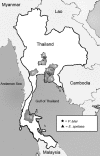
Description:Surveillance for lyssaviruses was conducted among bat populations in 8 provinces in Thailand. In 2002 and 2003, a total of 932 bats of 11 species were captured and released after serum collection. Lyssavirus infection was determined by conducting virus neutralization assays on bat serum samples. Of collected samples, 538 were either hemolysed or insufficient in volume, which left 394 suitable for analysis. These samples included the following: Pteropus lylei (n = 335), Eonycteris spelaea (n = 45), Hipposideros armiger (n = 13), and Rousettus leschennaulti (n = 1). No serum samples had evidence of neutralizing antibodies when tested against rabies virus. However, 16 samples had detectable neutralizing antibodies against Aravan virus, Khujand virus, Irkut virus, or Australian bat lyssavirus; all were specifically associated with fruit bats P. lylei (n = 15) and E. spelaea (n = 1). These results are consistent with the presence of naturally occurring viruses related to new putative lyssavirus genotypes.
-
Subjects:
-
Source:Emerg Infect Dis. 11(2):232-236.
-
Document Type:
-
Place as Subject:
-
Location:
-
Volume:11
-
Issue:2
-
Download URL:
-
File Type:
 [PDF - 249.96 KB]
 -
Collection(s):
-
Main Document Checksum:urn:sha256:7359ad91508b8d471de0582fc8c2f1ea7595944a830b59f600f64b4d3780c839
Supporting Files


File Language:
English
 Was this page helpful?
 Found an issue?



CDC STACKS serves as an archival repository of CDC-published products including
scientific findings, journal articles, guidelines, recommendations, or other public health information authored or
co-authored by CDC or funded partners.
As a repository, CDC STACKS retains documents in their original published format to ensure public access to scientific information.
As a repository, CDC STACKS retains documents in their original published format to ensure public access to scientific information.
You May Also Like
COLLECTION
Emerging Infectious Diseases