



Trends in anogenital wart incidence among Tennessee Medicaid enrollees, 2006–2014: The impact of human papillomavirus vaccination
Supporting Files

-
April 10 2019
-
File Language:
English
Details
-
Journal Article:Papillomavirus Res
-
Personal Author:
-
Description:Introduction
Evidence of human papillomavirus (HPV) vaccine impact on anogenital warts (AGWs) by race or urbanicity in the US is lacking. We evaluated HPV vaccine impact in Tennessee by assessing AGW trends among Tennessee Medicaid (TennCare) enrollees aged 15–39 years from 2006-2014.
Methods
Persons with incident AGWs were identified using diagnosis/pharmacy codes from TennCare billing claims. We calculated sex-specific annual AGW incidence by age group, race, and urbanicity; estimated annual percent changes (APCs) using log-linear models; and performed pairwise comparisons by race and urbanicity.
Results
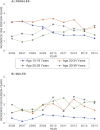
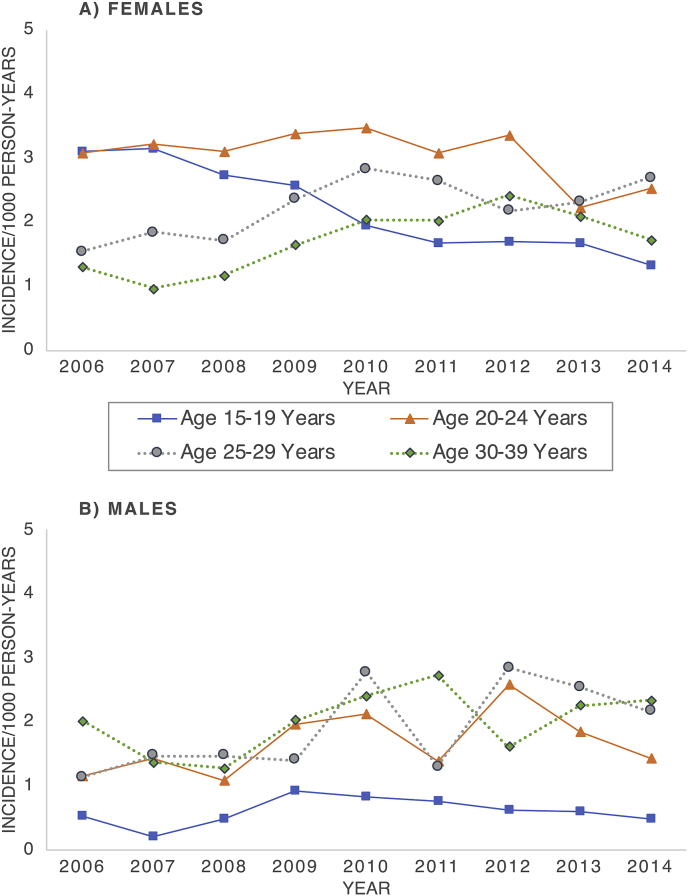
AGW incidence decreased among females aged 15–19 (APC = −10.6; P < 0.01) and 20–24 years (APC = −3.9; P = 0.02). Overall trends were similar between Whites and Blacks, and between those living in metropolitan statistical areas (MSAs) and non-MSAs. Rates among males aged 15–19 years began decreasing after 2010. Among enrollees aged 25–39 years, rates increased or were stable.
Conclusions
Following introduction of the HPV vaccine in 2006, AGWs decreased among age groups most likely to be vaccinated. The change in trend among young males after 2010 suggests early herd effects. Our findings indicate vaccine effects and support the importance of improving adherence to current vaccination recommendations for preventing AGWs and other HPV-related diseases.
-
Subjects:
-
Source:Papillomavirus Res. 2019; 7:141-149
-
DOI:
-
Pubmed ID:30980966
-
Pubmed Central ID:PMC6468146
-
Document Type:
-
Funding:
-
Genre:
-
Place as Subject:
-
Volume:7
-
Collection(s):
-
Main Document Checksum:urn:sha-512:f70fe79541c59e99d3bc1efa00dfcc57ded9bde219aa4a01479d52f16c734c4ffa5ec0d951e54512575941a2a16ee4fb71de8878c57cb58b6bbedd90bcd54f8a
-
Download URL:
-
File Type:
 [PDF
- 2.04 MB
]
[PDF
- 2.04 MB
]


File Language:
English
 Was this page helpful?
 Found an issue?

CDC STACKS serves as an archival repository of CDC-published products including
scientific findings,
journal articles, guidelines, recommendations, or other public health information authored or
co-authored by CDC or funded partners.
As a repository, CDC STACKS retains documents in their original published format to ensure public access to scientific information.
As a repository, CDC STACKS retains documents in their original published format to ensure public access to scientific information.
You May Also Like
COLLECTION
CDC Public Access