



Efficacy of novel indoor residual spraying methods targeting pyrethroid-resistant Aedes aegypti within experimental houses
Supporting Files
Public Domain

-
February 28 2019
-
File Language:
English
Details
-
Alternative Title:PLoS Negl Trop Dis
-
Personal Author:
-
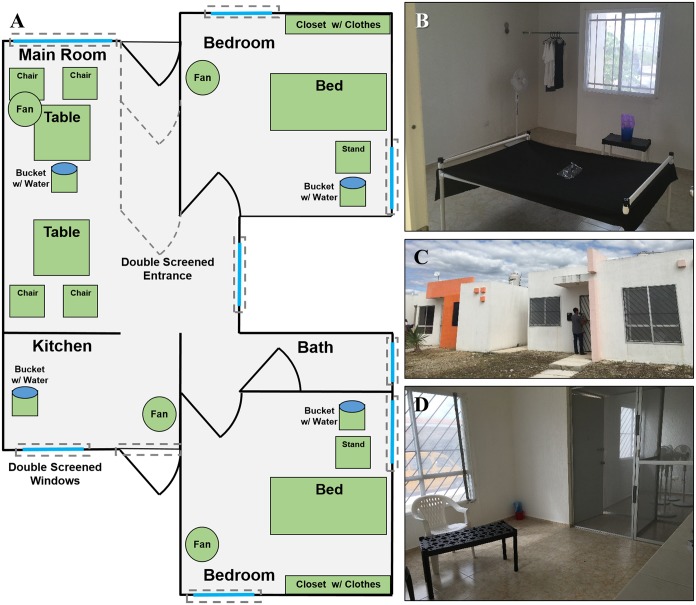
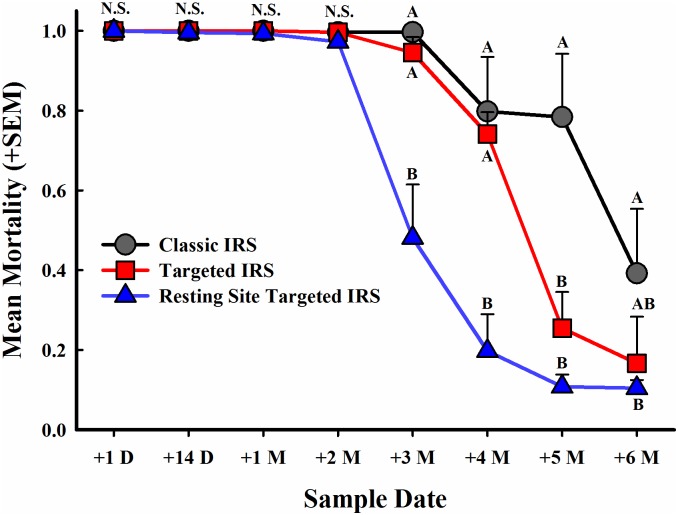
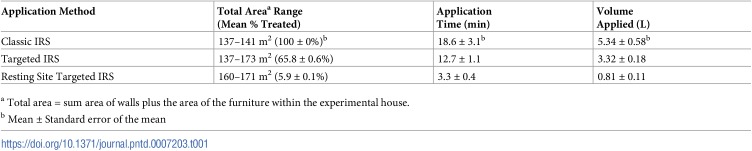
Description:Challenges in maintaining high effectiveness of classic vector control in urban areas has renewed the interest in indoor residual spraying (IRS) as a promising approach for Aedes-borne disease prevention. While IRS has many benefits, application time and intrusive indoor applications make its scalability in urban areas difficult. Modifying IRS to account for Ae. aegypti resting behavior, named targeted IRS (TIRS, spraying walls below 1.5 m and under furniture) can reduce application time; however, an untested assumption is that modifications to IRS will not negatively impact entomological efficacy. We conducted a comparative experimental study evaluating the residual efficacy of classically-applied IRS (as developed for malaria control) compared to two TIRS application methods using a carbamate insecticide against a pyrethroid-resistant, field-derived Ae. aegypti strain. We performed our study within a novel experimental house setting (n = 9 houses) located in Merida (Mexico), with similar layouts and standardized contents. Classic IRS application (insecticide applied to full walls and under furniture) was compared to: a) TIRS: insecticide applied to walls below 1.5 m and under furniture, and b) Resting Site TIRS (RS-TIRS): insecticide applied only under furniture. Mosquito mortality was measured eight times post-application (out to six months post-application) by releasing 100 Ae. aegypti females /house and collecting live and dead individuals after 24 hrs exposure. Compared to Classic IRS, TIRS and RS-TIRS took less time to apply (31% and 82% reduction, respectively) and used less insecticide (38% and 85% reduction, respectively). Mortality of pyrethroid-resistant Ae. aegypti did not significantly differ among the three IRS application methods up to two months post application, and did not significantly differ between Classic IRS and TIRS up to four months post application. These data illustrate that optimizing IRS to more efficiently target Ae. aegypti can both reduce application time and insecticide volume with no apparent reduction in entomological efficacy.
-
Subjects:
-
Source:PLoS Negl Trop Dis. 13(2)
-
Pubmed ID:30817759
-
Pubmed Central ID:PMC6394901
-
Document Type:
-
Volume:13
-
Issue:2
-
Collection(s):
-
Main Document Checksum:urn:sha256:32e48db2dbabb80f76f65a149e510e56522651678128ac591973aeb0ed547f30
-
Download URL:
-
File Type:
 [PDF
- 1.20 MB
]
[PDF
- 1.20 MB
]
Supporting Files


File Language:
English
 Was this page helpful?
 Found an issue?

CDC STACKS serves as an archival repository of CDC-published products including
scientific findings,
journal articles, guidelines, recommendations, or other public health information authored or
co-authored by CDC or funded partners.
As a repository, CDC STACKS retains documents in their original published format to ensure public access to scientific information.
As a repository, CDC STACKS retains documents in their original published format to ensure public access to scientific information.
You May Also Like
COLLECTION
CDC Public Access