


The Impact of a Multilevel Childhood Obesity Prevention Intervention on Healthful Food Acquisition, Preparation, and Fruit and Vegetable Consumption on African American Adult Caregivers
Supporting Files

-
November 22 2018
File Language:
English
Details
-
Alternative Title:Public Health Nutr
-
Personal Author:
-
Description:Objectives:
To evaluate the secondary impact of a multilevel, child-focused, obesity intervention on food-related behaviors (acquisition, preparation, and fruit and vegetable (FV) consumption) on youths’ primary caregivers.
Design:
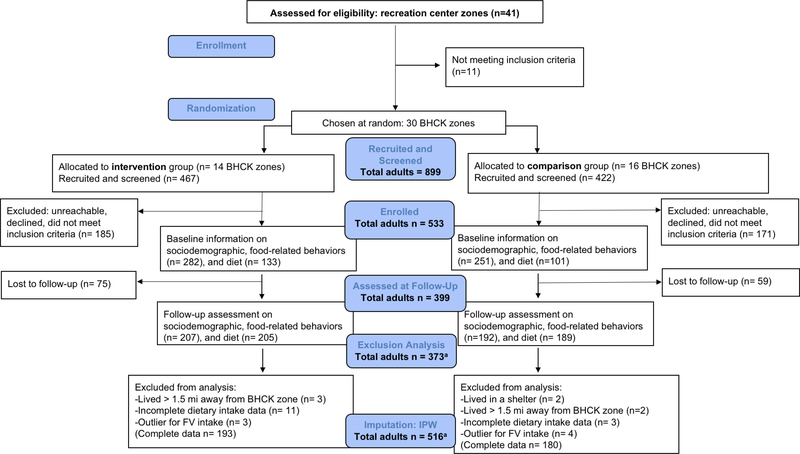
B’more Healthy Communities for Kids (BHCK), group-randomized, controlled trial, promoted access to healthy food and food-related behaviors through wholesaler and small store strategies, peer-mentor led nutrition education aimed at youth, and social media and text messaging targeting their adult caregivers. Measures included caregivers’ (n=516) self-reported household food acquisition frequency for FV, snacks, and grocery items over 30 days, and usual consumption of FV in a sub-sample of 226 caregivers via the NCI FV Screener. Hierarchical models assessed average-treatment-effects (ATE). Treatment-on-the-treated-effect (TTE) analyses evaluated the correlation between behavioral change and exposure to BHCK. Exposure scores at post-assessment were based on self-reported viewing of BHCK materials and participating in activities.
Setting:
30 Baltimore City low-income neighborhoods
Subjects:
Adult caregivers of youth ages 9–15 years.
Results:
90.89% of caregivers were female, average 39.31(± 9.31) years. Baseline mean fruit intake (servings/day) was 1.30(± 1.69) and vegetable was 1.35(± 1.05). In ATE, no significant effect of the intervention was found on caregiver food-related behaviors. In TTE, for each point increase in the BHCK exposure score (range 0–6.9), caregivers increased daily consumption of fruits by 0.2 servings (0.24± 0.11; 95%CI 0.04; 0.47). Caregivers reporting greater exposure to social media tripled their daily fruit intake (3.16± 0.92; 95%CI 1.33; 4.99) and increased frequency of unhealthy food purchasing, compared to baseline.
Conclusions:
Child-focused community-based nutrition interventions may also benefit family members’ fruit intake. Child-focused interventions should involve adult caregivers and intervention effects on family members should be assessed. Future multilevel studies should consider using social media to improve reach and engage caregiver participants.
-
Subjects:
-
Source:Public Health Nutr. 22(7):1300-1315
-
Pubmed ID:30463637
-
Pubmed Central ID:PMC6486455
-
Document Type:
-
Funding:
-
Place as Subject:
-
Volume:22
-
Issue:7
-
Collection(s):
-
Main Document Checksum:urn:sha256:bb255ef2db710eaaddb5c74d598b27687983240b2c059cd22f8a726311b84f42
-
Download URL:
-
File Type:
 [PDF
- 671.99 KB
]
[PDF
- 671.99 KB
]
Supporting Files


File Language:
English
ON THIS PAGE

CDC STACKS serves as an archival repository of CDC-published products including
scientific findings,
journal articles, guidelines, recommendations, or other public health information authored or
co-authored by CDC or funded partners.
As a repository, CDC STACKS retains documents in their original published format to ensure public access to scientific information.
As a repository, CDC STACKS retains documents in their original published format to ensure public access to scientific information.
You May Also Like
COLLECTION
CDC Public Access