



Factors Associated with Combined Do-Not-Resuscitate and Do-Not-Intubate Orders: A Retrospective Chart Review at an Urban Tertiary Care Center
Supporting Files

-
June 20 2018
-
Available in CDC Stacks on April 24, 2019, 12:00 AM
File Language:
English
Details
-
Journal Article:Resuscitation
-
Personal Author:
-
Description:BACKGROUND:
In clinical practice, do-not-intubate (DNI) orders are generally accompanied by do-not-resuscitate (DNR) orders. Use of do-not-resuscitate (DNR) orders is associated with older patient age, more comorbid conditions, and the withholding of treatments outside of the cardiac arrest setting. Previous studies have not unpacked the factors independently associated with DNI orders.
OBJECTIVE:
To compare factors associated with combined DNR/DNI orders versus isolated DNR orders, as a means of elucidating factors associated with the addition of DNI orders.
DESIGN:
Retrospective chart review.
SETTING/SUBJECTS:
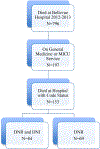
Patients who died on a General Medicine or MICU service (n=197) at an urban public hospital over a 2-year period.
MEASUREMENTS:
Logistic regression was used to identify demographic and medical data associated with code status.
RESULTS:
Compared with DNR orders alone, DNR/DNI orders were associated with a higher median Charlson Comorbidity Index (odds ratio OR 1.27, 95% confidence interval CI 1.13–1.43); older age (OR 1.02, 95% CI 1.01–1.04); malignancy (OR 2.27, 95% CI 1.18–4.37); and female sex (OR 1.98, 95% CI 1.02–3.87). In the last 3 days of life, they were associated with morphine administration (OR 2.76, 95% CI 1.43–5.33); and negatively associated with use of vasopressors/inotropes (OR 10.99, 95% CI 4.83–25.00).
CONCLUSIONS:
Compared with DNR orders alone, combined DNR/DNI orders are more strongly associated with many of the same factors that have been linked to DNR orders. Awareness of the extent to which the two directives may be conflated during code status discussions is needed to promote patient-centered application of these interventions. -
Subjects:
-
Source:Resuscitation. 130:1-5
-
DOI:
-
Pubmed ID:29935341
-
Pubmed Central ID:PMC6481924
-
Document Type:
-
Funding:
-
Genre:
-
Place as Subject:
-
Volume:130
-
Download URL:
-
File Type:
 [PDF - 135.28 KB]
 -
Collection(s):
-
Main Document Checksum:urn:sha-512:da2b7af134dfa2dc0ca721c0d359bf78a4e7fe18db63cba384a6ee58abca16183e9aaa0446ebce601cc04304ec7e5008a30447e32632a3f3039c609413bae714
Supporting Files


File Language:
English
 Was this page helpful?
 Found an issue?


CDC STACKS serves as an archival repository of CDC-published products including
scientific findings, journal articles, guidelines, recommendations, or other public health information authored or
co-authored by CDC or funded partners.
As a repository, CDC STACKS retains documents in their original published format to ensure public access to scientific information.
As a repository, CDC STACKS retains documents in their original published format to ensure public access to scientific information.
You May Also Like
COLLECTION
CDC Public Access