


Discovery and Characterization of Bukakata orbivirus (Reoviridae:Orbivirus), a Novel Virus from a Ugandan Bat
Supporting Files
Public Domain

-
March 02 2019
-
File Language:
English
Details
-
Journal Article:Viruses
-
Personal Author:Fagre, Anna C. ; Lee, Justin S. ; Kityo, Robert M. ; Bergren, Nicholas A. ; Mossel, Eric C. ; Nakayiki, Teddy ; Nalikka, Betty ; Nyakarahuka, Luke ; Gilbert, Amy T. ; Peterhans, Julian Kerbis ; Crabtree, Mary B. ; Towner, Jonathan S. ; Amman, Brian R. ; Sealy, Tara K. ; Schuh, Amy J. ; Nichol, Stuart T. ; Lutwama, Julius J. ; Miller, Barry R. ; Kading, Rebekah C.
-
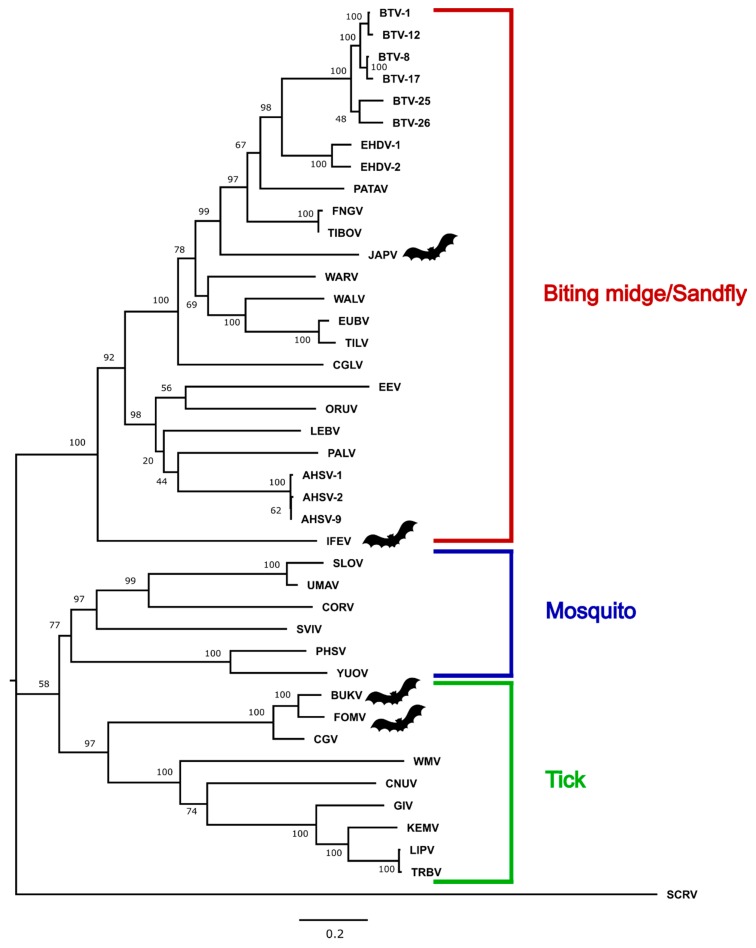
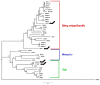
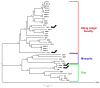
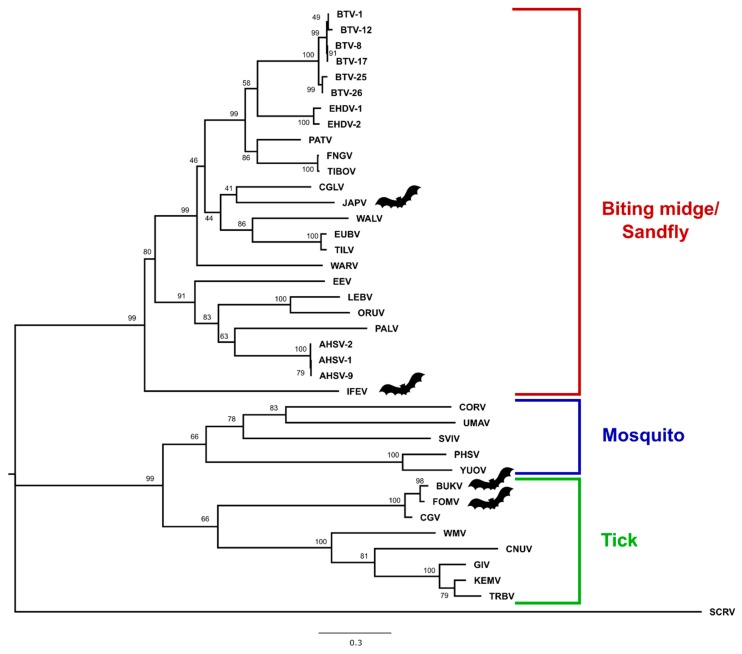
Description:While serological and virological evidence documents the exposure of bats to medically-important arboviruses, their role as reservoirs or amplifying hosts is less well-characterized. We describe a novel orbivirus (|) isolated from an Egyptian fruit bat (|) trapped in 2013 in Uganda and named Bukakata orbivirus. This is the fifth orbivirus isolated from a bat, however genetic information had previously only been available for one bat-associated orbivirus. We performed whole-genome sequencing on Bukakata orbivirus and three other bat-associated orbiviruses (Fomede, Ife, and Japanaut) to assess their phylogenetic relationship within the genus | and develop hypotheses regarding potential arthropod vectors. Replication kinetics were assessed for Bukakata orbivirus in three different vertebrate cell lines. Lastly, qRT-PCR and nested PCR were used to determine the prevalence of Bukakata orbivirus RNA in archived samples from three populations of Egyptian fruit bats and one population of cave-associated soft ticks in Uganda. Complete coding sequences were obtained for all ten segments of Fomede, Ife, and Japanaut orbiviruses and for nine of the ten segments for Bukakata orbivirus. Phylogenetic analysis placed Bukakata and Fomede in the tick-borne orbivirus clade and Ife and Japanaut within the |/phlebotomine sandfly orbivirus clade. Further, Bukakata and Fomede appear to be serotypes of the | species. Bukakata orbivirus replicated to high titers (10⁶⁻10⁷ PFU/mL) in Vero, BHK-21 [C-13], and R06E (Egyptian fruit bat) cells. Preliminary screening of archived bat and tick samples do not support Bukakata orbivirus presence in these collections, however additional testing is warranted given the phylogenetic associations observed. This study provided complete coding sequence for several bat-associated orbiviruses and in vitro characterization of a bat-associated orbivirus. Our results indicate that bats may play an important role in the epidemiology of viruses in the genus | and further investigation is warranted into vector-host associations and ongoing surveillance efforts.
-
Subjects:
-
Source:Viruses. 2019; 11(3)
-
DOI:
-
Pubmed ID:30832334
-
Pubmed Central ID:PMC6466370
-
Document Type:
-
Genre:
-
Place as Subject:
-
Volume:11
-
Issue:3
-
Collection(s):
-
Main Document Checksum:urn:sha-512:227193cbba6315c4af0aea07e5a3a12c7484886119d0acf653d2fb40051fd01e385b0dee788299015b73896c3cf2ec0976e1bb8859b90f534cab8ce607b5a411
-
Download URL:
-
File Type:
 [PDF
- 3.99 MB
]
[PDF
- 3.99 MB
]
Supporting Files


File Language:
English
ON THIS PAGE




CDC STACKS serves as an archival repository of CDC-published products including
scientific findings,
journal articles, guidelines, recommendations, or other public health information authored or
co-authored by CDC or funded partners.
As a repository, CDC STACKS retains documents in their original published format to ensure public access to scientific information.
As a repository, CDC STACKS retains documents in their original published format to ensure public access to scientific information.
You May Also Like
COLLECTION
CDC Public Access