



Large-cage assessment of a transgenic sex-ratio distortion strain on populations of an African malaria vector
Supporting Files
Public Domain

-
February 06 2019
-
Available in CDC Stacks on 2019-02-06T00:00:00Z
File Language:
English
Details
-
Journal Article:Parasit Vectors
-
Personal Author:
-
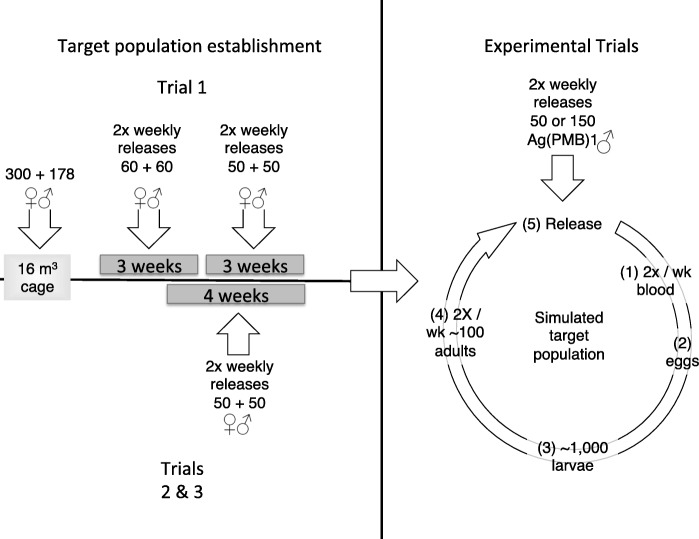
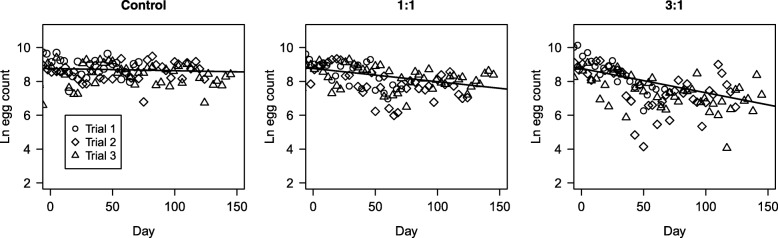
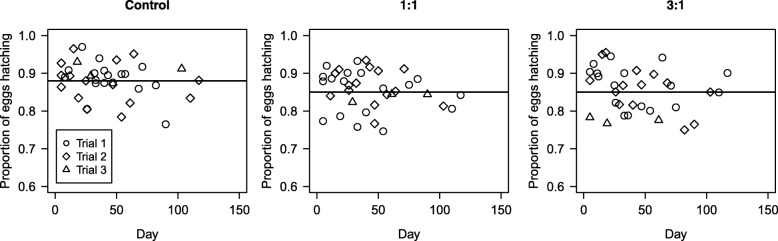
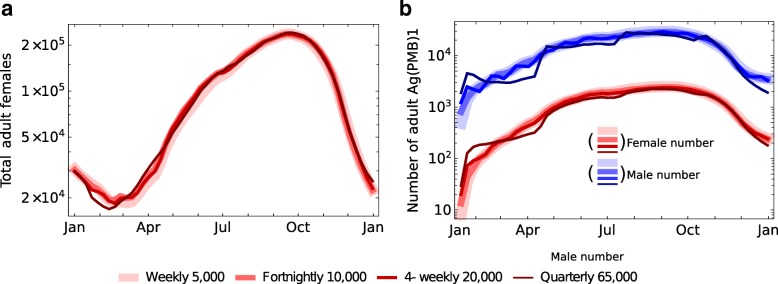
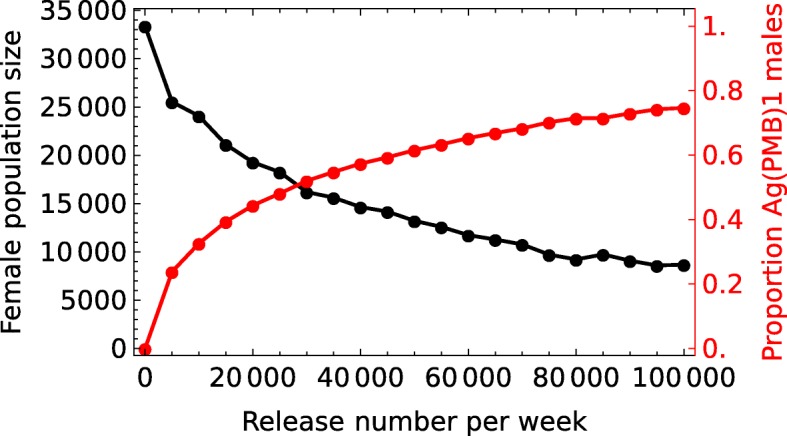
Description:Background ; Novel transgenic mosquito control methods require progressively more realistic evaluation. The goal of this study was to determine the effect of a transgene that causes a male-bias sex ratio on Anopheles gambiae target populations in large insectary cages. ; Methods ; Life history characteristics of Anopheles gambiae wild type and Ag(PMB)1 (aka gfp124L-2) transgenic mosquitoes, whose progeny are 95% male, were measured in order to parameterize predictive population models. Ag(PMB)1 males were then introduced at two ratios into large insectary cages containing target wild type populations with stable age distributions and densities. The predicted proportion of females and those observed in the large cages were compared. A related model was then used to predict effects of male releases on wild mosquitoes in a west African village. ; Results ; The frequency of transgenic mosquitoes in target populations reached an average of 0.44 ± 0.02 and 0.56 ± 0.02 after 6 weeks in the 1:1 and in the 3:1 release ratio treatments (transgenic male:wild male) respectively. Transgenic males caused sex-ratio distortion of 73% and 80% males in the 1:1 and 3:1 treatments, respectively. The number of eggs laid in the transgenic treatments declined as the experiment progressed, with a steeper decline in the 3:1 than in the 1:1 releases. The results of the experiment are partially consistent with predictions of the model; effect size and variability did not conform to the model in two out of three trials, effect size was over-estimated by the model and variability was greater than anticipated, possibly because of sampling effects in restocking. The model estimating the effects of hypothetical releases on the mosquito population of a West African village demonstrated that releases could significantly reduce the number of females in the wild population. The interval of releases is not expected to have a strong effect. ; Conclusions ; The biological data produced to parameterize the model, the model itself, and the results of the experiments are components of a system to evaluate and predict the performance of transgenic mosquitoes. Together these suggest that the Ag(PMB)1 strain has the potential to be useful for reversible population suppression while this novel field develops.
-
Subjects:
-
Source:Parasit Vectors. 12
-
DOI:
-
Pubmed ID:30728060
-
Pubmed Central ID:PMC6366042
-
Document Type:
-
Genre:
-
Place as Subject:
-
Volume:12
-
Download URL:
-
File Type:
 [PDF - 1.20 MB]
 -
Collection(s):
-
Main Document Checksum:urn:sha-512:a67b3ae3863246774d0e85054bcfba48fbe9ae00b66356d298b82cf65bd7e078401114a14bb9f52094033f50aa90a7d1b2930a4a0548bddc0be2fdc44add98fe
Supporting Files


File Language:
English
 Was this page helpful?
 Found an issue?







CDC STACKS serves as an archival repository of CDC-published products including
scientific findings, journal articles, guidelines, recommendations, or other public health information authored or
co-authored by CDC or funded partners.
As a repository, CDC STACKS retains documents in their original published format to ensure public access to scientific information.
As a repository, CDC STACKS retains documents in their original published format to ensure public access to scientific information.
You May Also Like
COLLECTION
CDC Public Access