


An In Vitro evaluation of disinfection protocols used for needleless connectors of central venous catheters
Supporting Files

-
Jun 07 2013
-
File Language:
English
Details
-
Journal Article:Lett Appl Microbiol
-
Personal Author:
-
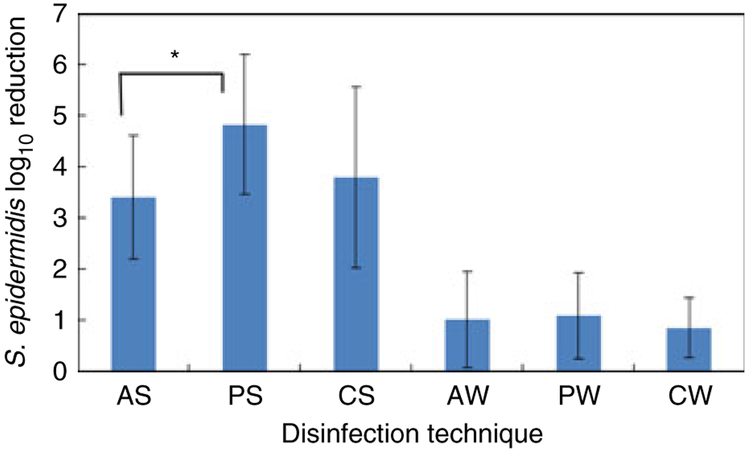
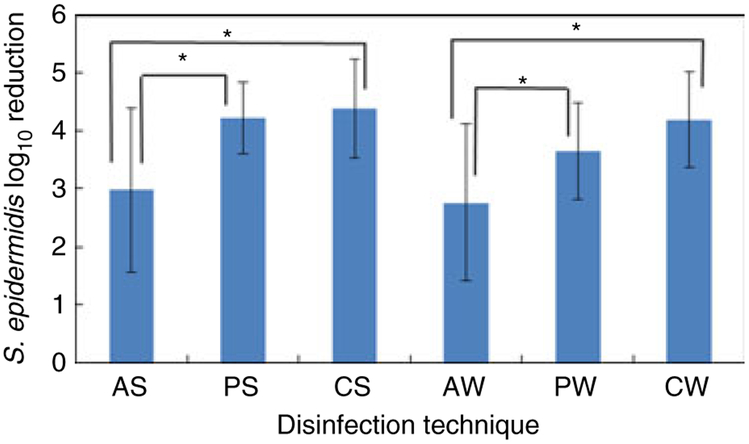
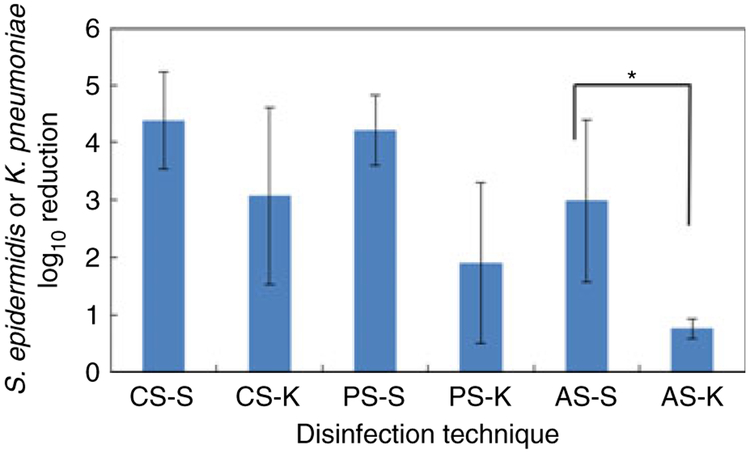
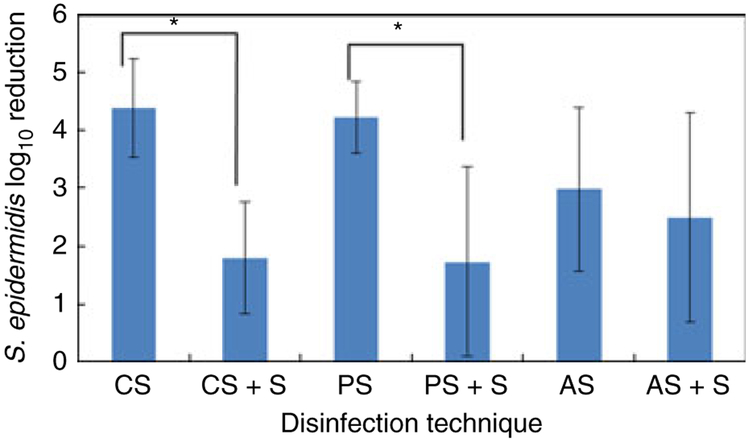
Description:A repeatable and sensitive method to evaluate the effect of three antiseptics and two disinfection techniques on viable micro-organisms on luer-activated catheter needleless connectors (NCs) was developed. NCs were inoculated with Staphylococcus epidermidis or Klebsiella pneumoniae and disinfected with 3·15% chlorhexidine gluconate + 70% isopropanol (CGI), 70% isopropanol (IPA) or 10% PVP povidone-iodine (PI) antiseptic pads using: (i) scrubbing the NC septum and threaded external surfaces or (ii) wiping only the surface of the septum. Treatments were also evaluated against NCs pretreated with human serum and exposed for 18 h to Staph. epidermidis prior to testing. Viable cells were quantified by plate count. The method for inoculation and recovery of luminal micro-organisms was repeatable (SD, 0·31; n = 28). IPA disinfection provided an approximate 3 log10 CFU reduction; CGI and PI provided 3-4 log10 reductions. PI and CGI were more effective than IPA (P < 0·05), but differences between CGI and PI were not significant for either disinfection method. IPA, but not CGI and PI was also less effective (P < 0·05) against NCs inoculated with Kl. pneumoniae than Staph. epidermidis. Pretreatment with serum and prolonged Staph. epidermidis inoculation removed the advantage seen with CGI and PI; log10 reductions were 1·80, 1·73 and 2·50 for CGI, PI and IPA, respectively. PI or CGI may be more effective than IPA for NC disinfection but effectiveness may be reduced on NCs contaminated with blood or serum.|sensitive and repeatable protocol was developed to evaluate antiseptics for disinfecting catheter needleless connectors (NCs). Povidone-iodine (PI) and chlorhexidine gluconate plus isopropanol (CGI) were more effective than isopropanol (IPA) for reducing Staphylococcus epidermidis contamination of NCs. The effectiveness of PI and CGI was reduced on NCs pre-exposed to human serum and prolonged bacterial inoculation. IPA was also less effective against NCs contaminated with Klebsiella pneumoniae.
-
Subjects:
-
Source:Lett Appl Microbiol. 57(4):282-287
-
DOI:
-
Pubmed ID:23710651
-
Pubmed Central ID:PMC6467294
-
Document Type:
-
Funding:
-
Genre:
-
Volume:57
-
Issue:4
-
Collection(s):
-
Main Document Checksum:urn:sha-512:5e47cd89f75cdc84b8693321fd84b7f778eac494112984469fb6e21551c0349b5be7153cd8d834f6ee58bc5d5f670a9de50d020568c710c644c887beac7909c8
-
Download URL:
-
File Type:
 [PDF
- 486.73 KB
]
[PDF
- 486.73 KB
]
Supporting Files


File Language:
English
ON THIS PAGE

CDC STACKS serves as an archival repository of CDC-published products including
scientific findings,
journal articles, guidelines, recommendations, or other public health information authored or
co-authored by CDC or funded partners.
As a repository, CDC STACKS retains documents in their original published format to ensure public access to scientific information.
As a repository, CDC STACKS retains documents in their original published format to ensure public access to scientific information.
You May Also Like
COLLECTION
CDC Public Access