


161. Prevalence and Risk Factors for Candida auris Colonization Among Patients in a Long-term Acute Care Hospital—New Jersey, 2017
Supporting Files
Public Domain

-
November 26 2018
-
File Language:
English
Details
-
Alternative Title:Open Forum Infect Dis
-
Personal Author:
-
Description:Background
Candida auris can be transmitted in healthcare settings, and patients can become asymptomatically colonized, increasing risk for invasive infection and transmission. We investigated an ongoing C. auris outbreak at a 30-bed long-term acute care hospital to identify colonization for C. auris prevalence and risk factors.
Methods
During February–June 2017, we conducted point prevalence surveys every 2 weeks among admitted patients. We abstracted clinical information from medical records and collected axillary and groin swabs. Swabs were tested for C. auris. Data were analyzed to identify risk factors for colonization with C. auris by evaluating differences between colonized and noncolonized patients.
Results
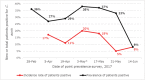
All 101 hospitalized patients were surveyed, and 33 (33%) were colonized with C. auris. Prevalence of colonization ranged from 8% to 38%; incidence ranged from 5% to 20% (figure). Among colonized patients with available data, 19/27 (70%) had a tracheostomy, 20/31 (65%) had gastrostomy tubes, 24/33 (73%) ventilator use, and 12/27 (44%) had hemodialysis. Also, 31/33 (94%) had antibiotics and 13/33 (34%) antifungals during hospitalization. BMI for colonized patients (mean = 30.3, standard deviation (SD) = 10) was higher than for noncolonized patients (mean = 26.5, SD = 7.9); t = −2.1; P = 0.04). Odds of colonization were higher among Black patients (33%) vs. White patients (16%) (odds ratio [OR] 3.5; 95% confidence interval [CI] 1.3–9.8), and those colonized with other multidrug-resistant organism (MDRO) (72%) vs. noncolonized (44%) (OR 3.2; CI 1.3–8.0). Odds of death were higher among colonized patients (OR 4.6; CI 1.6—13.6).
Conclusion
Patients in long-term acute care facilities and having high prevalences of MDROs might be at risk for C. auris. Such patients with these risk factors could be targeted for enhanced surveillance to facilitate early detection of C. auris. Infection control measures to reduce MDROs’ spread, including hand hygiene, contact precautions, and judicious use of antimicrobials, could prevent further C. auris transmission.
Disclosures
All authors: No reported disclosures.
-
Subjects:
-
Source:Open Forum Infect Dis. 2018; 5(Suppl 1):S14
-
Pubmed Central ID:PMC6252400
-
Document Type:
-
Genre:
-
Place as Subject:
-
Volume:5
-
Collection(s):
-
Main Document Checksum:urn:sha256:e512a6fd05c6b1ac846359af8646b01fd04a94710388fe4058532e53b0e1b13d
-
Download URL:
-
File Type:
 [PDF
- 471.24 KB
]
[PDF
- 471.24 KB
]
Supporting Files


File Language:
English
ON THIS PAGE


CDC STACKS serves as an archival repository of CDC-published products including
scientific findings,
journal articles, guidelines, recommendations, or other public health information authored or
co-authored by CDC or funded partners.
As a repository, CDC STACKS retains documents in their original published format to ensure public access to scientific information.
As a repository, CDC STACKS retains documents in their original published format to ensure public access to scientific information.
You May Also Like
COLLECTION
CDC Public Access