


Implementing a Birth Dose of Hepatitis B Vaccine in Africa: Findings from Assessments in 5 Countries
Supporting Files
Public Domain

-
July 02 2018
-
File Language:
English
Details
-
Alternative Title:J Immunol Sci
-
Personal Author:
-
Description:Introduction
Few African countries have introduced a birth dose of hepatitis B vaccine (HepB-BD) despite a World Health Organization (WHO) recommendation. HepB-BD given within 24 hours of birth, followed by at least two subsequent doses, is 90% effective in preventing perinatal transmission of hepatitis B virus. This article describes findings from assessments conducted to document the knowledge, attitudes, and practices surrounding HepB-BD implementation among healthcare workers in five African countries.
Methods
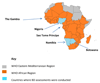
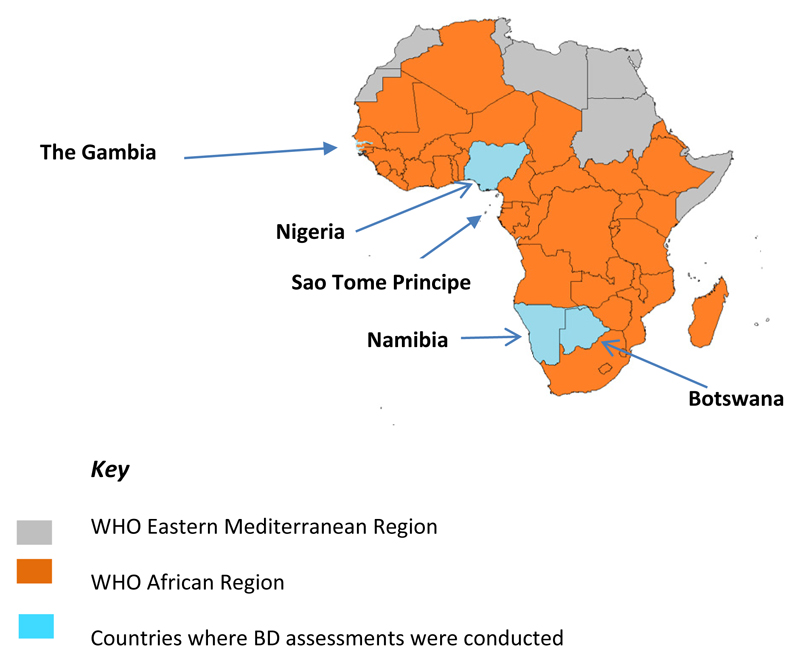
Between August 2015 and November 2016, a series of knowledge, attitude and practices assessments were conducted in a convenience sample of public and private health facilities in Botswana, the Gambia, Namibia, Nigeria, and São Tomé and Príncipe (STP). Data were collected from immunization and maternity staff through interviewer-administered questionnaires focusing on HepB-BD vaccination knowledge, practices and barriers, including those related to home births. HepB-BD coverage was calculated for each visited facility.
Results
A total of 78 health facilities were visited: STP 5 (6%), Nigeria 23 (29%), Gambia 9 (12%), Botswana 16 (21%), and Namibia 25 (32%). Facilities in the Gambia attained high total coverage of 84% (range: 60–100%) but low timely estimates 7% (16–28%) with the median days to receiving HepB-BD of 11 days (IQR: 6–16 days). Nigeria had low total (23% [range: 12–40%]), and timely (13% [range: 2–21%]) HepB-BD estimates. Facilities in Botswana had high total (94% [range: 80—100%]), and timely (74% [range: 57—88%]) HepB-BD coverage. Coverage rates were not calculated for STP because the maternal Hepatitis B virus (HBV) status was not recorded in the delivery registers. The study in Namibia did not include a coverage assessment component. Barriers to timely HepB-BD included absence of standard operating procedures delineating staff responsible for HepB-BD, not integrating HepB-BD into essential newborn packages, administering HepB-BD at the point of maternal discharge from facilities, lack of daily vaccination services, sub-optimal staff knowledge about HepB-BD contraindications and age-limits, lack of outreach programs to reach babies born outside facilities, and reporting tools that did not allow for recording the timeliness of HepB-BD doses.
Discussion
These assessments demonstrate how staff perceptions and lack of outreach programs to reach babies born outside health facilities with essential services are barriers for implementing timely delivery of HepB-BD vaccine. Addressing these challenges may accelerate HepB-BD implementation in Africa.
-
Subjects:
-
Source:J Immunol Sci. Suppl(5):31-40
-
Pubmed ID:30931434
-
Pubmed Central ID:PMC6436721
-
Document Type:
-
Place as Subject:
-
Issue:5
-
Collection(s):
-
Main Document Checksum:urn:sha256:f963fb240f5ab3568249e414147ba4c980ff838f928091fe6f2761e561317577
-
Download URL:
-
File Type:
 [PDF
- 515.47 KB
]
[PDF
- 515.47 KB
]
Supporting Files


File Language:
English
ON THIS PAGE


CDC STACKS serves as an archival repository of CDC-published products including
scientific findings,
journal articles, guidelines, recommendations, or other public health information authored or
co-authored by CDC or funded partners.
As a repository, CDC STACKS retains documents in their original published format to ensure public access to scientific information.
As a repository, CDC STACKS retains documents in their original published format to ensure public access to scientific information.
You May Also Like
COLLECTION
CDC Public Access