


Duplex Real-Time PCR Assay Distinguishes Aedes aegypti From Ae. albopictus (Diptera: Culicidae) Using DNA From Sonicated First-Instar Larvae
Supporting Files

-
Nov 07 2017
File Language:
English
Details
-
Alternative Title:J Med Entomol
-
Personal Author:
-
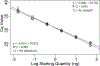
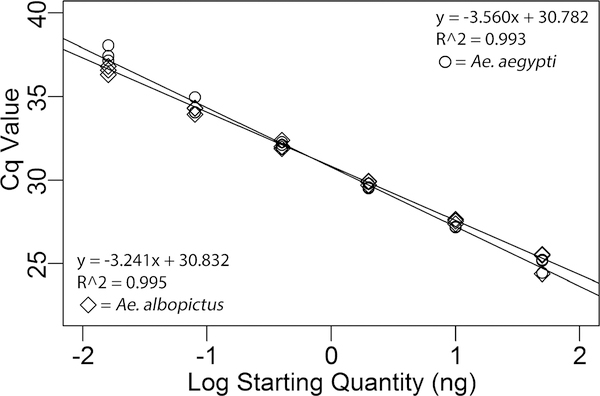
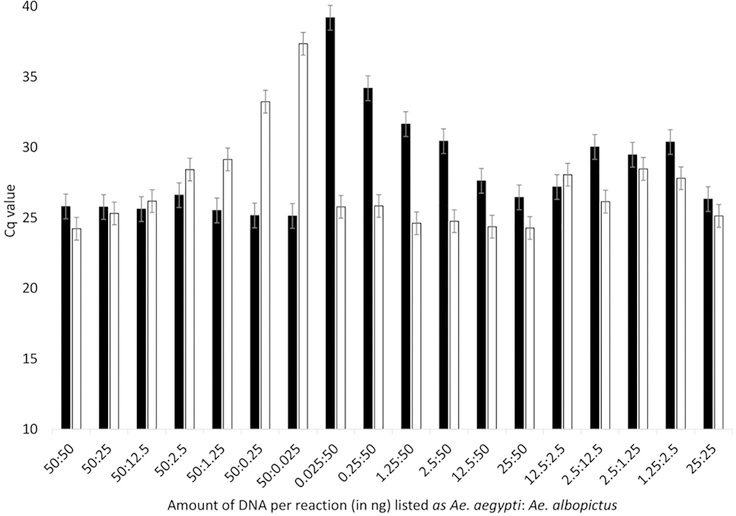
Description:Aedes aegypti (L.) and Ae. albopictus (Skuse) are important arbovirus vectors in the United States, and the recent emergence of Zika virus disease as a public health concern in the Americas has reinforced a need for tools to rapidly distinguish between these species in collections made by vector control agencies. We developed a duplex real-time PCR assay that detects both species and does not cross-amplify in any of the other seven Aedes species tested. The lower limit of detection for our assay is equivalent to ∼0.03 of a first-instar larva in a 60-µl sample (0.016 ng of DNA per real-time PCR reaction). The assay was sensitive and specific in mixtures of both species that reflected up to a 2,000-fold difference in DNA concentration. In addition, we developed a simple protocol to extract DNA from sonicated first-instar larvae, and used that DNA to test the assay. Because it uses real-time PCR, the assay saves time by not requiring a separate visualization step. This assay can reduce the time needed for vector control agencies to make species identifications, and thus inform decisions about surveillance and control.
-
Subjects:
-
Source:J Med Entomol. 54(6):1567-1572
-
Pubmed ID:28981691
-
Pubmed Central ID:PMC6437760
-
Document Type:
-
Funding:
-
Volume:54
-
Issue:6
-
Collection(s):
-
Main Document Checksum:urn:sha256:55c8fe5b9937665591c02d76f12bd474c015c210a9f558cd72cef79554491781
-
Download URL:
-
File Type:
 [PDF
- 771.08 KB
]
[PDF
- 771.08 KB
]
Supporting Files


File Language:
English
ON THIS PAGE



CDC STACKS serves as an archival repository of CDC-published products including
scientific findings,
journal articles, guidelines, recommendations, or other public health information authored or
co-authored by CDC or funded partners.
As a repository, CDC STACKS retains documents in their original published format to ensure public access to scientific information.
As a repository, CDC STACKS retains documents in their original published format to ensure public access to scientific information.
You May Also Like
COLLECTION
CDC Public Access